Artwork
Black Sawyers Working in front of the Bank of Pennsylvania, Philadelphia
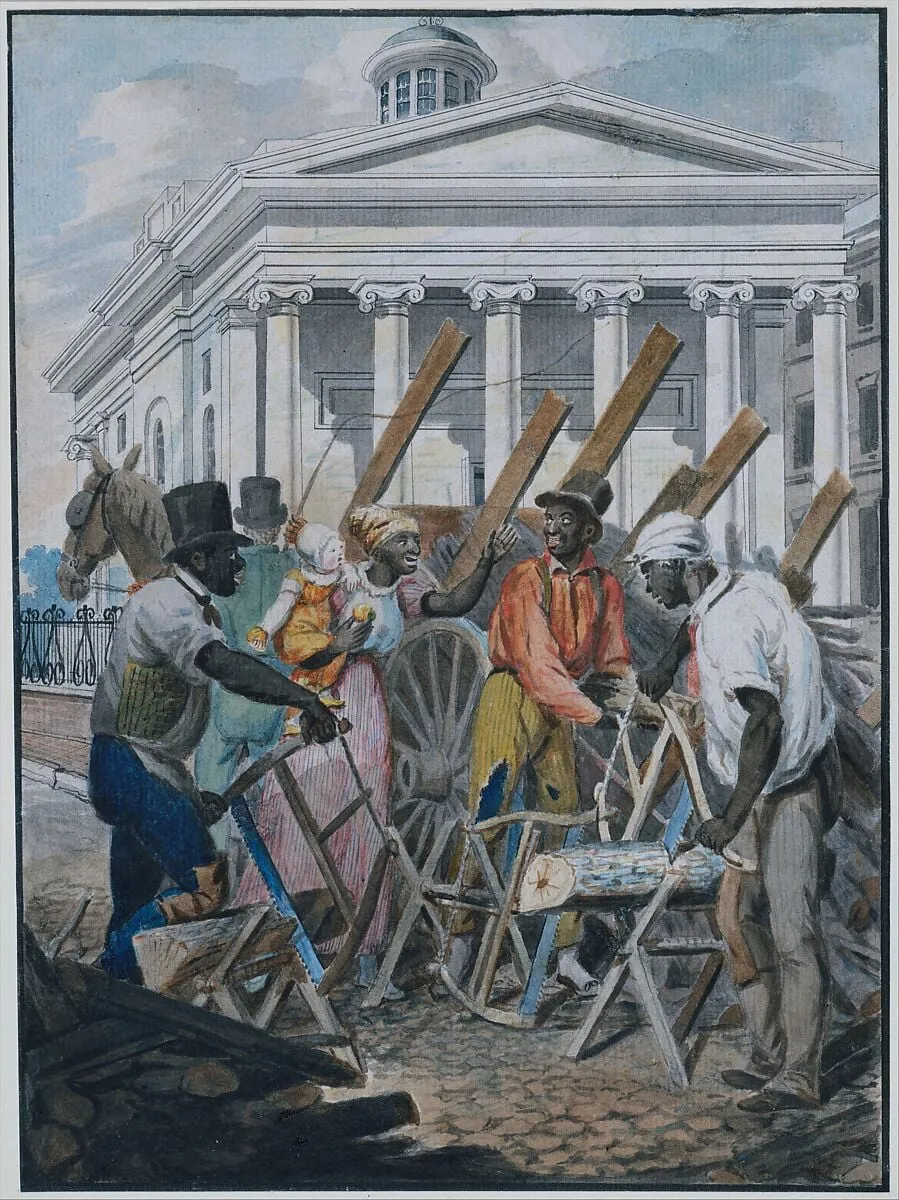
Black Sawyers Working in front of the Bank of Pennsylvania, Philadelphia is a watercolor work on paper by the American Folk Art artist John Lewis Krimmel. It dates from 1811 and is held in the collection of the Metropolitan Museum of Art.
About this work
Overview
Black Sawyers Working in front of the Bank of Pennsylvania, Philadelphia is a watercolor and graphite drawing by John Lewis Krimmel, dated 1811 to approximately 1813. The work measures 9 1/8 by 6 3/4 inches (23.2 x 17.1 cm) and is executed on white laid paper. It is held in the collection of the Metropolitan Museum of Art in New York, where it is classified under The American Wing, having been acquired through the Rogers Fund in 1942 with the object number 42.95.16. The piece is significant as a rare early American genre scene depicting Black laborers in an urban setting, offering documentary insight into the working lives of African Americans in the early republic.
Subject & Meaning
A woman holding a small child stands near a horse-drawn cart loaded with lumber, and additional figures in top hats appear behind the cart.
The composition depicts a group of Black sawyers cutting firewood in front of the neoclassical Bank of Pennsylvania in Philadelphia, identifiable by its tall Ionic columns and domed cupola. In the foreground, two men work a large saw together while another saws alone to the left. A woman holding a small child stands near a horse-drawn cart loaded with lumber, and additional figures in top hats appear behind the cart. The sawyers are cutting firewood that heated the city's homes and stoves, placing their labor within the essential urban economy. The presence of an African American woman holding what appears to be a white child introduces complex questions about caregiving, servitude, and social relationships in early nineteenth-century Philadelphia. The palette of muted earth tones, browns, and grays is punctuated by touches of brighter color in a red shirt, yellow trousers, blue pants, and a pink striped skirt.
Technique & Style
The medium is watercolor and graphite on white laid paper, with a matte, finished quality and visible paper texture. Light falls evenly across the scene with gentle shadows beneath the figures and equipment. The technique shows precise linear definition in the architectural details, particularly the bank's Ionic columns and domed cupola, while looser handling characterizes the ground and sky. The sky appears in pale blue with soft clouds. This combination of careful draftsmanship for structural elements and freer brushwork for natural elements is typical of Krimmel's documentary approach to genre subjects. The relatively small scale of 9 1/8 by 6 3/4 inches suggests the work was intended as a finished drawing rather than a preparatory study.
History & Provenance
The work was formerly attributed to Pavel Petrovich Svinin before being reattributed to John Lewis Krimmel. It was acquired by the Metropolitan Museum of Art in 1942 through the Rogers Fund. The drawing is currently located at the Metropolitan Museum of Art, New York, with the object number 42.95.16.
Context
John Lewis Krimmel (1786-1821) was a German-born American painter who became one of the earliest specialists in genre painting in the United States. His work documenting everyday life in early nineteenth-century America, particularly in Philadelphia and its surroundings, provides valuable visual records of the period's social conditions. The reattribution from Svinin to Krimmel reflects ongoing scholarly work to clarify the oeuvre of early American watercolorists and documentarians. The subject of Black laborers in Philadelphia places this work within a broader body of early American art addressing race and work, though such depictions remain relatively rare from this period. The work is catalogued in Wikidata as Q97387483 and has been made available through The Met's Open Access program.
Legacy
The image has circulated through commercial and educational channels, including the Bridgeman Images archive and the American Art Gallery database, indicating its continued use as a visual document of early African American labor history. The work's depiction of specific urban labor, combined with its attention to architectural setting and social detail, has made it a reference point for studies of race, labor, and visual culture in the early American republic. The Open Access availability of the image through the Metropolitan Museum has facilitated its reproduction and study in various contexts.
Artist & collection

Artist
John Lewis Krimmel (May 30, 1786 – July 15, 1821), sometimes called "the American Hogarth," was North America's first painter of genre scenes.