Artwork
The Independent Voter
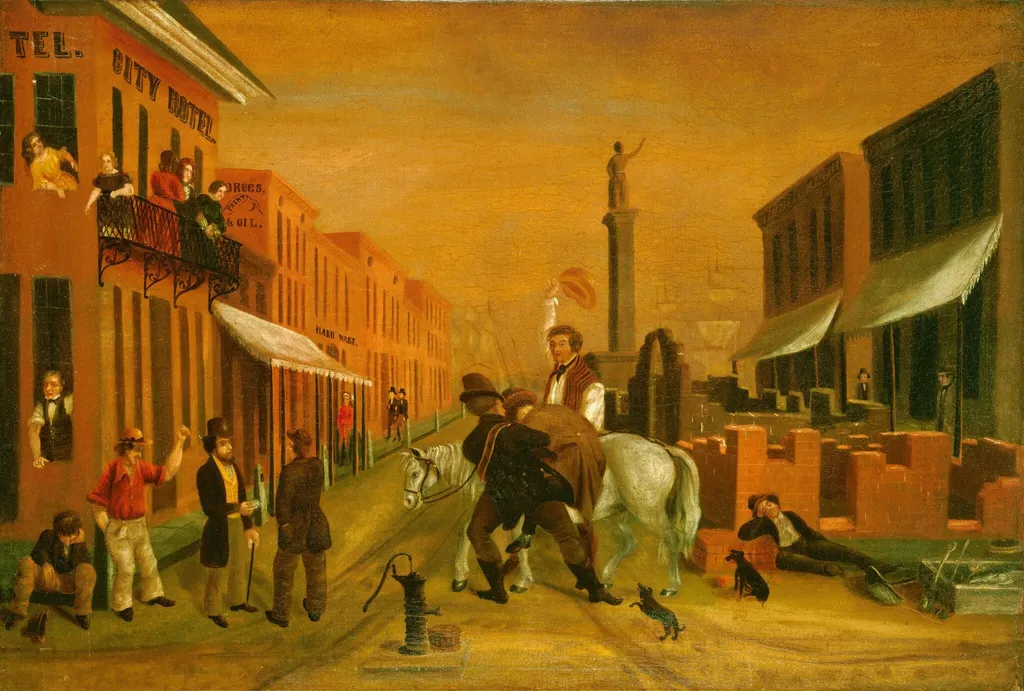
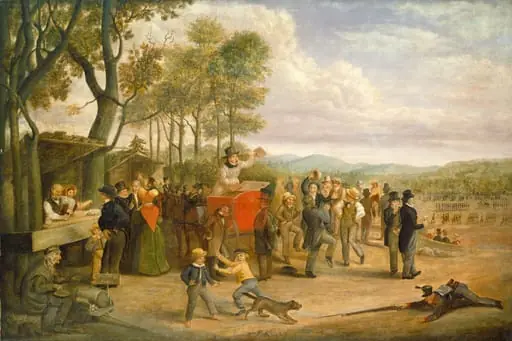
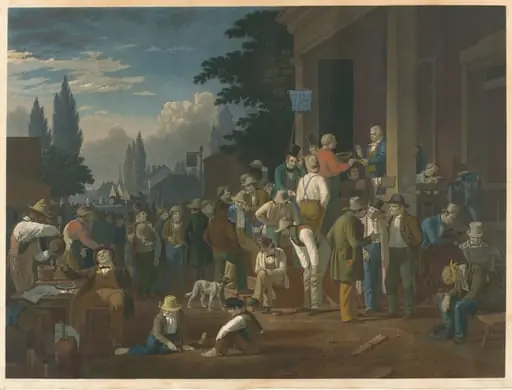
The Independent Voter is an oil painting by the Romanticist artist American 19th Century. It dates from 1849 and is held in the collection of the National Gallery of Art.
- Inscription
- Inscribed:on buildings, left to right: TEL.; CITY HOTEL.; DRUGS, / PAINTS / & OIL.; HARD WARE.
About this work
Overview
5 centimeters (35 9/16 by 51 3/4 inches), the work is classified as a genre scene and is held in the collection of the National Gallery of Art in Washington, D.
The Independent Voter is an oil on canvas painting by an unidentified American artist working in the 19th century, dated 1849 or after. Measuring 90.4 by 131.5 centimeters (35 9/16 by 51 3/4 inches), the work is classified as a genre scene and is held in the collection of the National Gallery of Art in Washington, D.C., under accession number 1980.61.8. The painting matters as a significant example of American naive painting, offering a vivid, unschooled perspective on mid-19th-century urban political life and street culture that complements more polished academic works of the same era.
Subject & Meaning
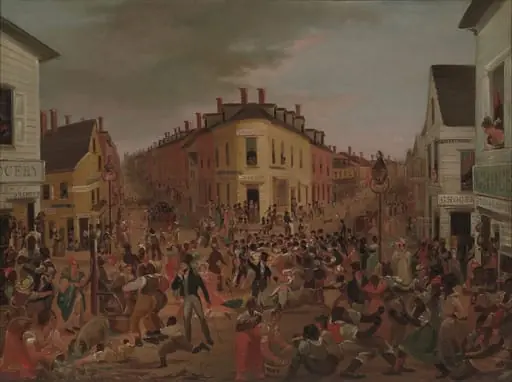
The painting depicts a bustling city street scene centered on a civic election ritual. At the composition's heart, two men assist or support a third man who rides a white horse; the rider raises his hat in his right hand, suggesting a celebratory or triumphant gesture. To the left, a three-story building displays painted commercial lettering reading "CITY HOTEL" and "DRUGS, PAINTS & OIL" with "HARD WARE" visible below, while several figures stand on an ornate iron balcony and lean from windows. Below them, men in varied dress, including a figure in a red shirt and another in a dark coat with a cane, gesture and converse. The Smithsonian's summary notes that two figures at left exchange an election ticket, while at right a man sleeps on the street near stacked bricks or lumber, a dog beside him. In the distance, a tall column supports a statue of a robed figure with an upraised arm, evoking civic monuments such as those honoring founding fathers. The title The Independent Voter carries pointed political resonance in an era of intense partisan rivalry between Democrats and Whigs, suggesting the scene may satirize, celebrate, or simply document the behavior of unaffiliated or swing voters whose allegiances were actively courted. The drunken rider, the ticket exchange, and the sleeping figure together construct a narrative about the performative and sometimes disorderly nature of democratic participation in the antebellum period.
Technique & Style
The work is executed in oil on canvas with a relatively smooth and descriptive brushwork approach. The surface shows fine craquelure throughout, consistent with its age and medium. The artist employs a flatter treatment in the sky while rendering greater detail in the figures and architecture. Light enters from the left, casting shadows to the right and creating a hazy, warm atmosphere dominated by oranges, yellows, and browns with touches of red and dark green. These formal qualities align with the conventions of American naive painting, characterized by straightforward perspective, earnest observation, and limited concern for academic proportion or atmospheric refinement. The handling is direct rather than painterly in the academic sense, with forms clearly delineated and spatial depth suggested through overlapping rather than rigorous linear perspective.
History & Provenance
The painting's recorded history begins in New York State, though its exact place of creation remains unknown. It was owned by Avis and Rockwell Gardiner of Stamford, Connecticut, who sold it in 1962 to Edgar William and Bernice Chrysler Garbisch, the prominent collectors of American folk art. The Garbisches bequeathed the work to the National Gallery of Art in 1980. The painting was exhibited in 1997 at the South Texas Institute for the Arts in Corpus Christi as a loan for display with the permanent collection. It is documented in Deborah Chotner's 1992 catalogue American Naive Paintings in the National Gallery of Art's systematic catalogue, where it appears with a color reproduction.
Context
The Independent Voter belongs to the corpus of American naive painting collected and studied with renewed seriousness in the mid-20th century, largely through the efforts of collectors such as the Garbisches. Its attribution to "American 19th Century" rather than a named artist reflects both the anonymity common to such works and the scholarly caution that surrounds them. The 1849 date or later places the work in a period of intense political mobilization in the United States, as the Second Party System gave way to realignments that would eventually produce the Republican Party. The Democratic Party, the oldest political party in the United States, had by the 1840s become deeply factionalized over slavery and territorial expansion, while the Whig Party represented the primary opposition. In this environment, the independent voter occupied an increasingly significant if ambiguous position. The painting's subject thus engages with live political questions of its era, though whether it endorses, satirizes, or merely records its scene remains open to interpretation. Deborah Chotner's inclusion of the work in the National Gallery's systematic catalogue of American naive paintings secured its place in the scholarly literature, where it serves as a case study in the intersection of folk art and political culture.
Legacy
As part of the National Gallery of Art's permanent collection, The Independent Voter has contributed to the institutional recognition of American naive painting as a field worthy of systematic study and museum display. Its bequest by the Garbisches connected it to one of the most important private collections of American folk art assembled in the 20th century. The work's afterlife is primarily scholarly and institutional rather than broadly cultural; it has not generated the popular iconography or frequent reproduction of some better-known American genre paintings. Nevertheless, its title has acquired renewed resonance in contemporary political discourse, as the percentage of Americans identifying as independent voters has grown substantially in the 21st century. Organizations advocating for independent voters now cite statistics showing independents as the largest political cohort in the country, though this modern movement bears no direct connection to the painting itself. Within art history, the work endures as a document of antebellum street life and a representative example of how untrained American artists engaged with the political and social themes of their time.
Artist & collection

Artist
Scenes of everyday American life in the 1800s. Farmhouse in Mahantango Valley is a quiet, sunlit view of rural Pennsylvania; Boy and Girl shows two children standing close, faces turned outward. A small woodcut, The…