Artwork
A View of Chester
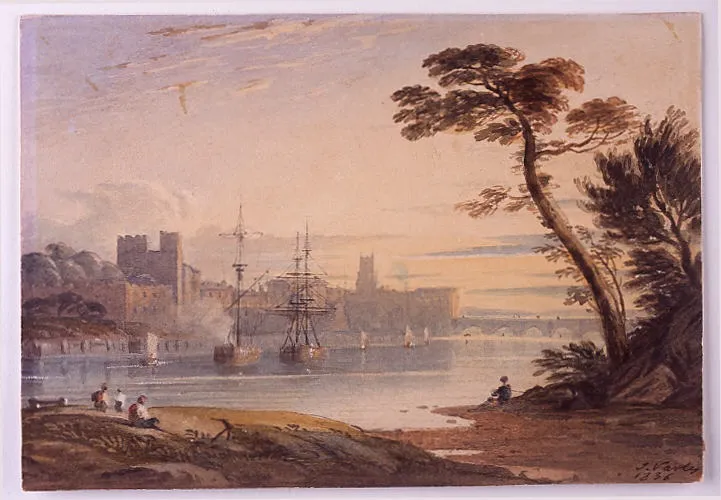
A View of Chester is an unspecified painting by the British Romanticist artist John Varley. It dates from 1836 and is held in the collection of the Metropolitan Museum of Art.
About this work
Subject & Meaning
His focus on precise architectural detail and atmospheric effects aligns with contemporary efforts to preserve visual records of England’s built environment.
The painting depicts the city of Chester as observed from the banks of the River Dee, capturing its medieval architecture and surrounding landscape. It emphasizes the historical and geographical character of the site, reflecting an interest in England’s antiquarian heritage during the early 19th century. The composition presents a topographical view that underscores the city’s enduring presence and cultural significance.
John Varley, a British watercolorist active in the Romantic era, created this work to document a notable urban landscape with historical resonance. His focus on precise architectural detail and atmospheric effects aligns with contemporary efforts to preserve visual records of England’s built environment. The painting thus functions both as a record of place and an artistic interpretation of national heritage.
History & Provenance
The work is held by the Metropolitan Museum of Art, New York, where it is accessioned as 67.100.1.
It was included in the exhibition British Watercolors and Drawings from the Metropolitan Museum of Art, held at the Yale Center for British Art, New Haven, in 1986.
Legacy
John Varley's 1836 painting A View of Chester contributed to his reputation as a leading watercolorist of the Romantic era, particularly through his emphasis on atmospheric effects and topographical accuracy. Though not widely celebrated during his lifetime, the work influenced later British landscape painters who valued its nuanced rendering of light and terrain, as evidenced by its continued presence in major collections like the Metropolitan Museum of Art. Its legacy reflects a quiet but significant role in shaping 19th-century British landscape painting conventions.
Overview
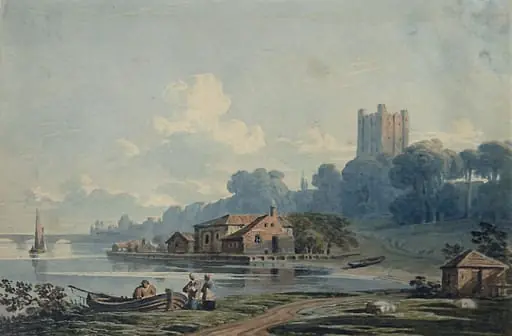
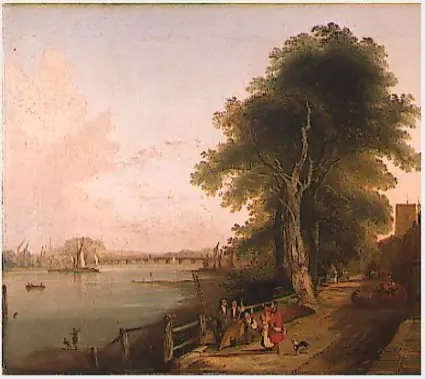
John Varley’s 1836 watercolour, A View of Chester, presents a tranquil river scene framed by the historic town’s architecture. The composition balances a quiet waterside populated by a small group of figures with a distant bridge and buildings, conveying a sense of measured calm that typifies early‑nineteenth‑century British landscape art.
Technique & Style
Varley employs a restrained palette of muted tones, allowing the soft washes of colour to suggest atmospheric depth. Delicate brushwork defines the water’s surface and the silhouettes of distant structures, while the careful handling of light creates a gentle glow that unifies foreground and background. The overall effect is one of understated elegance rather than dramatic contrast.
Artist & collection
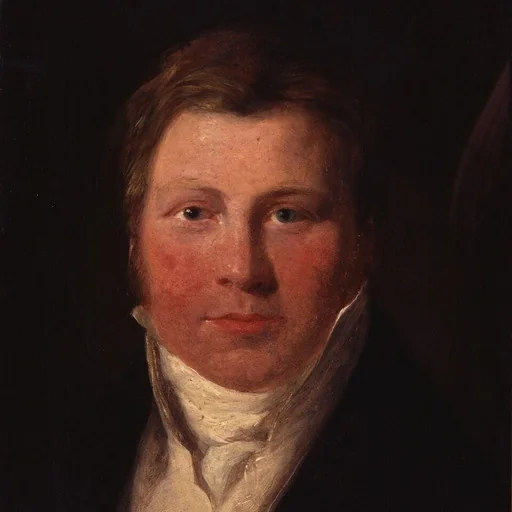
Artist
John Varley (17 August 1778 – 17 November 1842) was an English watercolour painter and astrologer, and a close friend of William Blake.