Artwork
An Oxfordshire Sheepfold
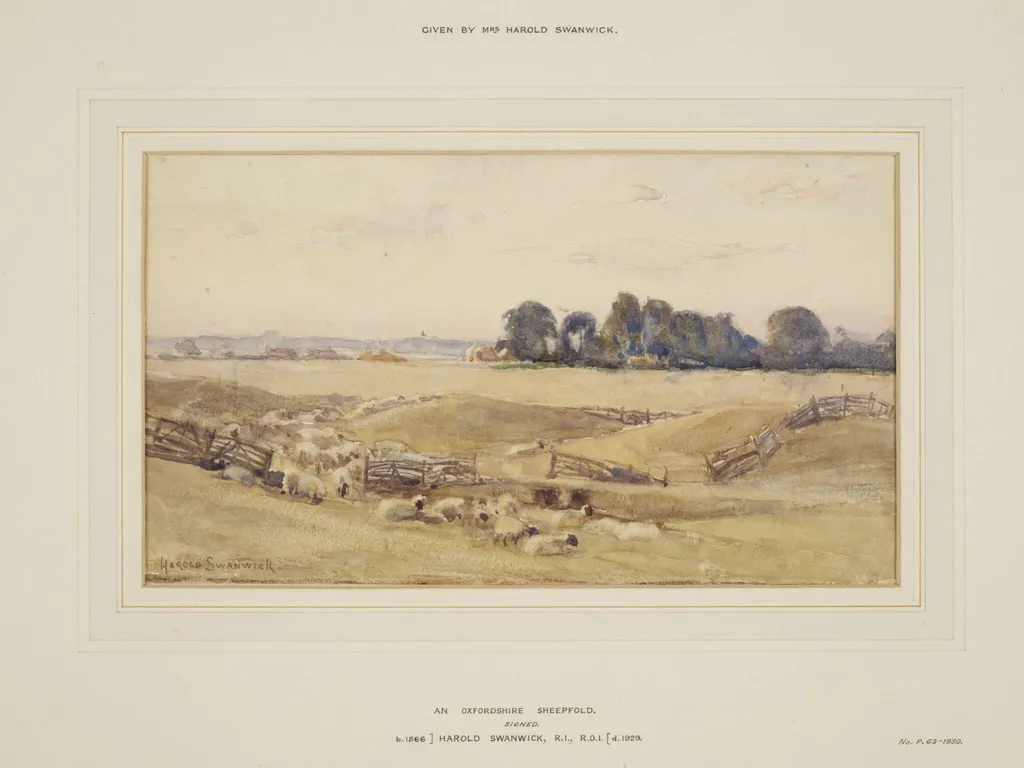
An Oxfordshire Sheepfold is a watercolor work on paper by the Impressionist artist Joseph Harold Swanwick. It dates from 1890 and is held in the collection of the Victoria and Albert Museum.
About this work
Overview
Rendered in transparent washes, it presents a quiet moment in the rural landscape, emphasizing stillness and subtle natural light.
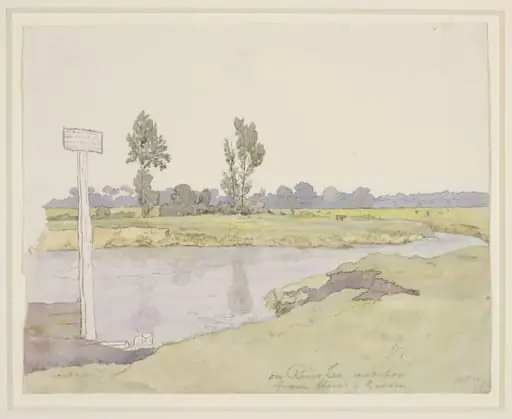
Created in 1890, this watercolour by Joseph Harold Swanwick captures a pastoral scene in Oxfordshire. The work is signed by the artist and titled explicitly on the lower edge. Rendered in transparent washes, it presents a quiet moment in the rural landscape, emphasizing stillness and subtle natural light.
The medium’s delicacy enhances the sense of calm, aligning with 19th-century British watercolour traditions focused on observational accuracy and atmospheric tone.
Subject & Meaning
The painting portrays a sheepfold, a simple enclosure for grazing animals, surrounded by a low fence and set against a distant horizon of sparse trees and faint building outlines. The sheep, grouped in soft, light-toned patches, rest peacefully, suggesting a moment of pause in daily agricultural life. There is no human presence, reinforcing a sense of solitude and the quiet rhythm of rural labor, typical of regional English landscape studies of the period.
Technique & Style
Swanwick employed loose, fluid brushwork and thin layers of watercolour to suggest form without rigid definition. The palette is restrained, dominated by earthy browns, muted greens, and pale washes of sky. Highlights on the sheep are achieved through reserved paper rather than opaque pigment, enhancing the naturalism.
The sketch-like quality conveys immediacy, reflecting a direct response to the landscape rather than a polished studio composition.
History & Provenance
The work’s documented origin is limited to its date and signature, with no known exhibition history or early ownership records. It remains within private collections since its creation, likely acquired directly from the artist or through regional networks in Oxfordshire. Its survival as a single, unsigned work reflects its modest scale and non-commercial status, typical of many amateur or regional artists of the time.
Context
In late 19th-century England, watercolour was widely used for topographical and rural studies, often by artists outside the Royal Academy system. Swanwick’s work aligns with a broader trend of documenting local landscapes as industrialization transformed the countryside. Though not part of the Impressionist movement, his approach shares an interest in light and transient effects, resonating with contemporary British watercolourists like Paul Sandby or John Sell Cotman.
Legacy
Swanwick’s painting contributes to a quiet archive of regional English landscapes that document pre-industrial rural life. While not widely exhibited or studied, it exemplifies the work of lesser-known artists who preserved the visual character of the English countryside through personal, observational art. Its endurance lies in its unassuming authenticity, offering a glimpse into everyday rural existence without idealization.
Own this work as a print
Artist & collection

- Nineveh from the North-East
 A Harvest Field
 Landscape with Farm and Fields in Flat Country
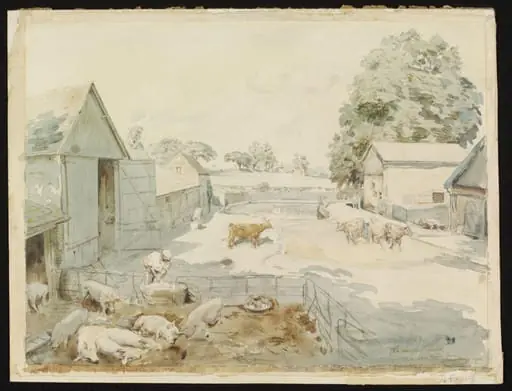 Red House Farm, Sproughton, near Ipswich
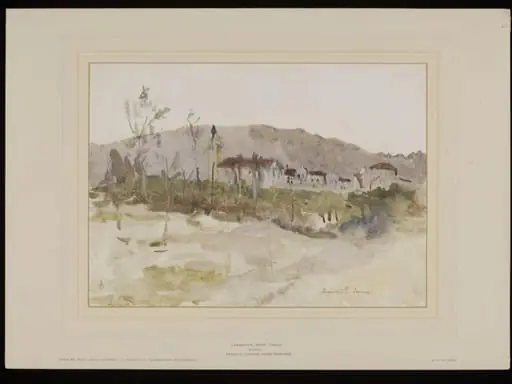 Landscape near Asolo
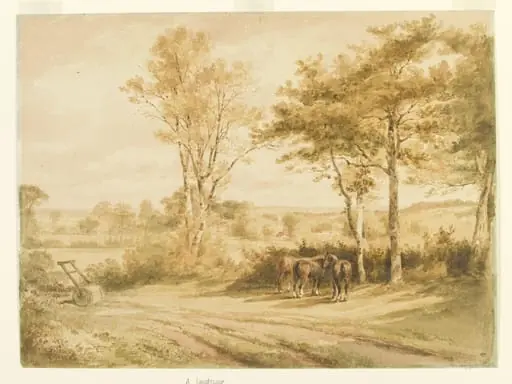 Hedgerow, Trees and Horses
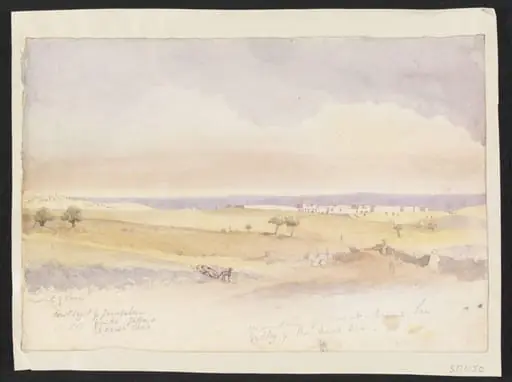 First sight of Jerusalem from the Jaffa & El Arish road
 Landscape with soldiers sketching
 Vale of Irthing, Cumberland
 The Downs from Friston
 Looking towards Bury from the North of the city
 On River Lee, not far from Horse and Groom