Artwork
Charles II in armour
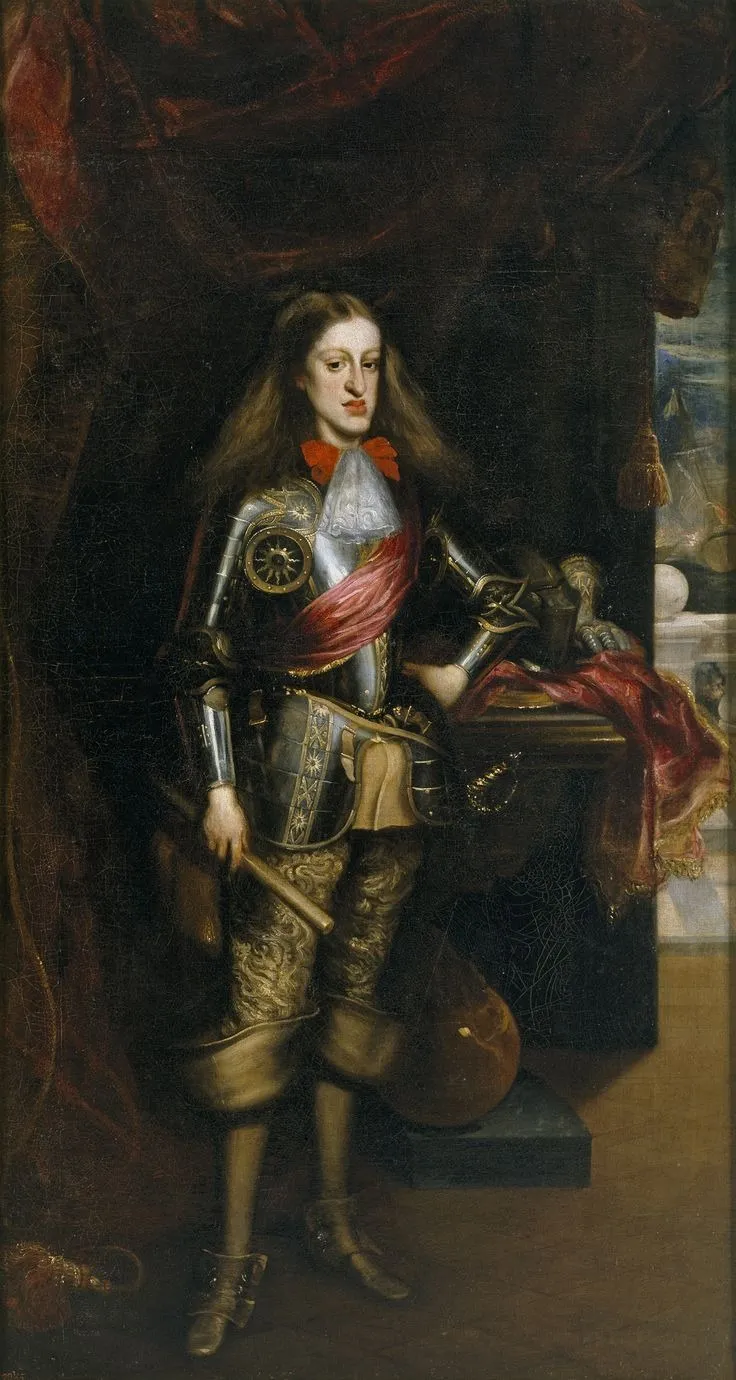
Charles II in armour is an oil painting by the Baroque artist Juan Carreño de Miranda. It is held in the collection of the Museo del Prado.
About this work
Subject & Meaning
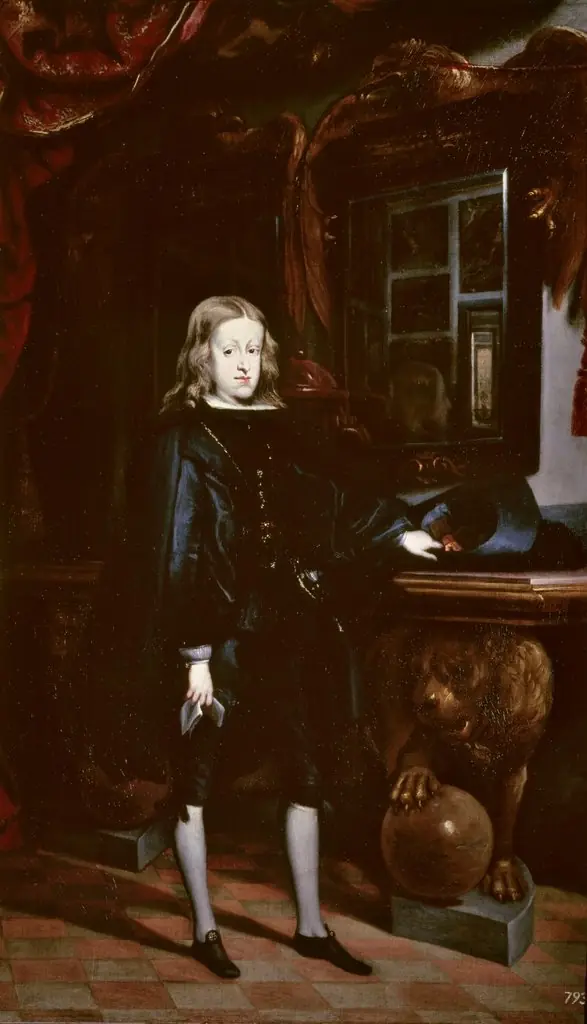
Behind the monarch, a table supported by bronze lions holds a helmet and gauntlet, while the background reveals two warships firing cannons beyond a balustrade.
The work depicts a full-length portrait of the twenty-year-old Charles II of Spain, presenting him for the first time in military attire with long hair, armor, riding boots, a sword, and a scepter. The armor is adorned with the Cross of Burgundy and a radiant sun, symbols specifically associated with Philip II's victory at the Battle of Saint-Quentin in 1557, thereby linking the young king to his illustrious predecessor. Behind the monarch, a table supported by bronze lions holds a helmet and gauntlet, while the background reveals two warships firing cannons beyond a balustrade.
These martial elements reference ongoing conflicts with Louis XIV of France, serving to construct an idealized image of a warrior-king despite the sitter's known physical and mental disabilities. The composition attempts to balance realism with royal propaganda, projecting strength and continuity of the Habsburg lineage.
Technique & Style
Created in 1681, the work is an oil painting executed on a canvas support. The composition presents a full-length portrait of Charles II, distinguished by his long hair and complete military attire, which includes body armor, riding boots, a sword, and a scepter. The armor itself is formally decorated with the Cross of Burgundy and a radiant sun motif.
Technical analysis via X-ray examination has revealed that an earlier portrait of the king at approximately ten years of age exists beneath the current surface layer. The background features a bronze lion-supported table holding a helmet and gauntlet, set against a balustrade with distant warships firing cannons, all rendered within the Baroque style.
History & Provenance
The portrait Charles II in armour was painted by Juan Carreño de Miranda in 1681, when the sitter was twenty years old, following the conventions of a full-length military portrait despite the king’s documented physical and mental infirmities. The work was commissioned during the reign of Charles II, the last Habsburg monarch of Spain, and represents his first depiction in martial attire.
It entered the royal collection and was originally installed in a room at the Escorial palace. The painting later passed into the holdings of the Museo del Prado in Madrid, where it is recorded under inventory number P07101.
The painting Charles II in armour is currently held by the Museo del Prado in Madrid, Spain. Its official inventory number is P07101. The work was originally located in a room at the Palace of El Escorial before entering the Prado's collection.
While the sources confirm the painting's physical location and accession details, they do not provide specific records of past exhibitions or a detailed exhibition history.
Context
The painting was created in 1681 by Juan Carreño de Miranda, a Spanish Baroque artist who worked under royal patronage. It depicts the young Charles II of Spain in full military attire, with armor adorned with the Cross of Burgundy and a sun motif, positioned before a background of warships that reference contemporary conflicts with France. The work originated in the Escurial palace and now resides in the Museo del Prado (inventory P07101), where technical analysis has revealed an earlier portrait of the king at age ten beneath the current surface.
Scholars note its significance as the first known depiction of the monarch in military dress and its reflection of the Spanish Baroque emphasis on symbolic power and royal propaganda.
Legacy
The painting’s later reputation has been shaped by its status as a key Baroque court portrait in the Prado’s holdings and by the tragic figure of its sitter. Following its creation in 1681, the work remained at the Escorial before entering the Museo del Prado, where it has been catalogued as P07101. Its iconography, Charles II portrayed at twenty in full military regalia, with Burgundian Cross and radiant sun on his armor, has been read as a calculated assertion of Habsburg martial authority during the later reign, despite the king’s well-documented physical and mental frailties.
The bellicose backdrop of cannon-firing warships has been interpreted as a direct reference to Spain’s ongoing conflict with Louis XIV’s France, reinforcing the image’s propagandistic purpose within the royal image-making tradition.
Overview
Juan Carreño de Miranda’s 1691 oil painting presents the monarch Charles II clad in full plate armor. The work, now in the Museo del Prado, captures the king in a solitary, dimly lit space, emphasizing his regal bearing through the contrast of gleaming metal against a dark backdrop.
Artist & collection