Artwork
España y Filipinas
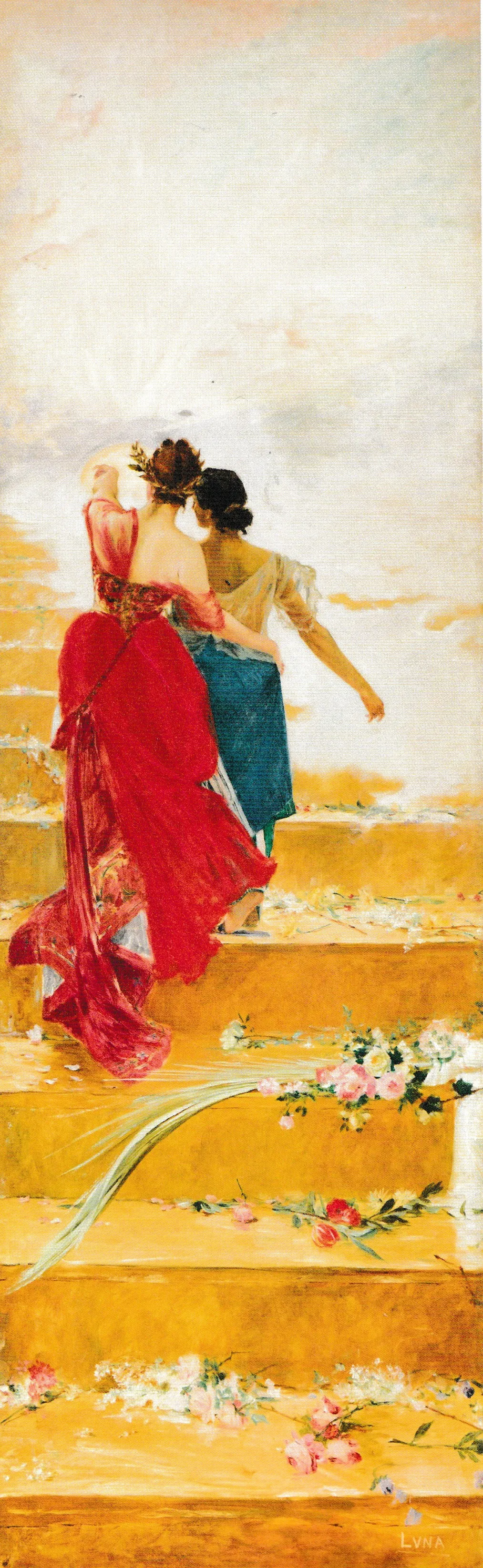
España y Filipinas is an oil painting by the Post-Impressionist artist Juan Luna. It dates from 1894 and is held in the collection of the Lopez Museum.
About this work
Subject & Meaning
The work allegorically portrays two women, one embodying Spain and the other the Philippines, dressed in traje de mestiza and shown from behind as they ascend a staircase toward a distant horizon. Spain is depicted as a taller, maternal figure guiding the modestly clothed Filipina, symbolizing a benevolent colonial presence that leads the Philippines toward progress and modernization. This imagery reflects the propagandist hope of 19th‑century Filipino reformists for assimilation, equality, and economic improvement, while also illustrating the cultural transformations brought about by Hispanization.
Technique & Style
The composition is an allegorical depiction of two women shown with their backs to the viewer, walking side by side up a staircase toward a distant horizon.
España y Filipinas is executed as an oil painting. While the series is predominantly described as oil on canvas, one specific version is noted as oil on wood. The composition is an allegorical depiction of two women shown with their backs to the viewer, walking side by side up a staircase toward a distant horizon. Stylistically, the work employs contrasting physical characterizations to convey its colonial allegory: the figure of Spain is rendered as a taller, maternal white woman with wide, strong shoulders, while the Philippines is depicted as a slender, brown-skinned woman. Both figures are clothed in the traje de mestiza, a female dress that reflects the social transformations and class consciousness resulting from 19th-century Hispanization. The taller Spaniard, embodying a benevolent image of colonialism, points ahead to guide the humbly dressed Filipina along the path to progress, creating what has been described as a bucolic scene of master and servant walking hand in hand.
History & Provenance
Juan Luna created España y Filipinas in 1886 as an oil painting on wood, depicting an allegorical relationship between Spain and the Philippines through two women in traje de mestiza.
The work was commissioned by Filipino politician Pedro Paterno and first exhibited in 1893 in Madrid.
Subsequently it entered the possession of Don José Vázquez Castiñeira, remained in his family for nearly 130 years, and was later sold at auction in 2012 and 2013, achieving a record price for Philippine art.
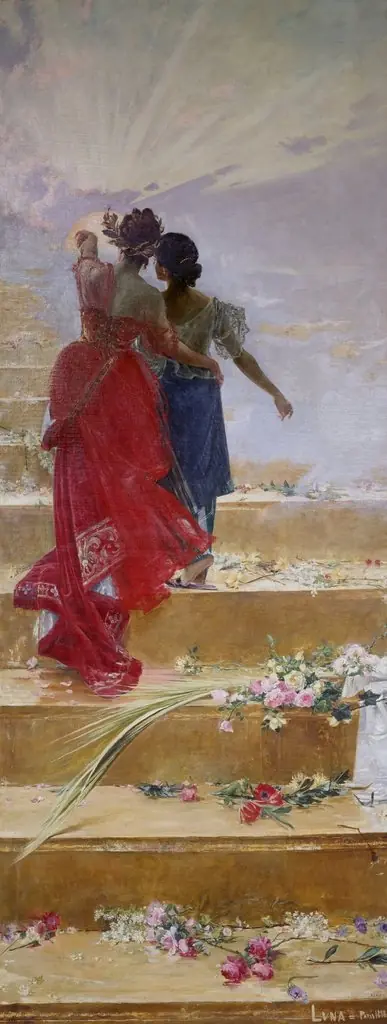
A second version, commissioned by Víctor Balaguer i Cirera, is held by the Museo del Prado and loaned to Cádiz; a third, smaller version, is part of the López Museum and Library collection in Manila. Juan Luna produced multiple versions of España y Filipinas, and three have been located. The earliest, painted in 1884, was commissioned by Pedro Paterno and publicly exhibited at the 1893 Exposición Histórico-Natural y Etnográfica at the National Archaeological Museum in Madrid. After passing through the possession of José Vázquez Castiñeira and his descendants in Galicia, it was sold at Balclis in Barcelona in 2012, then acquired at Sotheby's Hong Kong in 2013 for HK$25.88 million (US$2.693 million) by a private Philippine art dealer; it is now in the permanent collection of the National Gallery Singapore. The largest version, dated 1888, was commissioned by Víctor Balaguer i Cirera and is held by the Museo del Prado in Madrid, on long-term loan to the City Council of Cádiz. A third, smaller version (1888-1893) resides in the López Museum and Library in Manila. Originally held by the Biblioteca Museu Víctor Balaguer, it was acquired by Eugenio López Sr. for the museum.
Context
Juan Luna's *España y Filipinas* is regarded as an enduring legacy of the Filipino Ilustrado movement, serving as a key allegorical work within the Propaganda Movement. The painting functions as a visual manifesto for 19th-century reformist desires, including assimilation, modernization, and economic improvement under Spanish rule. While often contrasted with José Rizal's more critical stance, scholars interpret the work as Luna's non-combative diplomatic posture, projecting a vision of benevolent colonialism where Spain guides the Philippines toward progress. The series of versions, including the 1884 commission by Pedro Paterno and the 1888 version for Minister Víctor Balaguer, underscores the artwork's role in political advocacy. Its presence in major institutions like the Museo del Prado and the López Museum highlights its significance in the canon of Philippine art history, representing the complex cultural transformations of the Hispanization era.
Legacy
The painting España y Filipinas has been recognized as a significant legacy of Juan Luna, particularly for how it shaped perceptions of the Philippines' relationship with Spain. According to sources, the work was described in contemporary commentary as a 'bucolic allegory' of master and servant walking hand in hand, linking colonized and colonizer in a gesture of guided progress. Its propagandistic message of assimilation, reform, and modernization resonated with 19th-century Filipino ilustrados, reflecting their aspirations for equality and economic improvement. The painting's legacy was further cemented through multiple versions: one commissioned by Pedro Paterno and exhibited in Madrid in 1893, a larger rendition commissioned by Víctor Balaguer that entered the Museo del Prado's collection, and a smaller version now held by the López Museum and Library in Manila. The 1884 version achieved a record price at auction in 2013, underscoring its cultural and monetary value. Contemporary scholarship, including entries in Spanish and English encyclopedias, continues to reference the work as a foundational piece in Philippine artistic heritage and a symbol of colonial-era discourse.
Artist & collection
Artist
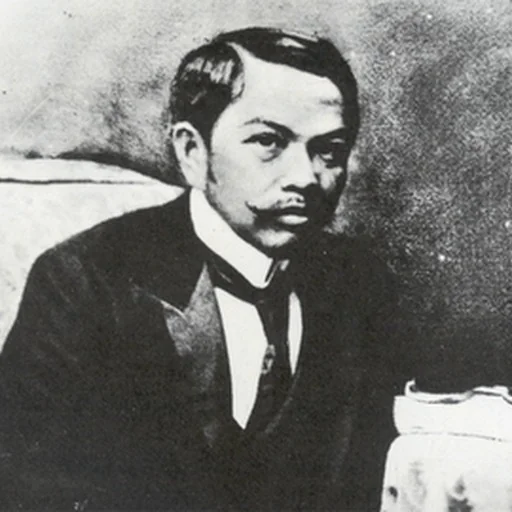
Juan Luna de San Pedro y Novicio (Spanish: Tagalog:; October 25, 1857 – December 7, 1899) was a Filipino painter, sculptor and a political activist of the Philippine Revolution during the late 19th century.