Artwork
The Death of Cleopatra
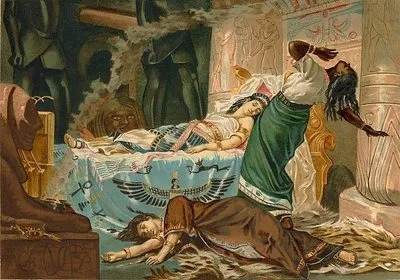
The Death of Cleopatra is an unspecified painting by the Academic Art artist Juan Luna. It dates from 1891 and is held in the collection of the Museo del Prado.
About this work
Subject & Meaning
The setting is funerary, decorated with hieroglyphs, a sphinx by the footboard, canopic jars by the headboard, and a statue of Anubis in the background.
The painting depicts the death of Cleopatra, the last active ruler of ancient Egypt, shown moments after she has taken her own life. Luna drew on Plutarch's account in the Parallel Lives, portraying the queen's corpse at the center of the composition on a bed with a golden headboard and footboard, dressed in regal attire and bejeweled, with a transparent cloth across her breasts that plays into the era's convention of an eroticized Cleopatra. Smoke rising from an incense lamp hovers above her body, signaling her death.
Two attendants accompany her: the servant Iras lies dead at her feet, while the dark-skinned Charmion collapses after adjusting the royal diadem. The asp that reportedly caused Cleopatra's death slithers away near a column.
The setting is funerary, decorated with hieroglyphs, a sphinx by the footboard, canopic jars by the headboard, and a statue of Anubis in the background. Beyond its classical subject, the work has been read as a statement of a colonized people resisting their colonizer and as a demonstration of Filipino artistic achievement on par with European contemporaries.
Technique & Style
Created in 1881, The Death of Cleopatra is an oil painting on canvas executed by Juan Luna in the academic art style with Egyptian Revival influences. The work depicts the Egyptian queen moments after her suicide, rendered with a composition inspired by Plutarch's historical accounts. Luna employed rich visual details to establish a funerary atmosphere, including a bed adorned with golden headboards and sheets decorated with hieroglyphs.
The figure of Cleopatra is portrayed in bejeweled attire, with transparent drapery around her torso that aligns with the era's eroticized depictions of the monarch. Surrounding elements such as canopic jars, a sphinx, and an Anubis statue further reinforce the ancient Egyptian setting. A column of smoke rising from an incense lamp hovers above the body, while a barely visible asp slithers near a column base, signifying the cause of death.
The painting measures 250 cm in height and features a complex arrangement of the queen and her two dying servants.
History & Provenance
Juan Luna began work on The Death of Cleopatra in his studio on Via Margutta in Rome, where he had lived since moving to the city in 1878 with his master, Alejo Vera. A preparatory study (boceto) was produced in 1880, modeled on Jean-André Rixens's 1874 depiction of the same subject.
The finished oil on canvas was completed in 1881 and entered the Exposición Nacional de Bellas Artes in Madrid that same year, Luna's first art competition, where it won a silver medal. Following the competition, Luna sold it for 5,000 Spanish pesetas, then the highest price recorded for a painting by a Filipino artist; the Spanish government acquired it for one thousand duros as Luna's graduation work. It has been registered as a state acquisition since 1881, was inventoried at the Museo de Arte Moderno from 1896 to 1971, and is now held at the Museo del Prado in Madrid.
After an 1887 appearance, the painting was not publicly exhibited again until a 2017 showing at the National Gallery Singapore. The 1880 boceto was sold at Salcedo Auctions in March 2019 for ₱9.3 million.
Context
The Death of Cleopatra (1881) was Luna's graduation work, an oil on canvas that earned a silver medal at the 1881 National Exposition of Fine Arts in Madrid, his first major public showing and the event that secured a scholarship from the Ayuntamiento de Manila. Contemporary scholarship links the painting to academic art and Egyptian Revival currents, noting its compositional borrowings from Plutarch's narrative and its Egyptian symbolic details, sphinx, canopic jars, hieroglyphic decoration. The work, one of only three Filipino pieces permanently housed in the Prado, reflects both Luna's Roman period and a broader Filipino assertion of cultural identity during colonial rule. Its acquisition by the Spanish government and later inclusion in major exhibitions underscore its lasting art-historical significance.
Legacy
The painting earned Juan Luna a silver medal at the 1881 National Exposition of Fine Arts in Madrid, marking his debut in art competitions and securing him a scholarship from the Manila Ayuntamiento. Sold for 5,000 Spanish pesetas, then the highest price paid for a Filipino work, it was acquired by the Spanish government as Luna's graduation piece for 1,000 duros. Beyond its market success, the work became a symbol of Filipino capability, demonstrating that artists from the colonized Philippines could rival European contemporaries, and has been read as an allegory for national consciousness and resistance against colonial rule.
After disappearing from public view following 1887, the painting re-emerged 130 years later in a 2017 exhibition at the National Gallery Singapore. Today, it remains one of only three works by Filipino artists on permanent display at the Museo del Prado.
Overview
Juan Luna's 1881 oil painting, The Death of Cleopatra, depicts the final moments of ancient Egypt's last active ruler. Created during the Filipino artist's time in Rome, the canvas earned a silver medal at the National Exposition of Fine Arts in Madrid the same year it was completed. This significant work is now part of the permanent collection at the Museo del Prado in Madrid, Spain.
Artist & collection
Artist
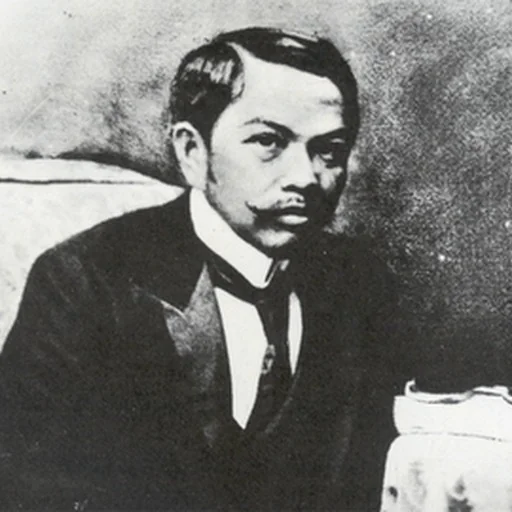
Juan Luna de San Pedro y Novicio (Spanish: Tagalog:; October 25, 1857 – December 7, 1899) was a Filipino painter, sculptor and a political activist of the Philippine Revolution during the late 19th century.