Artwork
Jacob’s Dream
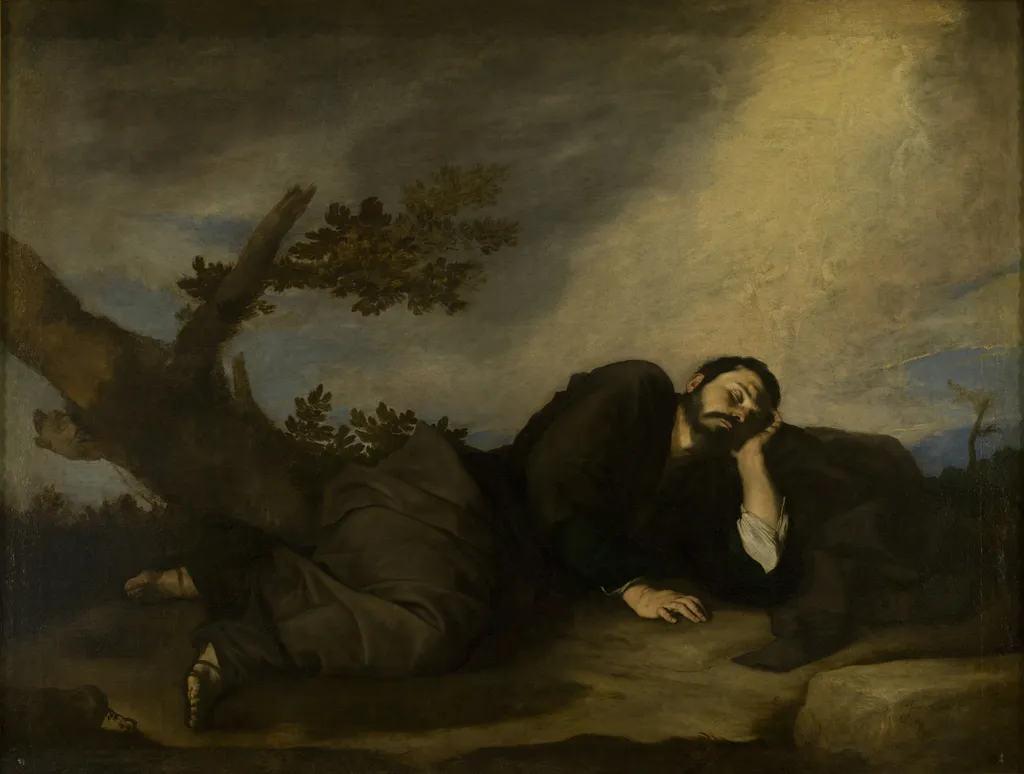
Jacob’s Dream is an oil painting by the Baroque artist Jusepe de Ribera. It dates from 1639 and is held in the collection of the Museo del Prado.
About this work
Subject & Meaning
This realistic portrayal of Jacob aligns with Counter-Reformation principles, prioritizing direct and easily understandable religious imagery for the viewer.
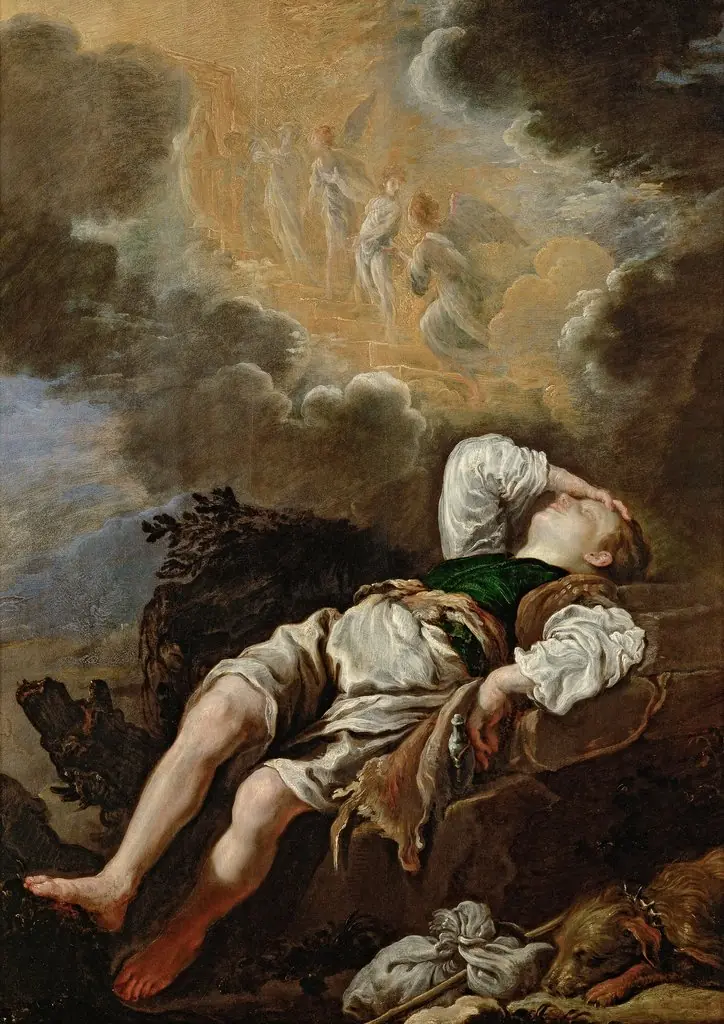
Jusepe de Ribera's 1639 painting depicts the biblical narrative from Genesis in which the patriarch Jacob, fleeing his brother Esau, sleeps with a stone for a pillow and dreams of a ladder reaching heaven. The work illustrates this vision with angels ascending and descending a luminous ladder, while God promises Jacob the land of Canaan. Symbolically, the ladder has been interpreted as the "ladder of humility" within monastic traditions.
Ribera emphasizes the human condition of the sleeping patriarch against a desolate landscape, creating a sharp distinction between the earthly reality below and the golden, cloud-like celestial vision above. This realistic portrayal of Jacob aligns with Counter-Reformation principles, prioritizing direct and easily understandable religious imagery for the viewer.
Technique & Style
Executed in 1639, Jacob’s Dream is an oil painting on canvas measuring 179 by 233 centimeters. The work exemplifies the Tenebrist style of Jusepe de Ribera, characterized by a stark contrast between the earthly reality of the sleeping patriarch and the celestial vision above. Ribera focuses on the naturalistic depiction of Jacob resting on a stone under a dull brown cloth, utilizing a sculptural handling of the figure that emphasizes tension in the hands and torso.
The composition is anchored by a horizontal diagonal created by a half-fallen tree, while the ladder of light and ascending angels appear as a faint, golden cloud, rendered with a touch of fantasy. This realistic yet dramatic approach aligns with Counter-Reformation principles, prioritizing direct comprehension for the viewer through a desolate landscape and a distinct separation between the material and the divine.
History & Provenance
Jacob’s Dream was painted by Jusepe de Ribera in 1639 as a private commission for Don Ramiro Núñez de Guzmán, then viceroy of Naples.
By 1658 the work belonged to Jerónimo de la Torre in Madrid, and by 1694 it had passed to Francisca de la Torre. It was sold in Madrid in 1718 and entered the Spanish royal collection in 1746, when Elisabetta Farnese held it at the Royal Palace of La Granja de San Ildefonso, at which time it was attributed to Bartolomé Esteban Murillo.
It remained with the Spanish monarchy: in 1794 it hung in the king’s bedroom at the Royal Palace of Aranjuez. In 1818 it was transferred to the Real Academia de Bellas Artes de San Fernando, and in 1827 it entered the Museo del Prado, where it has remained since.
Jusepe de Ribera's Jacob’s Dream (1639) is currently held in the Museo del Prado in Madrid. The work entered the museum's collection in 1827 after being transferred from the Real Academia de Bellas Artes de San Fernando. Prior to this, the painting resided in the Royal Palace of Aranjuez in 1794 and the Royal Palace of La Granja de San Ildefonso in 1746, where it was then attributed to Bartolomé Esteban Murillo.
Its provenance traces back to the mid-17th century, with documented ownership by Jerónimo de la Torre in 1658 and Francisca de la Torre in 1694, followed by a sale in Madrid in 1718. The painting was likely commissioned by Don Ramiro Núñez de Guzmán, the Viceroy of Naples. No specific accession number is provided in the available records.
Context
Jacob’s Dream occupies a distinctive place in Jusepe de Ribera’s late religious oeuvre, where naturalistic depiction and visionary imagery intersect. Painted in 1639, the work diverges from earlier treatments of Jacob’s ladder by foregrounding the patriarch’s vulnerable, sleeping body rather than the ascending and descending angels, an approach aligned with Counter-Reformation emphases on clarity and direct legibility for viewers.
The painting’s attribution history further situates it within the broader reception of Ribera’s art: it was long misattributed to Bartolomé Esteban Murillo, reflecting the period’s tendency to associate luminous palette and dramatic light with Murillo’s style. Later scholarship has firmly reclaimed the work for Ribera, underscoring its role in the Neapolitan painter’s mature phase and its resonance with contemporary debates on religious imagery.
Its presence in the Museo del Prado, acquired through royal collections, secures its place in canonical Spanish Baroque painting, while the 1957 abstract Jacob’s Ladder by Helen Frankenthaler signals the painting’s unexpected afterlife as a modernist touchstone.
Legacy
Jacob’s Dream has shaped art history through its visual language and later reinterpretations. The ladder of light, rendered as a luminous ascent of angels, became a symbolic motif that resonated beyond its biblical narrative. In the 20th century, American abstract painter Helen Frankenthaler drew on Ribera’s compositional daring, citing Jacob’s Dream as a direct inspiration for her 1957 work Jacob’s Ladder, now held at The Museum of Modern Art in New York.
The painting’s journey through royal and ecclesiastical collections in Spain also contributed to its reputation as a cornerstone of Baroque religious art, influencing scholarly discourse on Counter-Reformation visual culture. Its presence in major institutions such as the Museo del Prado has ensured continued public and academic attention, reinforcing its legacy as both a technical and thematic touchstone.
Overview
Created in 1639, this oil on canvas by José de Ribera, often identified with the moniker Lo Spagnoletto, depicts a solitary figure reclining beneath a tree. The composition is dominated by a stark contrast between deep shadows and a narrow shaft of illumination that falls on the sleeping man, emphasizing the dramatic mood characteristic of Ribera’s tenebrist approach.
Own this work as a print
Artist & collection
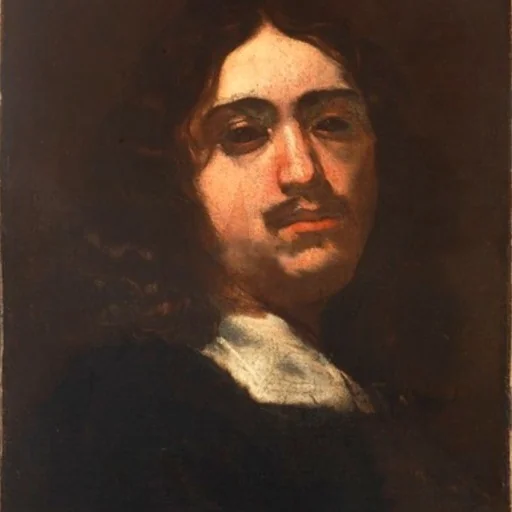
Artist
Jusepe de Ribera (Valencian:; baptised 17 February 1591 – 3 November 1652) was a Spanish painter and printmaker.