Artwork
Boys Throwing Stones
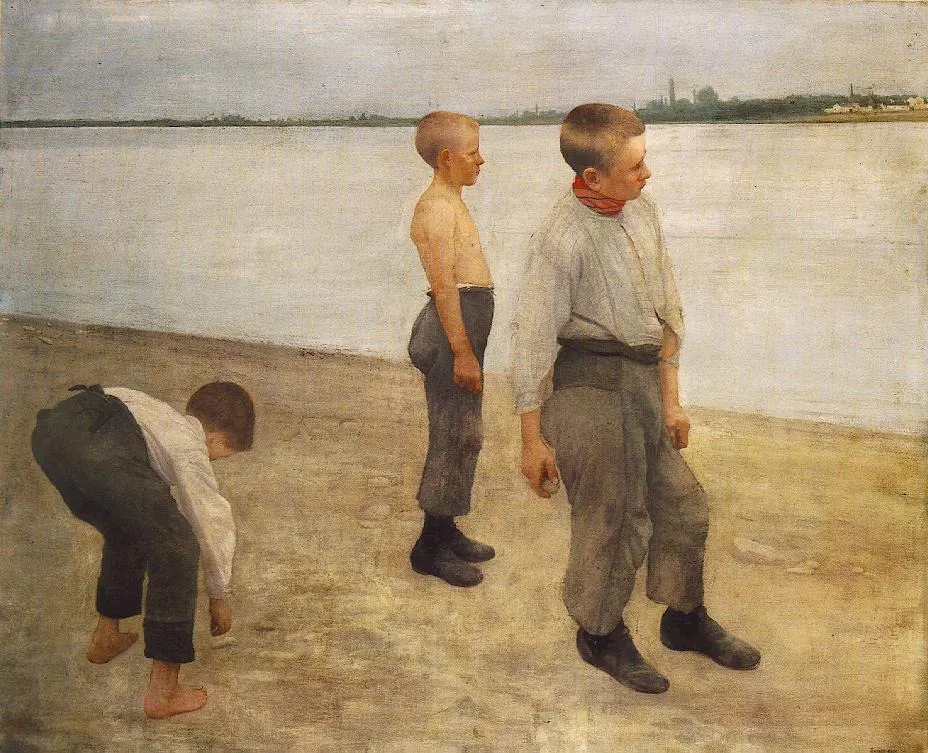
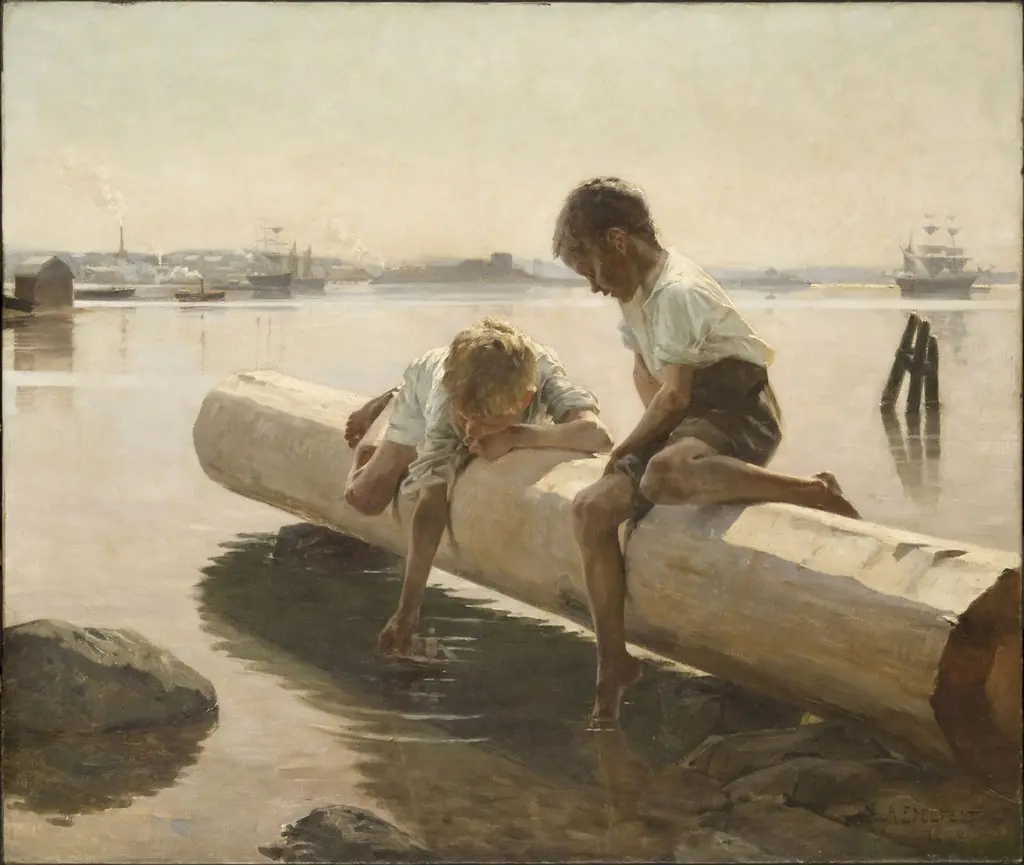
Boys Throwing Stones is an oil painting by the Naturalist artist Károly Ferenczy. It dates from 1896 and is held in the collection of the Hungarian National Gallery.
About this work
Overview
Painted in 1896 by Károly Ferenczy, Boys Throwing Stones is an oil-on-canvas work that captures a quiet moment of childhood play.
Painted in 1896 by Károly Ferenczy, Boys Throwing Stones is an oil-on-canvas work that captures a quiet moment of childhood play. Ferenczy, a key figure in Hungary’s Nagybánya artists’ colony, favored direct observation of rural and everyday scenes. This painting exemplifies the colony’s commitment to naturalism, rejecting idealized narratives in favor of unembellished, lived experience rendered with quiet precision.
Subject & Meaning
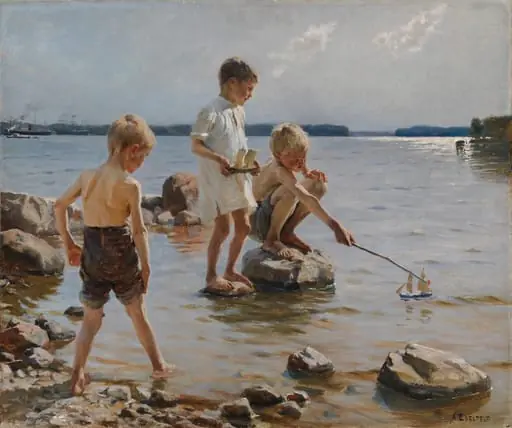
The painting shows three boys on a shoreline, engaged in a simple, unstructured game. One leans forward, gathering stones; the others stand still, perhaps waiting their turn. Their clothing, white shirts, gray or dark pants, suggests modest means, and the absence of adult figures emphasizes their autonomy.
The scene holds no moral or dramatic weight; its meaning lies in its unselfconscious normalcy, reflecting a broader interest in the dignity of ordinary life.
Technique & Style
Ferenczy employs loose, attentive brushwork to convey texture and light. The boys’ skin and fabric are modeled with subtle shifts in tone, while the water and distant cityscape are rendered with softer edges, creating spatial depth. Shadows fall naturally across the figures, grounding them in a tangible environment.
The palette is restrained, earthy tones with muted blues and whites, enhancing the painting’s quiet realism without theatricality.
History & Provenance
Created after Ferenczy’s return from Munich, where he studied under Simon Hollósy, the painting emerged from the early years of the Nagybánya colony, which he helped establish in 1896. It remained within Hungarian artistic circles and was later acquired by the Hungarian National Gallery, where it continues to represent the colony’s foundational ideals. Its provenance is well-documented, with no evidence of public exhibition prior to its institutional acquisition.
Context
In late 19th-century Hungary, artists increasingly turned from academic traditions toward scenes of rural and working-class life. The Nagybánya colony, influenced by French naturalism and plein air practices, sought to capture authenticity through direct observation. Boys Throwing Stones aligns with this movement, positioning childhood play not as sentimentalized fantasy but as a genuine, unmediated moment within the broader social landscape.
Legacy
The painting stands as a representative work of Hungarian naturalism, influencing later generations who valued emotional restraint and visual honesty. While not widely reproduced internationally, it remains a touchstone in Hungarian art history for its quiet depiction of everyday life. Its preservation in the Hungarian National Gallery ensures its continued role as a reference point for studies of regional realism and the evolution of modern Hungarian painting.
Artist & collection
Artist
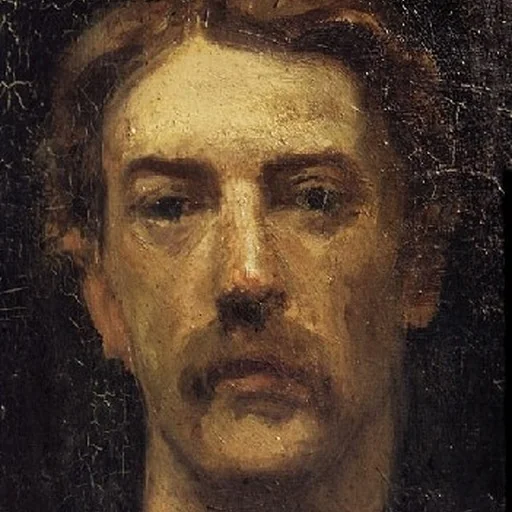
Károly Ferenczy (February 8, 1862 – March 18, 1917) was a Hungarian painter and leading member of the Nagybánya artists' colony.