Artwork
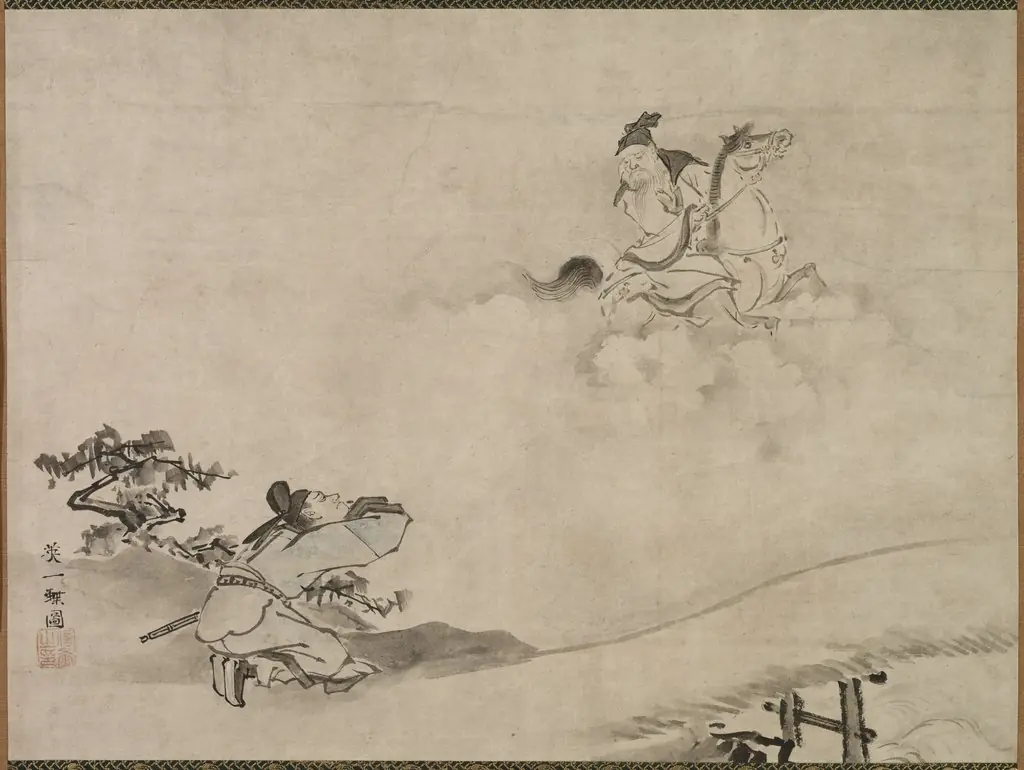
列子図襖|The Daoist Immortal Liezi

列子図襖|The Daoist Immortal Liezi is an ink painting by the Kanō school artist Kano School. It dates from 1606 and is held in the collection of the Metropolitan Museum of Art.
About this work
Overview
The Daoist Immortal Liezi is a set of four sliding-door panels created around 1606 by the Kano School, now housed at The Metropolitan Museum of Art. Executed in ink, color, gold, and gold leaf on paper, the work depicts four distinct scenes across its panels.
Subject & Meaning
The painting portrays figures resembling Daoist scholars or mystics in simple robes, set against sparse, often stormy landscapes. Scenes include groups on cliffs, lone walkers with symbolic objects (like a fan), and a figure ascending a hill under dark clouds, evoking themes of solitude, contemplation, and harmony with nature, aligning with Daoist principles.
Technique & Style
Characterized by the Kano School's traditional techniques, the work combines ink, color, and gold elements on paper. The style emphasizes simplicity and suggestion, with empty spaces contributing to a sense of quietude and distance, underscoring the contemplative mood of the scenes.
History & Provenance
Created circa 1606 by the Kano School, a prominent Japanese painting school, the set is currently part of The Metropolitan Museum of Art's collection.
Context
The painting's themes of harmony with nature, solitude, and spiritual pursuit reflect core Daoist philosophies, suggesting the work was created for a context where Daoist ideals were valued, possibly for meditation or ceremonial spaces.
Legacy
As a Kano School piece with clear Daoist themes, it contributes to the understanding of Japanese artistic engagement with Chinese philosophies during the Edo period, though its specific influence on later art is not broadly highlighted in available information.
Artist & collection
Artist
The Kano School turned sliding doors, screens, and scrolls into shimmering worlds of ink, mineral color, and gold leaf.