Artwork
Odalisque with Slave
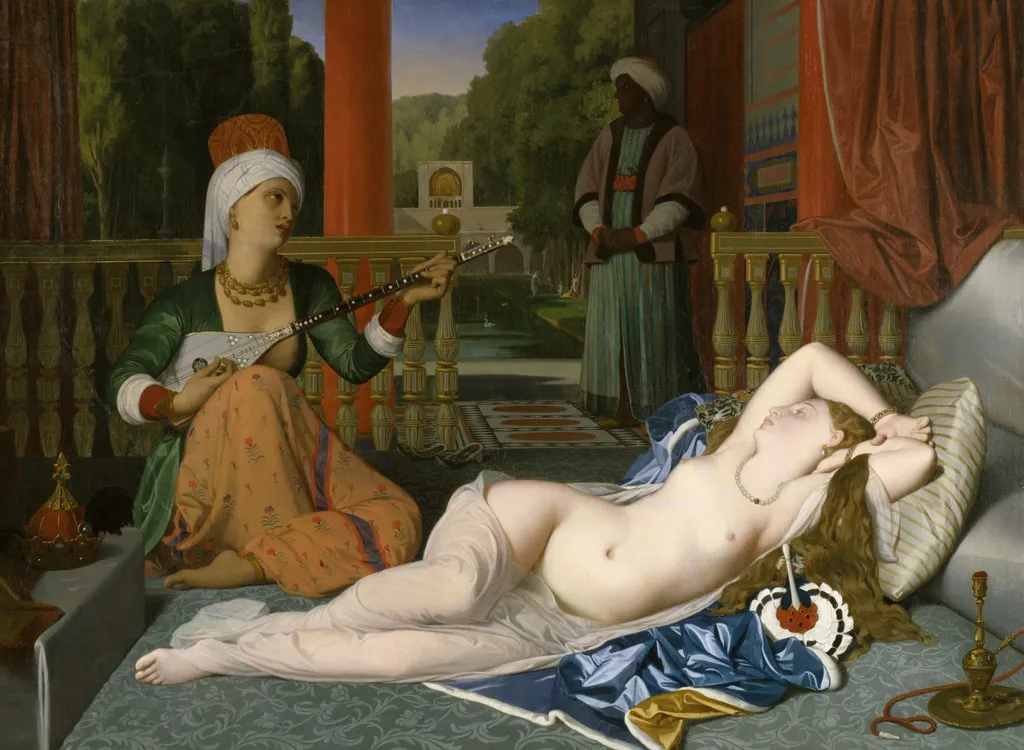
Odalisque with Slave is an oil painting by the Neoclassicist artist Jean Auguste Dominique Ingres. It dates from 1842 and is held in the collection of the Walters Art Museum.
About this work
Subject & Meaning
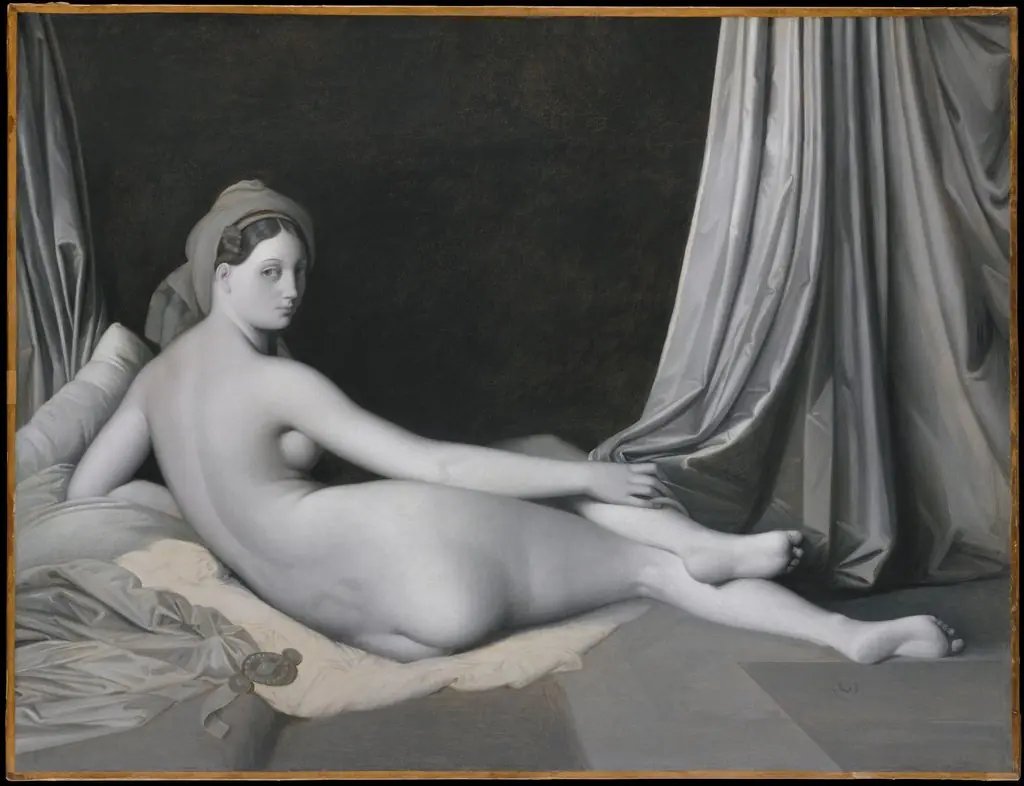
The work synthesizes elements from earlier studies, specifically echoing the pose of the odalisque in Ingres's lost 1809 painting, The Sleeping Woman of Naples.
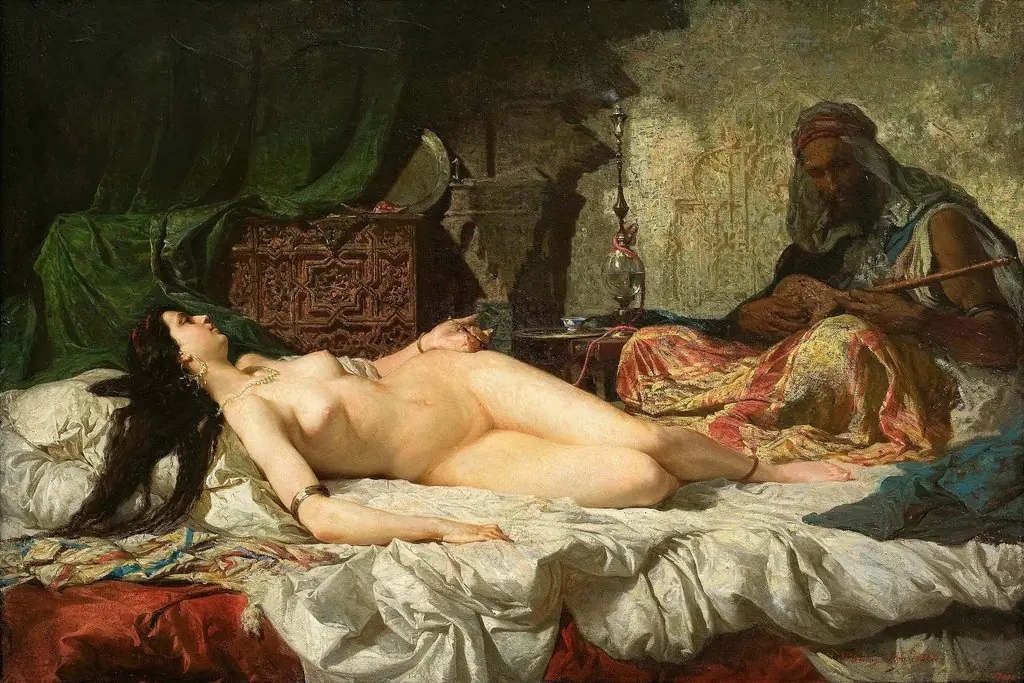
Odalisque with Slave depicts a harem scene featuring a reclining, fair-skinned odalisque, likely of Circassian origin, accompanied by a dark-skinned slave playing a stringed instrument and a standing male guardian. The composition utilizes Orientalist tropes, including a turban, hookah, and garden setting, to present a European fantasy of the East rather than an observed reality, as the artist never visited a harem. The work synthesizes elements from earlier studies, specifically echoing the pose of the odalisque in Ingres's lost 1809 painting, The Sleeping Woman of Naples.
Symbolically, the painting represents the 19th-century European fascination with the exotic and the eroticized harem, blending nudity with domestic servitude. This stereotyped vision, influenced by the garden at the Château de Dampierre, serves as a prime example of Neoclassical Orientalism, where the idealized female form is juxtaposed against the exoticized, subservient male figure.
Technique & Style
Odalisque with Slave (1842) is an oil painting on canvas measuring approximately 76 by 105 cm, produced by Jean-Auguste-Dominique Ingres with significant assistance from his pupils Hippolyte Flandrin and Paul Flandrin. According to Paul Flandrin's own account, he executed the greater part of the canvas, while Ingres reserved the final retouches for himself. The work is a replica of an earlier composition from 1839-1840 and was painted at the Château de Dampierre.
Stylistically, the painting belongs to the Neoclassical and Orientalist movements, depicting a harem interior with a reclining fair-skinned odalisque, a slave playing a long-necked lute-like instrument, and a dark-skinned guard in the background. Unlike the original, which featured a wall behind the figures, this version substitutes a garden view inspired by Dampierre's grounds, complete with a water feature and distant figures. Ingres, who never visited an actual harem, relied on preparatory drawings made without a live model; the odalisque's pose reworks his lost 1809 painting La dormiente di Napoli, while nine sketches of the musician survive at the Musée Ingres in Montauban and one at the British Museum.
History & Provenance
Jean-Auguste-Dominique Ingres first executed an original version of this composition between 1839 and 1840 during his second Roman residency. Following its positive reception in Paris, King Wilhelm I of Württemberg commissioned a replica. Ingres produced this second version in 1842 at the Château de Dampierre, assisted by his pupils Hippolyte and Paul Flandrin.
Paul Flandrin later claimed in an 1890 published letter that he painted the majority of the canvas, with Ingres contributing only final touches. The background scenery was adapted to reflect the gardens of Dampierre. After passing through various private collections, the 1842 replica was bequeathed to the Walters Art Museum in Baltimore in 1943, where it remains.
The 1842 oil painting Odalisque with Slave, executed by Jean-Auguste-Dominique Ingres with assistance from Hippolyte and Paul Flandrin, is held in the collection of the Walters Art Museum in Baltimore. The work entered the museum's holdings in 1943 following a series of previous ownership transfers. Originally commissioned by King Wilhelm I of Württemberg as a replica of an earlier 1839–1840 composition, this specific version was produced at the Château de Dampierre.
While the piece has been exhibited at the Walters Art Museum since its acquisition, historical records note that the original precursor to this work was sent to Paris shortly after its creation, where it received a favorable reception from French critics. The current location in Baltimore represents the final destination after these varied provenance movements.
Context
Completed between 1839 and 1842, this work exemplifies Ingres's contribution to Orientalism, depicting a harem scene based on European stereotypes rather than direct observation, as the artist never visited such settings. The composition relies on earlier studies, including a lost 1809 painting, and was executed with significant assistance from students Hippolyte and Paul Flandrin; the latter claimed in an 1890 published letter that he painted the majority of the 1842 replica commissioned by King Wilhelm I of Württemberg. While the original version received favorable reviews from Parisian critics upon its arrival from Rome, the 1842 iteration features a garden background inspired by the Château de Dampierre.
Art historians identify this painting, alongside Titian's Venus of Urbino and Ingres's own Grande Odalisque, as a likely precursor to Édouard Manet's Olympia (1863), securing its place in the lineage of the female nude in art history.
Legacy
After its favorable Parisian debut, the 1842 Odalisque with Slave was commissioned by King Wilhelm I of Württemberg and reproduced in the Château de Dampierre, where Ingres collaborated with pupils Hippolyte and Paul Flandrin, the latter asserting primary authorship in an 1890 newspaper account. The work entered the Walters Art Museum in 1943 and has been studied as a key example of Neoclassical Orientalism. Contemporary critics praised its composition, which reworked motifs from Ingres’s earlier La dormiente.
Scholars note its compositional influence on Édouard Manet’s Olympia (1863), underscoring its lasting impact on nineteenth‑century art discourse.
Overview
Jean Auguste Dominique Ingres's Odalisque with Slave, an oil painting from 1842, exemplifies Neoclassical genre scenes. It depicts an interior with figures, including two women and a male attendant, set against a backdrop suggesting an exotic locale. This work, a notable example of Ingres's later career, is part of the collection at the Walters Art Museum.
Own this work as a print
Artist & collection

Artist
Jean-Auguste-Dominique Ingres was a French Neoclassical painter. Ingres was profoundly influenced by past artistic traditions and aspired to become the guardian of academic orthodoxy against the ascendant Romantic…