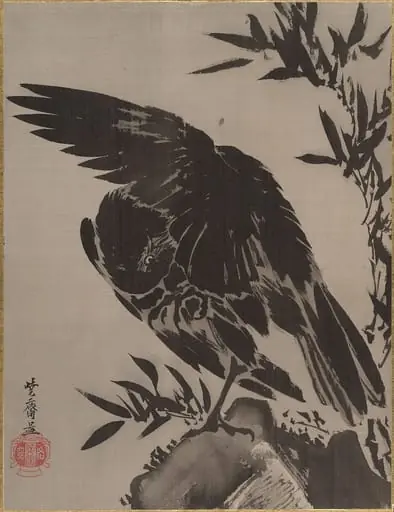
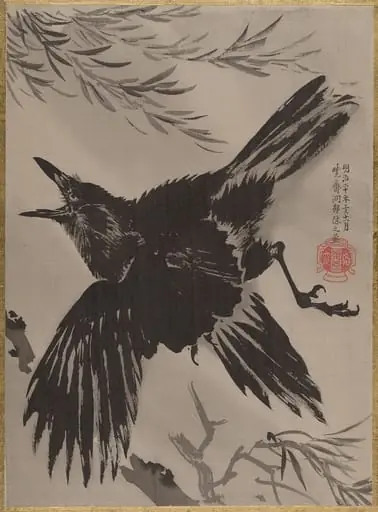
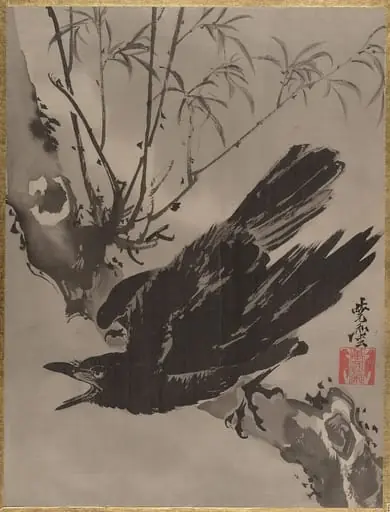
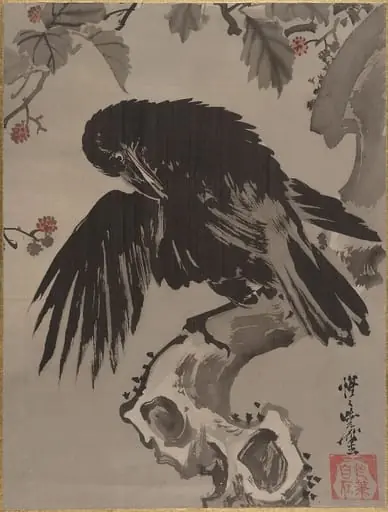
Artwork
月に鴉図|Crow and the Moon
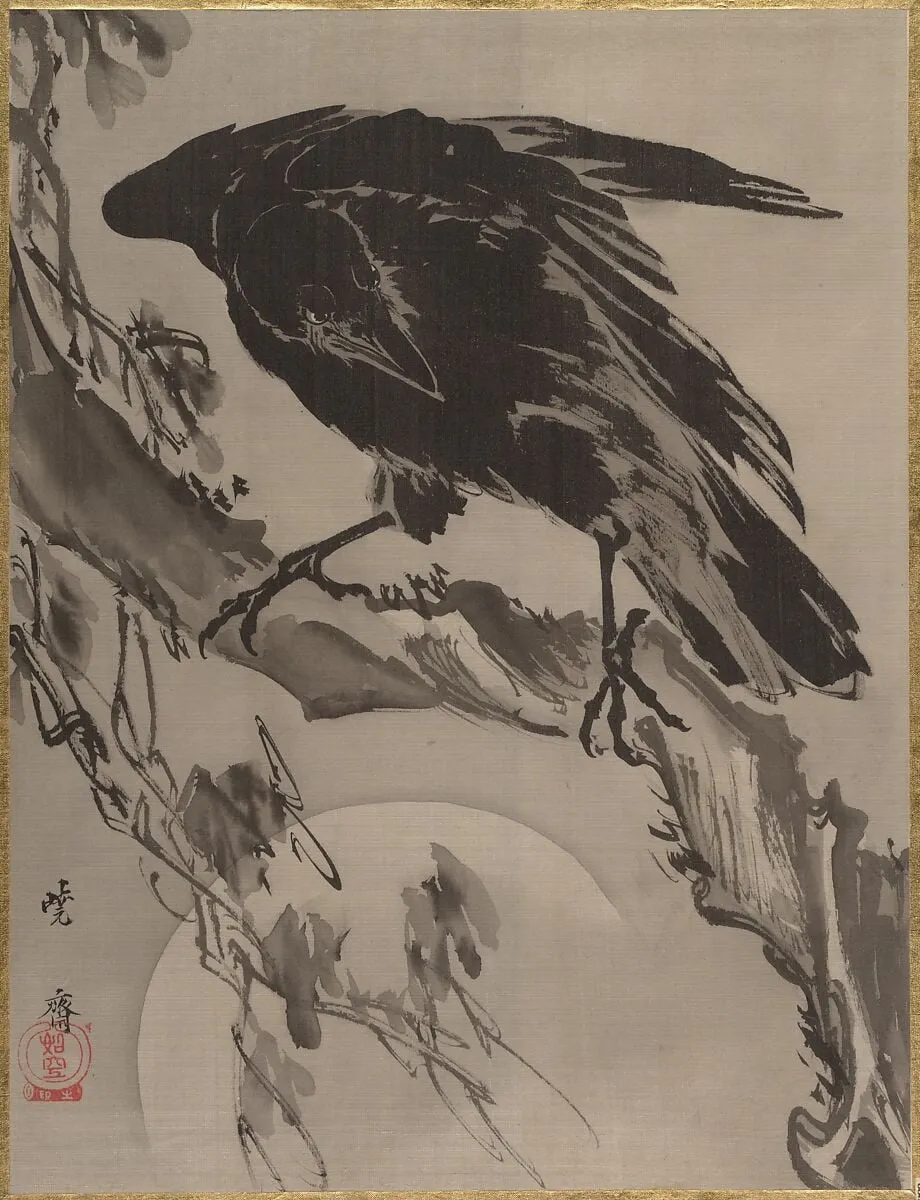
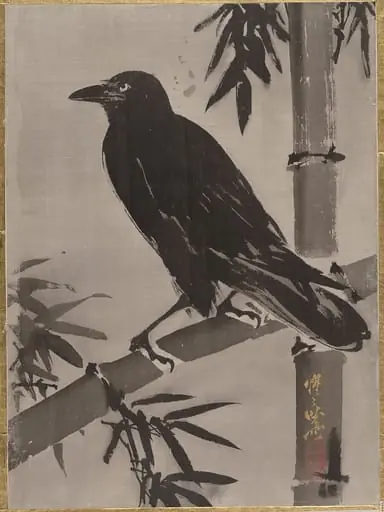
月に鴉図|Crow and the Moon is an ink painting by the Impressionist artist Kawanabe Kyōsai 河鍋暁斎. It dates from 1887 and is held in the collection of the Metropolitan Museum of Art. Kawanabe Kyōsai's Crow and the Moon, created around 1887, is an album leaf rendered in ink and color on silk.
- Accession no.
- 14.76.61.25
- Credit line
- Charles Stewart Smith Collection, Gift of Mrs. Charles Stewart Smith, Charles Stewart Smith Jr., and Howard Caswell Smith, in memory of Charles Stewart Smith, 1914
About this work
Subject & Meaning
While the work is classified broadly as a landscape, its focus remains tightly centered on the interaction between the avian figure and the celestial body.
The artwork depicts a solitary bird, identified as a crow, positioned against a luminous moon within a minimalist nocturnal landscape. Executed in ink and color on silk, the composition isolates these two primary elements to emphasize their visual and thematic relationship. While the work is classified broadly as a landscape, its focus remains tightly centered on the interaction between the avian figure and the celestial body.
The imagery leverages traditional Japanese iconography where the crow often serves as a messenger or a symbol of transformation, set against the eternal, cyclical nature of the moon. Created in 1887, the piece captures a moment of stillness, using the stark contrast between the dark bird and the bright moon to evoke a sense of quiet contemplation within the natural world.
History & Provenance
The work titled 月に鴉図|Crow and the Moon was produced in 1887 by Kawanabe Kyōsai as an ink-and-color painting on a silk album leaf, depicting a crow against a lunar disc. Created in Japan, it is now held in the collection of the Metropolitan Museum of Art in New York and measures 36.2 cm in height by 27.6 cm in width. No documentation of a specific commission or earlier ownership has been identified.
The available sources do not provide an accession number or exhibition history; the work remains part of the museum’s collection of Japanese paintings.
Context
Kawanabe Kyōsai’s 1887 album leaf, 月に鴉図|Crow and the Moon, depicts a solitary crow beneath a luminous moon, a motif that recurs throughout his work, as Kyōsai was especially celebrated for his paintings of crows. The piece reflects his engagement with traditional Japanese subjects during the Meiji period, when Edo‑period aesthetics met the modernizing currents of late‑nineteenth‑century Japan. Its inclusion in the Metropolitan Museum of Art’s collection has supported continued attention to Kyōsai’s role in this transitional moment, with the work noted for its refined brushwork and subtle color.
Overview
Kawanabe Kyōsai's Crow and the Moon, created around 1887, is an album leaf rendered in ink and color on silk. This work exemplifies the nihonga movement, showcasing a minimalist composition of a solitary crow against a pale moon. Kyōsai, known for his individualistic approach and mastery of traditional Japanese painting, captures a sense of vitality through expressive brushwork, reflecting his unique artistic vision during a period of significant cultural transition.
Technique & Style
Executed in ink and color on silk, Crow and the Moon demonstrates Kawanabe Kyōsai's technical skill within the nihonga tradition. The artist combined established Japanese ink painting techniques with a notably free and spontaneous brushwork, almost akin to a sketch. This approach imbues the crow with a sense of immediate presence and movement, departing from more rigid, formal styles and emphasizing an expressive, lively quality.
Artist & collection
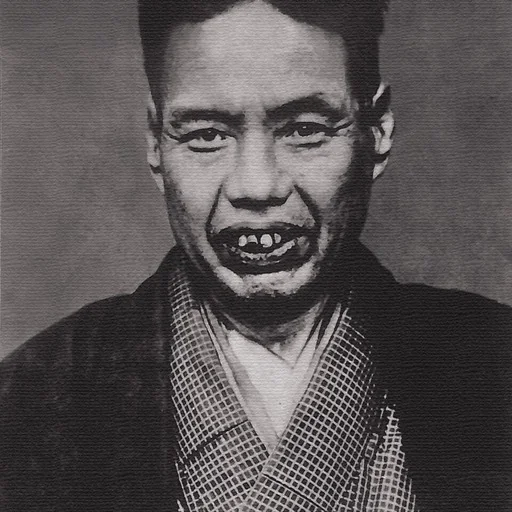
Artist
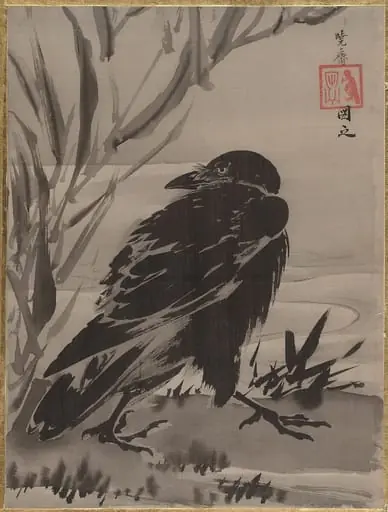
Kawanabe Kyōsai (河鍋 暁斎; May 18, 1831 – April 26, 1889) was a Japanese painter and caricaturist. In the words of art historian Timothy Clark, "an individualist and an independent, perhaps the last virtuoso in traditional Japanese painting".