Artwork
Homeward Oxherds in Wind and Rain
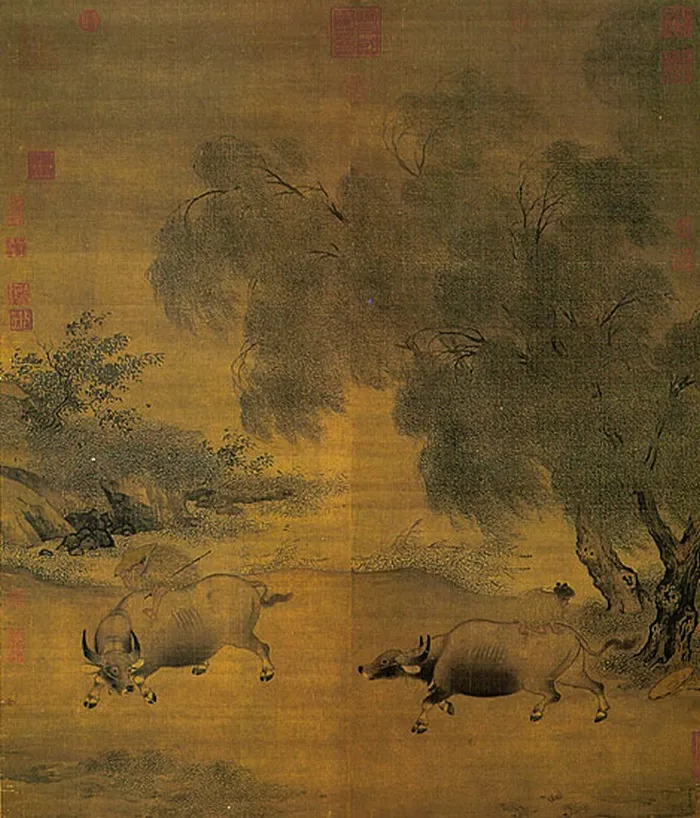
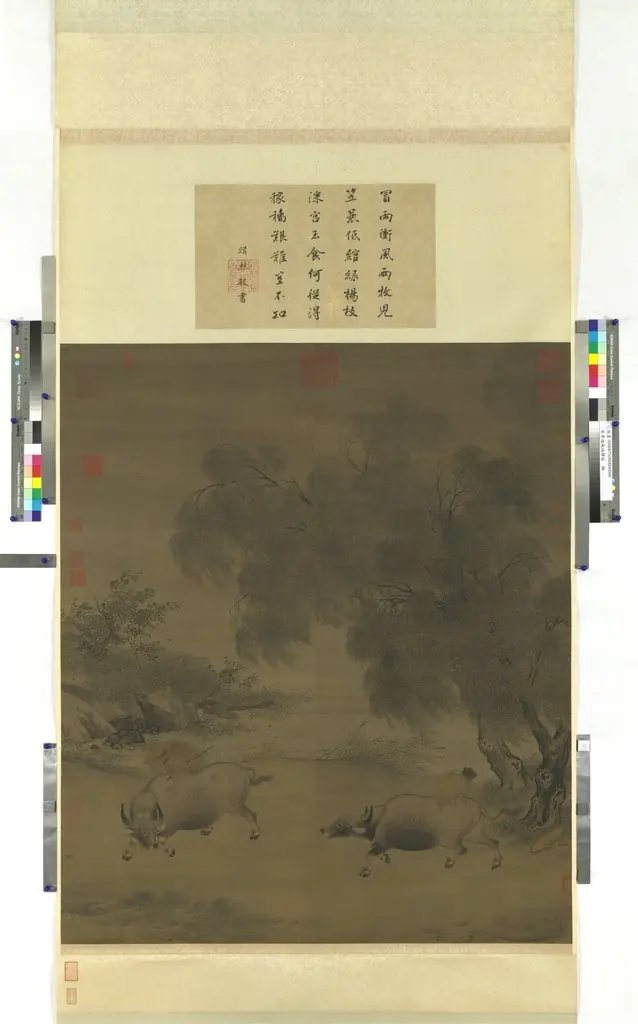
Homeward Oxherds in Wind and Rain is an ink painting by the Song dynasty landscape artist Li Di. It dates from 1114 and is held in the collection of the National Palace Museum.
About this work
Overview
Originally dated to 1114 in some catalogues, an inscription in the lower right corner of the painting itself indicates the year 1174.
Homeward Oxherds in Wind and Rain is a Southern Song dynasty painting attributed to the court artist Li Di. Executed in ink and color on silk, the work measures 120.7 by 102.8 centimeters and is held in the National Palace Museum in Taipei. Originally dated to 1114 in some catalogues, an inscription in the lower right corner of the painting itself indicates the year 1174. The composition captures two shepherd boys driving their oxen through a storm, establishing Li Di as a significant painter of land animals and rural scenes at the twelfth-century court.
Subject & Meaning
The painting depicts two young oxherds driving their beasts homeward through inclement weather. The boy in front huddles forward, holding down his bamboo hat against the wind, while the second boy is caught mid-leap, preparing to dismount to retrieve his hat that has just blown off. The oxen walk single file through shallow water, yet the front ox turns its gaze backward and the rear ox raises its head, allowing the two animals to maintain eye contact. This creates a deliberate psychological contrast: the boys are tormented and nearly beside themselves in the storm, whereas the oxen remain placid and unperturbed. The animals, initially the charges of the boys, seem to assume the role of protectors, an effect heightened by their slight anthropomorphization and central placement, which deepens the emotional resonance of the scene.
Technique & Style
Li Di employed fine, densely packed lines to render the figures and landscape elements with meticulous precision. The coarse woven rush raincoats, the soft hair and rigid horns of the oxen, delicate willow leaves, and pointy reeds are all defined through textured strokes, while the oxen's musculature is modeled with careful brushwork. In contrast, the background dissolves into a hazy, empty expanse achieved through wet, atmospheric ink washes. This juxtaposition of a substantial, detailed foreground against an empty void was characteristic of its era, serving to evoke how wind and rain restrict human vision and to emphasize the gloomy ambience, while inviting the viewer to imagine what lies beyond. The palette is restrained, relying on muted olive greens, browns, and warm amber tones across the aged silk support.
History & Provenance
The painting features an inscription marking the year 1174, placing its creation firmly in the latter half of the twelfth century, despite some corpus records listing an earlier date of 1114. Red collector's seals border the composition, heavily concentrated along the left edge and top, testifying to its long history of ownership and appreciation, though the specific names associated with these seals are not documented in the available sources. The work eventually entered the collection of the National Palace Museum in Taipei, where it remains accessioned today. It has also been reproduced for scholarly study, notably by Nigensha in 1986 in cooperation with the National Palace Museum.
Context
Li Di was active during the latter half of the twelfth century and served as an important painter in the Southern Song dynasty court. Historical records note his talent for painting flowers, birds, bamboo, rocks, and land animals. Homeward Oxherds in Wind and Rain exemplifies the Song dynasty approach to landscape and animal painting, where realism was achieved not just through anatomical accuracy but through the clever manipulation of mood and environmental effects. The work demonstrates the period's sophisticated understanding of how compositional voids and atmospheric weather could be used to elicit viewer sympathy and project emotional depth, securing Li Di's reputation for adding psychological realism to traditional rural subjects.
Artist & collection

- Untitled
 Landscape
 宋 佚名 倣李成 寒林策驢圖 軸|Travelers in a Wintry Forest
 南宋 佚名 倣夏珪 冒雨尋莊圖 團扇|Returning Home in a Driving Rain
 Drinking in the Moonlight
 Visiting Tai Kuei on a Snowy Night
 Fish on the Banks of the Wei River
 Fisherman on a Snowy River
 Man, Buffalo, and Calf
 Untitled
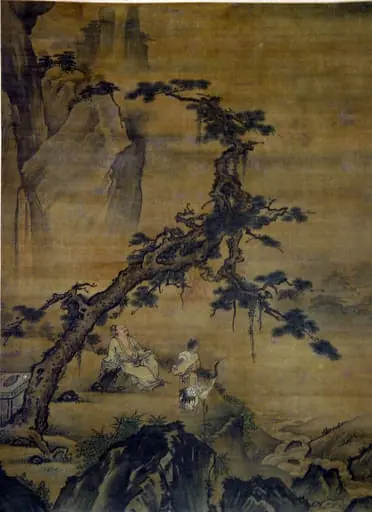 明 佚名 松鶴圖 軸|Scholar and Attendant in Mountain Retreat
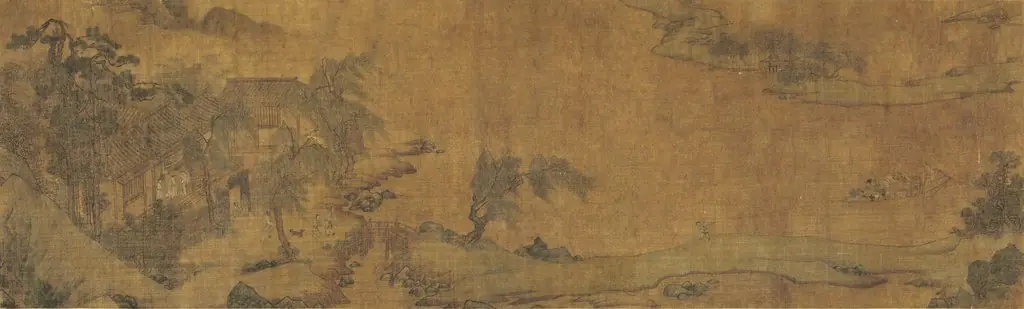 Homecoming Ode