Artwork
Madonna and Child with the Blessing Christ, and Saints Mary Magdalene and Catherine of Alexandria with Angels [entire triptych]
![Madonna and Child with the Blessing Christ, and Saints Mary Magdalene and Catherine of Alexandria with Angels [entire triptych], by Pietro Lorenzetti, tempera, 1340](https://artifactworldgallery.com/img/pietro-lorenzetti--madonna-and-child-with-the-blessing-christ-and-saints-mary-m--f78e415f61769b64-w1024.webp)
Madonna and Child with the Blessing Christ, and Saints Mary Magdalene and Catherine of Alexandria with Angels [entire triptych] is a tempera painting by the Italo Byzantine artist Pietro Lorenzetti. It dates from 1340 and is held in the collection of the National Gallery of Art.
- Inscription
- Inscribed:middle panel, across the bottom edge, on a fragment of the old frame set into the present one: [PETRUS] L[A]URENTII DE SENIS [ME] PI[N]XIT [ANNO] D[OMI]NI MCCCX...I [1]
About this work
Subject & Meaning
The presence of the Blessing Christ above the Virgin and Child reinforces the theological hierarchy and divine authority within the scene.
The triptych depicts a sacred ensemble centered on the Madonna and Child, flanked by the Blessing Christ, Saint Mary Magdalene, and Saint Catherine of Alexandria, accompanied by angels. As a work of religious art, the composition functions as a devotional image intended to evoke spiritual contemplation. The inclusion of specific saints, such as Catherine of Alexandria known for her wisdom and martyrdom, alongside Mary Magdalene, suggests a thematic focus on faith and redemption.
The presence of the Blessing Christ above the Virgin and Child reinforces the theological hierarchy and divine authority within the scene. This arrangement of figures creates a unified representation of heavenly intercession, characteristic of Pietro Lorenzetti's religious genre paintings from the early 1340s.
History & Provenance
The triptych is attributed to Pietro Lorenzetti and dated to approximately 1340. Its documented history begins on the Florence art market by 1924, where it was likely offered for sale alongside other works by the artist. By 1926, the panels had entered the possession of Alessandro Contini in Rome, who commissioned expert opinions on the work that same year.
Correspondence regarding the panels involving Felix M. Warburg, Contini, and restoration experts commenced in 1926 and concluded in 1927, the year Warburg likely acquired the triptych in New York. Upon Warburg's death in 1937, the work passed by inheritance to his wife, Frieda Schiff Warburg. She subsequently gifted the painting to the National Gallery of Art in Washington, D.C., in 1941, where it remains part of the collection.
The triptych is held in the collection of the National Gallery of Art, Washington, D.C.
Its inventory number is 1941.1.1–3. The panels entered the Gallery in 1941 as a gift from Frieda Schiff Warburg, following the bequest of her husband, Felix M. Warburg, who acquired them in 1927 from Alessandro Contini (Rome).
Context
The triptych, titled “Madonna and Child with the Blessing Christ, and Saints Mary Magdalene and Catherine of Alexandria with Angels”, is attributed to Pietro Lorenzetti and dated to the early 14th century, reflecting the religious painting tradition of Siena.
Scholarly discussion, notably by Raimond van Marle and Miklós Boskovits, has examined its provenance and attribution, linking it to half‑length saint panels documented in the Pinacoteca Nazionale and to the artist’s workshop.
Its acquisition history, from Florence market to Felix M. Warburg and eventual gift to the National Gallery of Art, illustrates the 20th‑century art market trajectory for early Italian works.
Overview
Pietro Lorenzetti's Madonna and Child with the Blessing Christ, and Saints Mary Magdalene and Catherine of Alexandria with Angels, created around 1340, is a religious triptych originally painted in tempera on panel before being transferred to canvas. This multi-panel work showcases the artist's innovative approach to Sienese painting. It features the Virgin Mary holding the Christ Child in the central panel, flanked by two prominent saints and angelic figures, reflecting a period of artistic transition.
Technique & Style
Executed in tempera on panel, a common medium of the era, this work later underwent transfer to canvas. Lorenzetti’s style, while rooted in the Italo-Byzantine tradition, demonstrates a significant departure from its rigid conventions. He explored spatial depth and rendered figures with a nascent three-dimensionality, imbuing the composition with a greater sense of naturalism. The gold backgrounds and simple settings contribute to an overall effect of refined elegance.
![Madonna and Child with the Blessing Christ, and Saints Peter, James Major, Anthony Abbott, and a Deacon Saint [entire triptych]](https://artifactworldgallery.com/img/martino-di-bartolomeo--madonna-and-child-with-the-blessing-christ-and-saints-peter--2c53e26d577a363b-w320.webp)
Own this work as a print
Artist & collection
Artist
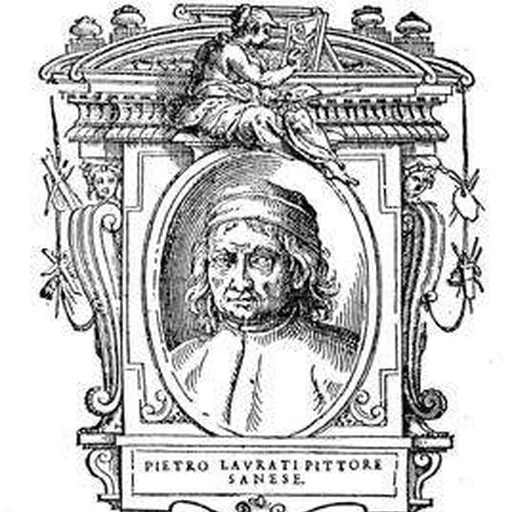
Pietro Lorenzetti (Italian:; c. 1280 – 1348) or Pietro Laurati was an Italian painter, active between c. 1306 and 1345. Together with his younger brother Ambrogio, he introduced naturalism into Sienese art. In their…

![Saint Catherine of Alexandria, with an Angel [right panel], by Pietro Lorenzetti](https://artifactworldgallery.com/img/pietro-lorenzetti--saint-catherine-of-alexandria-with-an-angel-right-panel--8acb359f1d360041-w320.webp)
![Saint Mary Magdalene, with an Angel [left panel], by Pietro Lorenzetti](https://artifactworldgallery.com/img/pietro-lorenzetti--saint-mary-magdalene-with-an-angel-left-panel--c015f106a0790d0d-w320.webp)
![Madonna and Child, with the Blessing Christ [middle panel], by Pietro Lorenzetti](https://artifactworldgallery.com/img/pietro-lorenzetti--madonna-and-child-with-the-blessing-christ-middle-panel--02357aa6ff04175b-w320.webp)
- Madonna and Child with the Blessing Christ, and Saints Peter, James Major, Anthony Abbott, and a Deacon Saint [entire triptych]
 Madonna and Child Enthroned with Angels and Saints
 Triptych with the Virgin and Child, and Saints Mary Magdalene and Ansanus
 Madonna and Child with Saints and Angels
![Madonna and Child with Saints Andrew, Benedict, Bernard, and Catherine of Alexandria with Angels [entire triptych], by Agnolo Gaddi](https://artifactworldgallery.com/img/agnolo-gaddi--madonna-and-child-with-saints-andrew-benedict-bernard-and-ca--93a6585f38530738-w320.webp) Madonna and Child with Saints Andrew, Benedict, Bernard, and Catherine of Alexandria with Angels [entire triptych]
Madonna and Child with Saints Andrew, Benedict, Bernard, and Catherine of Alexandria with Angels [entire triptych] Madonna and Child Enthroned with Saints and Angels