Artwork
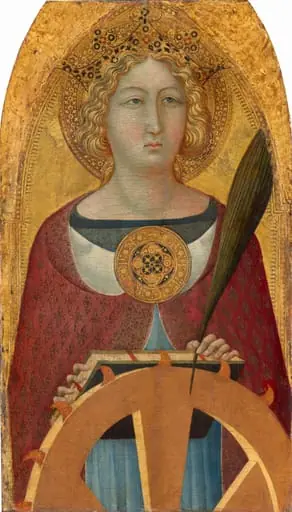
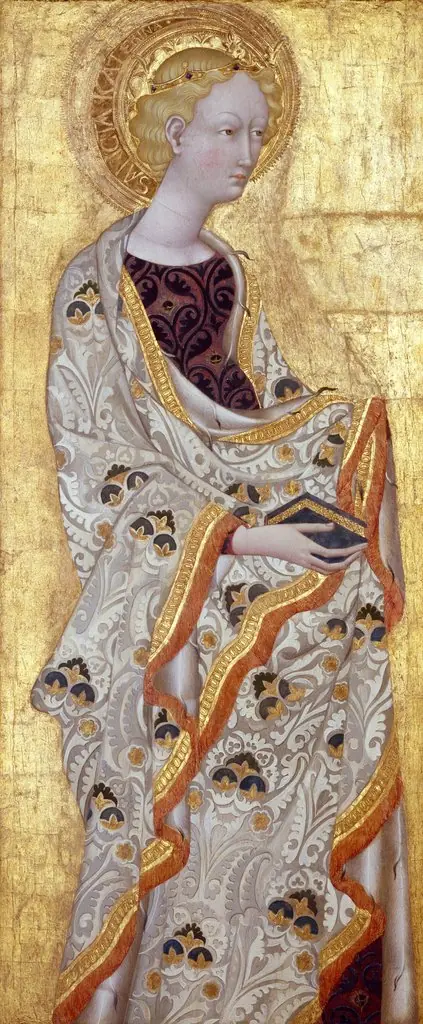
Saint Catherine of Alexandria, with an Angel [right panel]
![Saint Catherine of Alexandria, with an Angel [right panel], by Pietro Lorenzetti, tempera, 1340](https://artifactworldgallery.com/img/pietro-lorenzetti--saint-catherine-of-alexandria-with-an-angel-right-panel--8acb359f1d360041-w1024.webp)
Saint Catherine of Alexandria, with an Angel [right panel] is a tempera painting by the Byzantine icon painting artist Pietro Lorenzetti. It dates from 1340 and is held in the collection of the National Gallery of Art.
About this work
Saint Catherine holds a book and her broken spiked wheel, a small angel beside her with a palm branch. A fourth-century scholar, she stands in a red robe and crown against gold leaf. Pietro Lorenzetti worked in tempera, with delicate folds in her cloak. 1340.
Subject & Meaning
She holds a book, a symbol of her scholarly wisdom and theological learning, aligning with her role as a Christian philosopher defending her faith.
The right panel depicts Saint Catherine of Alexandria, identifiable by her traditional attributes: a crown, signifying her royal lineage, and the broken wheel, emblematic of the failed execution by torture that became her martyrdom. She holds a book, a symbol of her scholarly wisdom and theological learning, aligning with her role as a Christian philosopher defending her faith. An angel beside her presents a martyr’s palm, reinforcing her sanctity and the triumph of faith over persecution.
The composition’s devotional tone underscores themes of spiritual constancy and divine vindication, central to late medieval religious iconography. These elements collectively emphasize Catherine’s identity as a learned virgin martyr whose steadfastness under trial exemplifies Christian virtue.
History & Provenance
The right panel of Saint Catherine of Alexandria, with an Angel is generally dated to around 1340, attributed to Pietro Lorenzetti. Its early provenance is unclear; by 1924 it appeared on the Florentine art market, where Raimond van Marle noted a group of similar half-length saints possibly from Lorenzetti’s workshop. By 1926 the panel was in the possession of Alessandro Contini (later Contini Bonacossi) in Rome, who commissioned expertises that year.
It was acquired in 1927 by Felix M. Warburg in New York, passing to his widow Frieda Schiff Warburg after his death. In 1941 the panel was donated to the National Gallery of Art, Washington, D.C., where it remains.
The right panel, Saint Catherine of Alexandria, with an Angel, is held in the collection of the National Gallery of Art in Washington, D.C. The work entered the museum's holdings in 1941 as a gift from Frieda Schiff Warburg, who had inherited it from her husband, Felix M. Warburg, following his death in 1937. Prior to this transfer, the panel was acquired by Felix Warburg in New York in 1927, having passed through the hands of Alessandro Contini in Rome by 1926 and appearing on the Florentine art market around 1924. While the source material details this specific provenance chain leading to the National Gallery of Art, it does not record a distinct exhibition history or list specific public displays of the work prior to its accession.
Legacy
The right‑hand panel of the triptych, depicting Saint Catherine of Alexandria with an Angel, entered the National Gallery of Art in Washington, D.C., in 1941 after a documented sale to Felix M. Warburg in 1927 and a gift from his wife in 1941. Early 20th‑century scholarship highlighted the work when evaluating half‑length saint figures attributed to Pietro Lorenzetti’s workshop, with writers such as Raimond van Marle and Miklós Boskovits referencing its style and iconography. Its appearance in exhibition narratives and catalogues, including a 1929 publication by Ernest Theodore De Wald, cemented its status as a representative example of Sienese influence in early Renaissance painting. The panel’s inclusion in a major public collection has contributed to ongoing scholarly discussion of Lorenzetti’s legacy.
Overview
Pietro Lorenzetti, an Italian painter active in the first half of the 14th century, created Saint Catherine of Alexandria, with an Angel around 1340. This work, originally tempera on panel and later transferred to canvas, showcases the artist's distinctive approach. It blends the established Byzantine iconographic tradition with the emerging naturalistic innovations that Lorenzetti and his brother Ambrogio introduced to Sienese art, foreshadowing later Renaissance developments in spatial and three-dimensional representation.
Technique & Style
Lorenzetti employed tempera paint, a common medium of the period, and incorporated gold leaf into the composition. The gold background imparts a luminous, ethereal quality, evoking a heavenly realm. The artist's attention to detail is evident in the delicate folds of Catherine's cloak, which, alongside the naturalistic rendering of the figures, demonstrates Lorenzetti's pioneering efforts in introducing greater three-dimensionality and spatial depth to Sienese painting.
Artist & collection
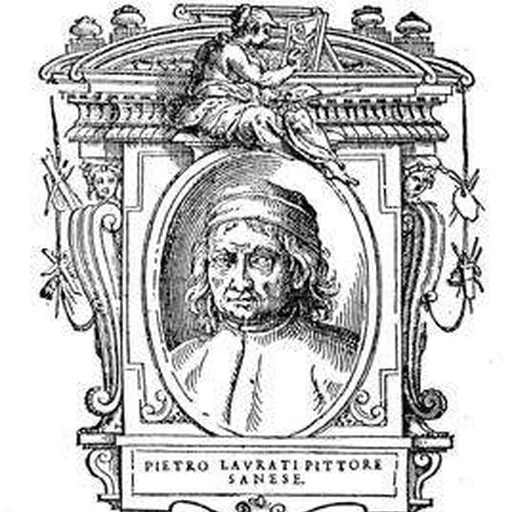
Artist
Pietro Lorenzetti (Italian:; c. 1280 – 1348) or Pietro Laurati was an Italian painter, active between c. 1306 and 1345. Together with his younger brother Ambrogio, he introduced naturalism into Sienese art. In their…

![Saint Mary Magdalene, with an Angel [left panel], by Pietro Lorenzetti](https://artifactworldgallery.com/img/pietro-lorenzetti--saint-mary-magdalene-with-an-angel-left-panel--c015f106a0790d0d-w320.webp)
![Madonna and Child, with the Blessing Christ [middle panel], by Pietro Lorenzetti](https://artifactworldgallery.com/img/pietro-lorenzetti--madonna-and-child-with-the-blessing-christ-middle-panel--02357aa6ff04175b-w320.webp)
![Madonna and Child with the Blessing Christ, and Saints Mary Magdalene and Catherine of Alexandria with Angels [entire triptych], by Pietro Lorenzetti](https://artifactworldgallery.com/img/pietro-lorenzetti--madonna-and-child-with-the-blessing-christ-and-saints-mary-m--f78e415f61769b64-w320.webp)
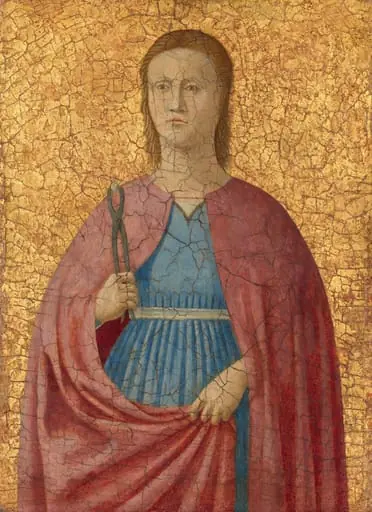
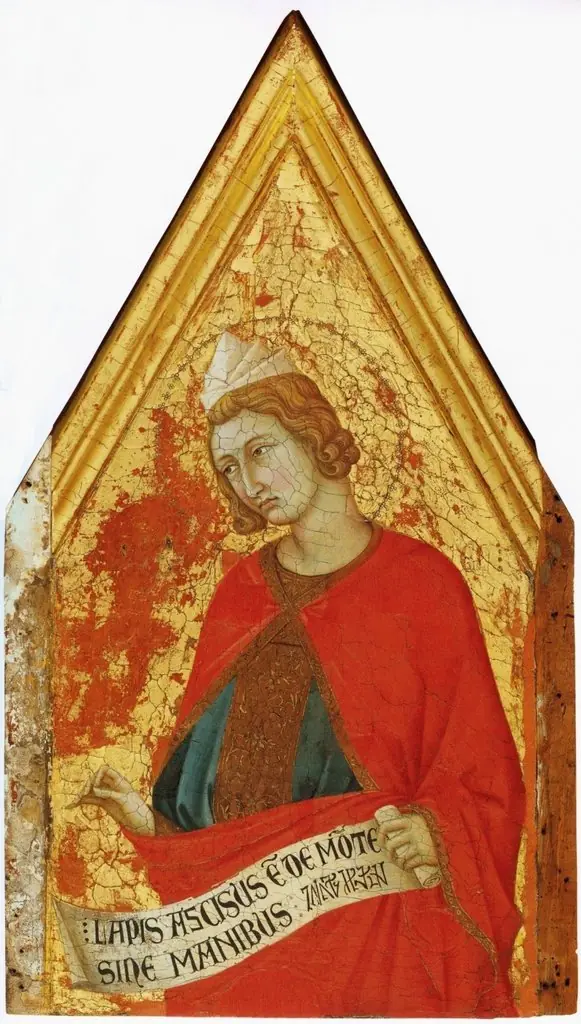
![Madonna and Child, with the Blessing Christ [middle panel], by Martino di Bartolomeo](https://artifactworldgallery.com/img/martino-di-bartolomeo--madonna-and-child-with-the-blessing-christ-middle-panel--9e7ebbf6d3ba8295-w320.webp)