Artwork
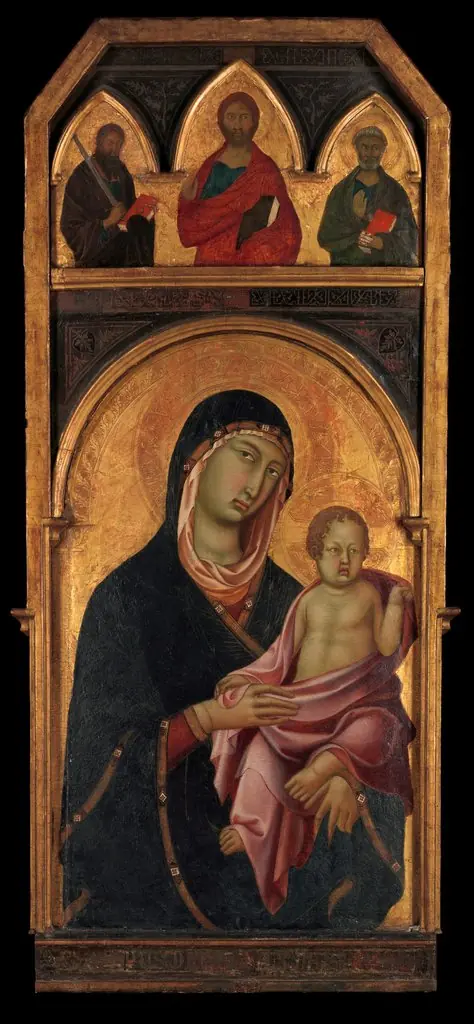
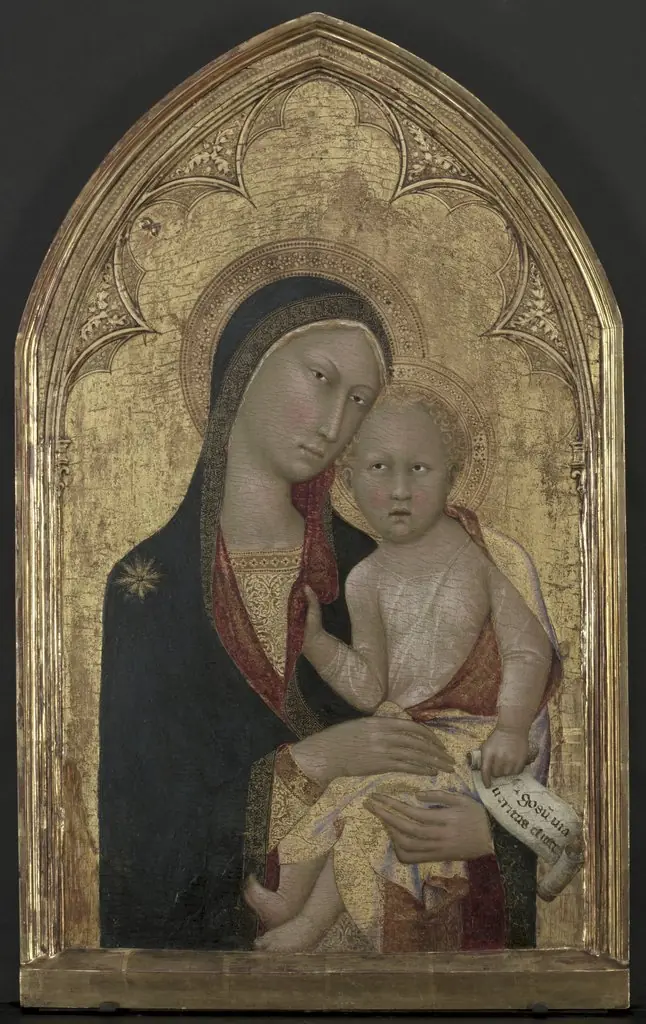
Madonna and Child, with the Blessing Christ [middle panel]
![Madonna and Child, with the Blessing Christ [middle panel], by Pietro Lorenzetti, tempera, 1340](https://artifactworldgallery.com/img/pietro-lorenzetti--madonna-and-child-with-the-blessing-christ-middle-panel--02357aa6ff04175b-w1024.webp)
Madonna and Child, with the Blessing Christ [middle panel] is a tempera painting by the Byzantine icon painting artist Pietro Lorenzetti. It dates from 1340 and is held in the collection of the National Gallery of Art.
- Inscription
- Inscribed:across the bottom edge, on a fragment of the old frame set into the present one: [PETRUS] L[A]URENTII DE SENIS [ME] PI[N]XIT [ANNO] D[OMI]NI MCCCX...I [1]
About this work
Technique & Style
Executed probably around 1340, this work is a tempera painting originally created on a wooden panel.
Executed probably around 1340, this work is a tempera painting originally created on a wooden panel. The physical support has subsequently been transferred from panel to canvas. Stylistically, the composition features half-length figures, a format art historians have compared to other panels by Pietro Lorenzetti in the Pinacoteca Nazionale in Siena. The piece functions as the central section of a larger religious triptych.
History & Provenance
Probably executed around 1340, the middle panel of the triptych emerged on the Florentine art market by 1924, when Raimond van Marle noted that half-length figures comparable to Pietro Lorenzetti's panels in the Pinacoteca Nazionale in Siena had recently been offered for sale in Florence, though he suggested they might be products of the artist's bottega. By 1926 the work had entered the collection of Alessandro Contini (later Contini Bonacossi) in Rome, who commissioned expert opinions on the triptych that year. Correspondence among Contini, Felix M. Warburg, his advisor Paul Sachs, and the restorers Hammond Smith and Stephen Pichetto, beginning in 1926 and ending in 1927, documents the negotiations leading to Warburg's purchase of the three panels in 1927.
The painting passed by inheritance to his wife, Frieda Schiff Warburg, who gave it to the National Gallery of Art in 1941.
Context
The middle panel of the Lorenzetti triptych, Madonna and Child with the Blessing Christ, was probably executed around 1340 in tempera on panel, later transferred to canvas. It belongs to the religious painting genre and appeared on the Florentine art market before entering the collection of Alessandro Contini by 1926. Felix M. Warburg acquired the three panels in 1927, and the work was later given to the National Gallery of Art, where it remains. As part of Pietro Lorenzetti's circle, the panel reflects the Sienese school's tradition of half-length devotional imagery.
Legacy
The panel entered the National Gallery of Art in 1941 as the gift of Frieda Schiff Warburg, following a provenance running from the Florentine market through Alessandro Contini to Felix M. Warburg. Early scholarship, notably Raimond van Marle's 1924 survey, discussed the work in connection with Pietro Lorenzetti's half-length devotional imagery. Its inclusion in museum catalogues has reinforced its standing as a representative example of Sienese trecento painting.
Overview
Pietro Lorenzetti's Madonna and Child, with the Blessing Christ, created around 1340, is a tempera painting originally on panel and later moved to canvas. This work exemplifies the religious themes prevalent in 14th-century Sienese art, blending traditional Byzantine iconography with emerging naturalistic tendencies. It portrays a tender interaction between the Virgin Mary and the Christ Child, reflecting the era's devotional practices while hinting at the spatial innovations that would characterize later Renaissance painting.
Subject & Meaning
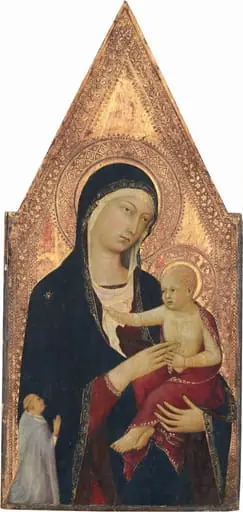
The central panel presents a poignant depiction of the Virgin Mary cradling the Christ Child, with a smaller image of Christ blessing from above. Mary, draped in a red robe and blue cloak, gazes tenderly as the child, clad in yellow, reaches up to touch her chin. This intimate portrayal, set against a golden, patterned background, embodies the devotional spirit of the period. The composition adheres to established Byzantine symbolic and hierarchical traditions, yet conveys a sense of human connection.
![Madonna and Child, with the Blessing Christ [middle panel]](https://artifactworldgallery.com/img/martino-di-bartolomeo--madonna-and-child-with-the-blessing-christ-middle-panel--9e7ebbf6d3ba8295-w320.webp)
Artist & collection
Artist
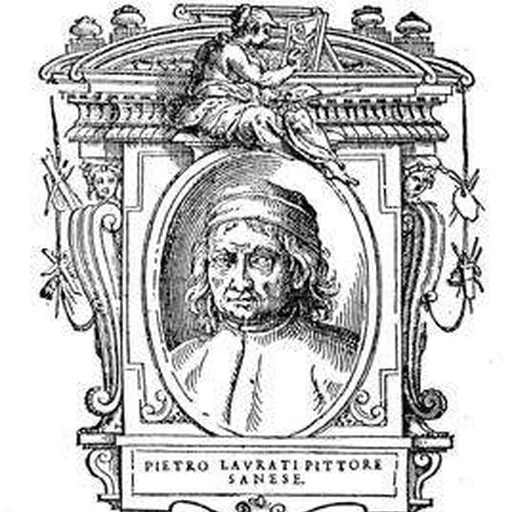
Pietro Lorenzetti (Italian:; c. 1280 – 1348) or Pietro Laurati was an Italian painter, active between c. 1306 and 1345. Together with his younger brother Ambrogio, he introduced naturalism into Sienese art. In their…

![Saint Catherine of Alexandria, with an Angel [right panel], by Pietro Lorenzetti](https://artifactworldgallery.com/img/pietro-lorenzetti--saint-catherine-of-alexandria-with-an-angel-right-panel--8acb359f1d360041-w320.webp)
![Saint Mary Magdalene, with an Angel [left panel], by Pietro Lorenzetti](https://artifactworldgallery.com/img/pietro-lorenzetti--saint-mary-magdalene-with-an-angel-left-panel--c015f106a0790d0d-w320.webp)
![Madonna and Child with the Blessing Christ, and Saints Mary Magdalene and Catherine of Alexandria with Angels [entire triptych], by Pietro Lorenzetti](https://artifactworldgallery.com/img/pietro-lorenzetti--madonna-and-child-with-the-blessing-christ-and-saints-mary-m--f78e415f61769b64-w320.webp)