Artwork
Madonna with Child with Young John the Baptist
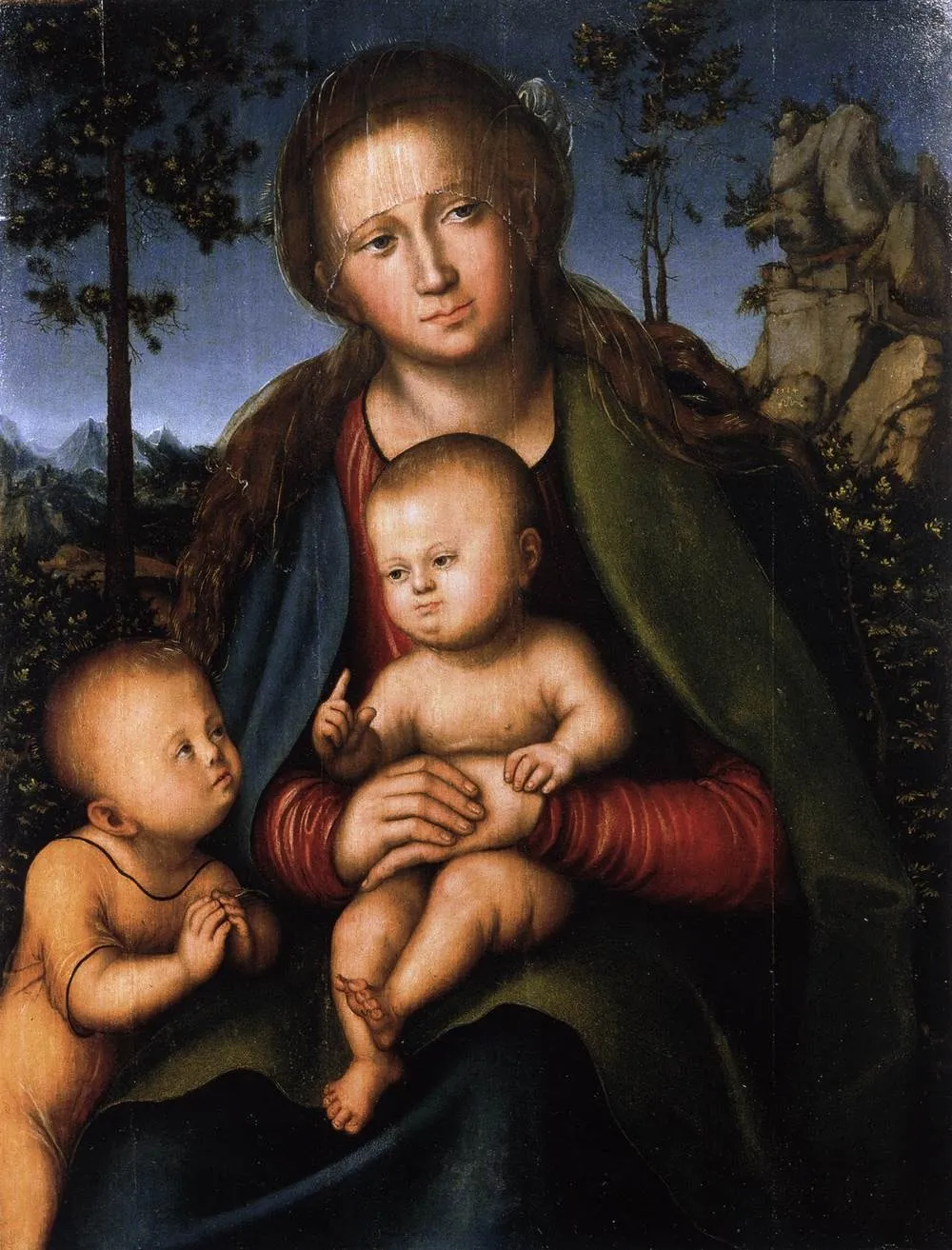
Madonna with Child with Young John the Baptist is an oil painting by the Northern Renaissance artist Lucas Cranach the Elder. It dates from 1514 and is held in the collection of the Uffizi Gallery.
About this work
Overview
Madonna with Child with Young John the Baptist is an oil-on-panel painting by the German Renaissance master Lucas Cranach the Elder, dated 1514.
Madonna with Child with Young John the Baptist is an oil-on-panel painting by the German Renaissance master Lucas Cranach the Elder, dated 1514. Measuring 76.6 by 58 centimetres, the work is now held in the Uffizi Gallery in Florence, to which it was accessioned in 2001. The painting occupies a significant place in art history as a compelling document of Northern European engagement with Italian Renaissance models, demonstrating how Cranach, one of the foremost painters of the German Renaissance, absorbed and transformed the artistic language of his Italian contemporaries. Its recovery in 2001 after nearly three decades of being stolen has also made it a notable case in the history of art crime and recovery.
Subject & Meaning
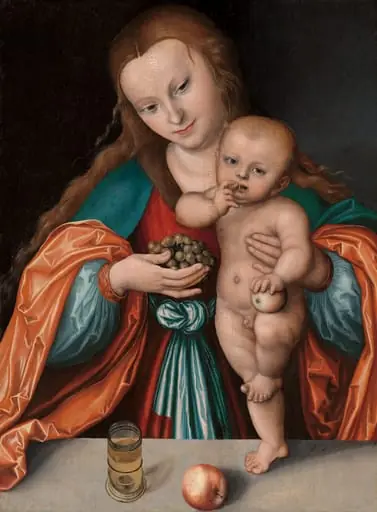
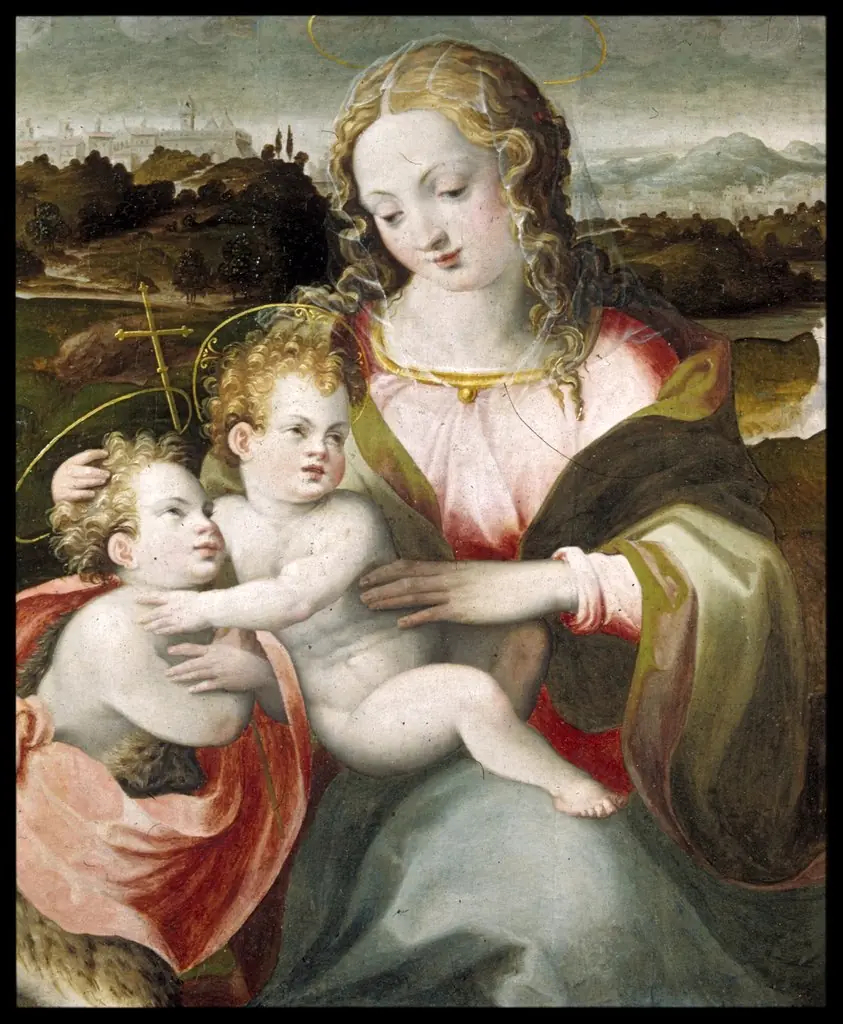
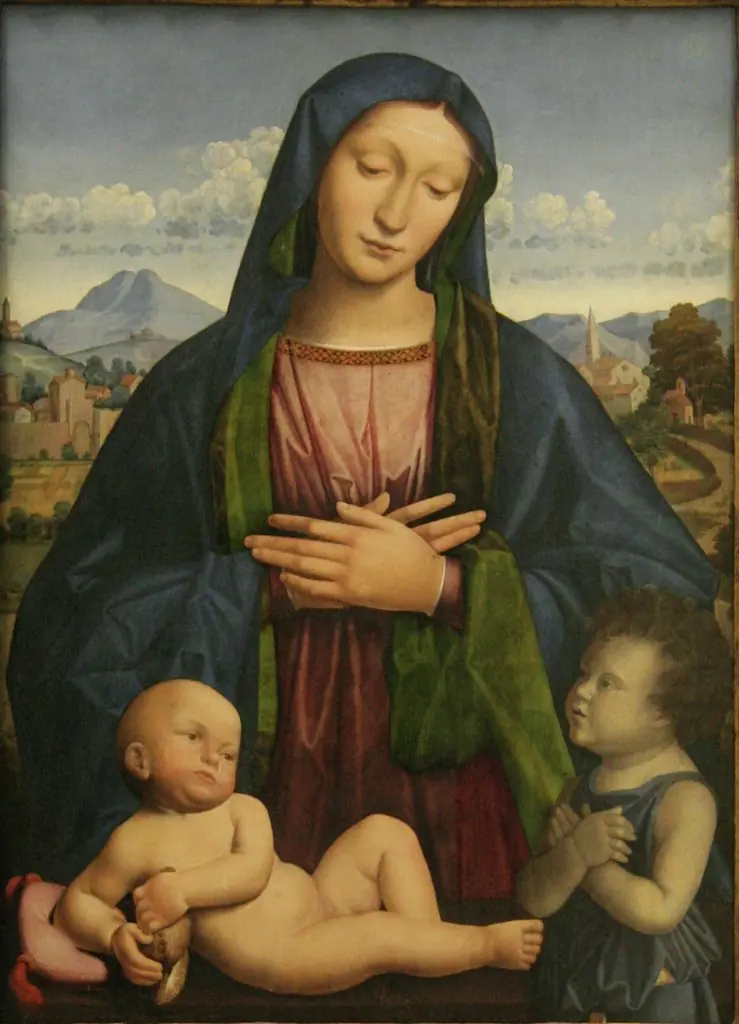
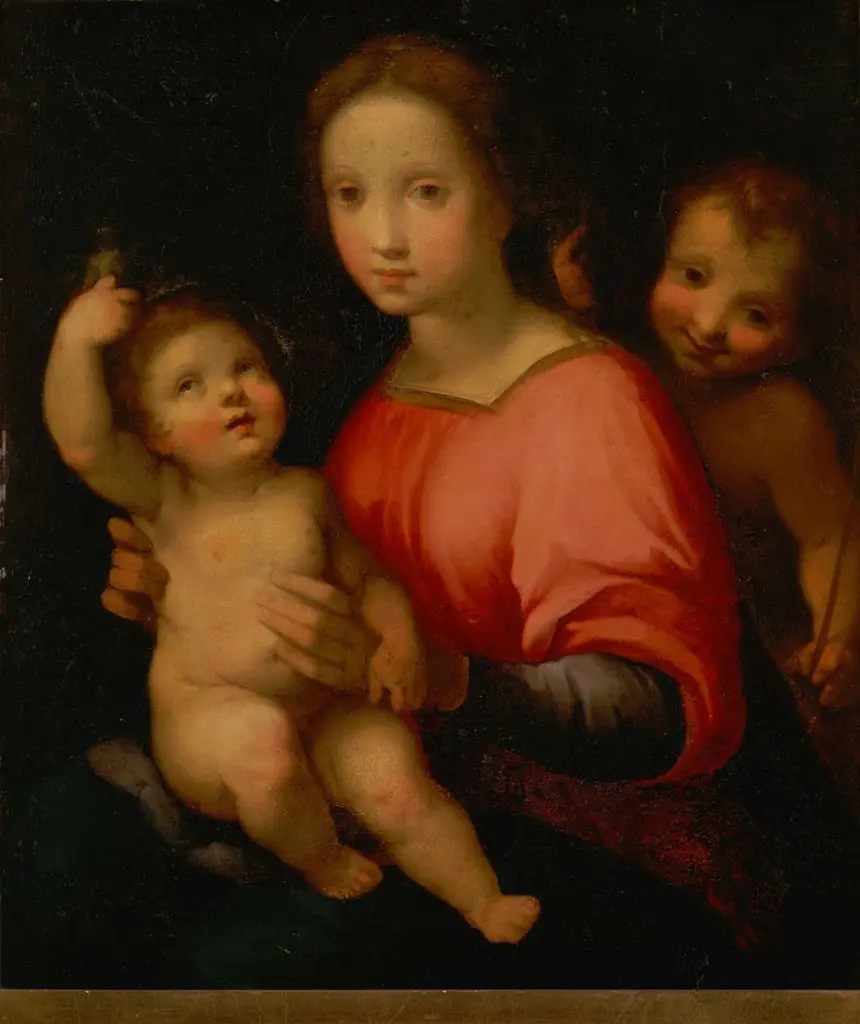
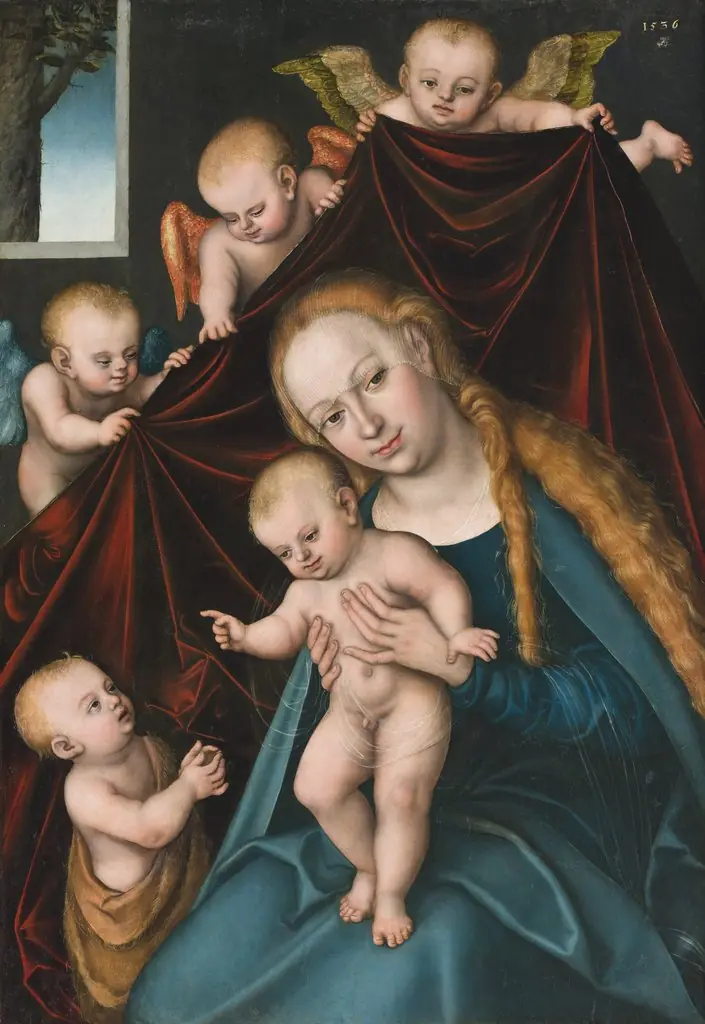
The painting presents a sacred conversation between the Virgin Mary, the Christ Child, and the young John the Baptist. Mary sits at the centre, holding the naked infant Jesus on her lap, while the second naked child, John the Baptist, stands to the left. The Virgin wears a dark green mantle over a red garment with a blue cloth visible at her shoulder, her long brown hair falling over her shoulders as she gazes directly outward. The Christ Child raises one hand in a gesture and looks slightly left, while the young John clasps his hands together and gazes upward toward the held infant. This interaction through gestures and glances recalls the compositional logic of Raphael's Terranuova Madonna, where children similarly engage across the pictorial space. The thin dark cord around the standing child's neck serves as an attribute identifying John the Baptist, alluding to his future role as a hermit in the wilderness. The rocky landscape behind, with its tall thin trees, small structures, and distant mountains beneath a fair sky, provides a setting that is both natural and symbolically resonant, evoking the wilderness that defines John's later life while framing the holy figures in a space of contemplative retreat.
Technique & Style
Executed in oil on panel, the painting displays the smooth, blended brushwork characteristic of Cranach's handling during this period, with careful attention to the soft transitions of skin and the folds of drapery. Light falls evenly across the figures, modelling their rounded forms in a manner that reflects Italian Renaissance influence. The palette consists of deep greens, reds, and blues against earthy browns and flesh tones, producing the bright colours noted by scholars as typical of Italian Renaissance painting. The surface shows fine vertical cracks throughout, consistent with its age and panel support. The composition places dominant figures in the foreground against the landscape backdrop, with the simplification of anatomies, particularly in the heads, representing Cranach's retention of his Northern heritage even as he adopted Italianate conventions of volume and compositional structure.
History & Provenance
The painting was originally located in the Florence Charterhouse, the Certosa del Galluzzo, outside the city of Florence. In 1973, the work was stolen from this location, initiating a nearly twenty-eight-year period of disappearance. It was recovered by the Arma, the Italian military police force, in 2001, and subsequently entered the collection of the Uffizi Gallery. The painting has been exhibited in contexts related to its recovery, including the 2010 exhibition "L'arma per l'arte. Aspetti del sacro ritrovati" in Florence.
Context
The painting emerges from a critical moment in Cranach's career when German artists were actively engaging with Italian Renaissance art. The work's Raphaelesque inspiration places it within a broader pattern of Northern painters absorbing and responding to Italian models during the early sixteenth century. The Italian Wikipedia source explicitly frames this as demonstrating the interests of Northern painters toward Italy, with the bright colours, attention to volume, and compositional cut all described as stylistic derivations from Italian art then well-evident in the German painter's work. The painting thus serves as evidence of the cosmopolitan artistic exchange that characterised the Renaissance across Europe, challenging any notion of isolated national schools. Gloria Fossi's 2004 publication on the Uffizi has documented the work within the museum's holdings.
Legacy
The painting's reputation has been shaped significantly by its status as a recovered artwork, making it a symbol of successful art crime investigation and the enduring value of cultural patrimony. Its return to public access in 2001 after the 1973 theft represents one of the longer intervals between theft and recovery for a major Renaissance painting. Art historically, the work continues to be cited as a paradigmatic example of Cranach's Italianate phase and of the broader phenomenon of Northern European artists responding to Italian Renaissance innovations. Its presence in the Uffizi, one of the world's most visited museums, ensures ongoing visibility, while its documentation in the Cranach Digital Archive provides scholarly access to its imagery and research context.
Artist & collection
Artist
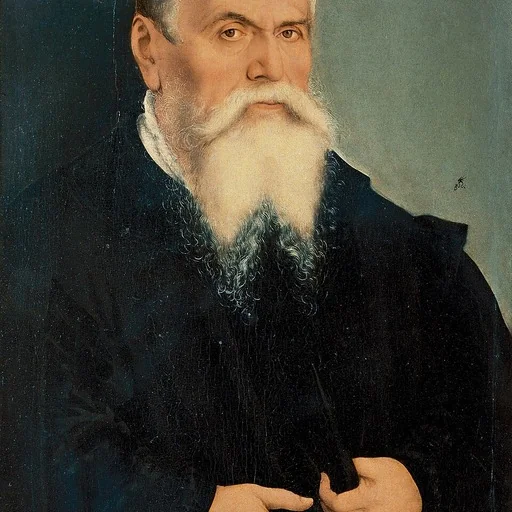
Lucas Cranach the Elder was a German Renaissance painter and printmaker in woodcut and engraving.