Artwork
Virgin and Child enthroned with saints John the Baptist, Francis, Paul and Jerome
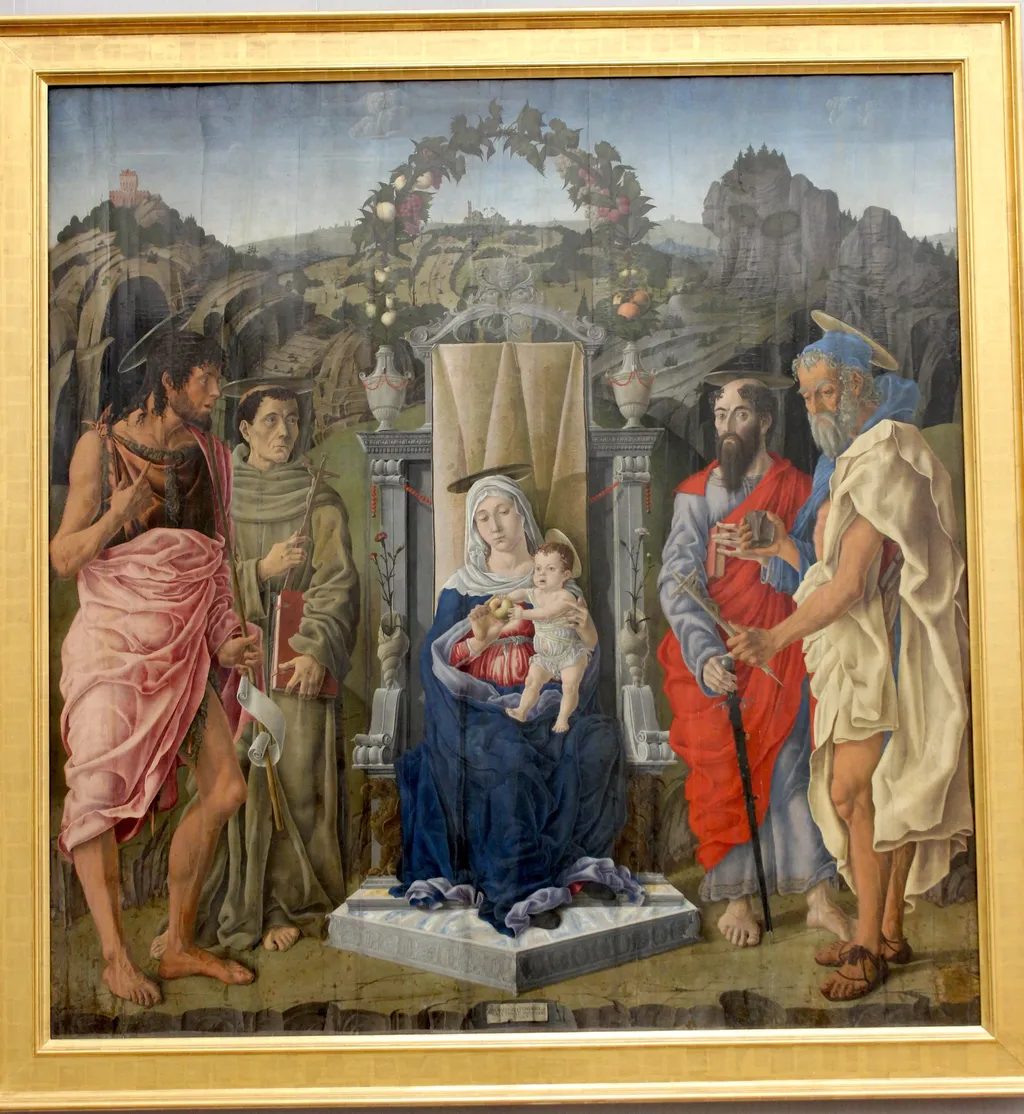
Virgin and Child enthroned with saints John the Baptist, Francis, Paul and Jerome is a paint painting by the Northern Renaissance artist Marco Zoppo. It dates from 1471 and is held in the collection of the Gemäldegalerie Berlin. This painting, created in 1471, depicts the Virgin and Child enthroned with four saints.
About this work
Overview
Executed in paint on a poplar panel measuring 262 by 254 centimeters, this sacra conversazione is now held in the Gemäldegalerie, Berlin.
The Virgin and Child enthroned with saints John the Baptist, Francis, Paul and Jerome is a monumental altarpiece painted in 1471 by the Bolognese Renaissance artist Marco Zoppo. Executed in paint on a poplar panel measuring 262 by 254 centimeters, this sacra conversazione is now held in the Gemäldegalerie, Berlin. The work represents the mature achievement of Zoppo, who trained under Lippo Dalmasio and later with Francesco Squarcione in Padua, and it stands as his masterpiece, demonstrating his synthesis of Paduan sculptural rigor with Bolognese coloristic tradition. Its nearly square format and imposing scale mark it as a significant example of late fifteenth-century Italian altarpiece design.
Subject & Meaning
The painting presents a symmetrical sacra conversazione centered on the Virgin Mary enthroned, holding the infant Christ who reaches toward her. Mary extends an apple to Jesus, an iconographic detail that affirms their roles as the new Adam and Eve for humanity's salvation. The four male saints flank the throne in hierarchical pairs: at the far left stands John the Baptist, identifiable by his gaunt ascetic appearance, pink robe, and cross-shaped staff; beside him is Francis of Assisi in brown Franciscan habit, holding a book and cross. To the right of the throne stand Paul, bearded and clad in red and blue with his attribute of a sword, and Jerome, older and distinguished by white and blue robes with a stone and book. All principal figures wear halos. Above the throne, a canopy of fruiting vines creates a symbolic arbor, alluding to the Eucharist and the blood of Christ. The detailed landscape background, featuring a stone bridge with arches at left, rocky cliffs at right, and rolling hills receding to a pale blue horizon, establishes an idealized setting that suggests both earthly paradise and heavenly realm.
Technique & Style
The altarpiece is painted on poplar wood, a support typical of large-scale Italian panel paintings of the period. The palette is dominated by ultramarine blue in the Virgin's mantle, rose pink, vermilion red, and earth tones. Light falls evenly from the left, modeling the figures with soft shadows that demonstrate Zoppo's attention to sculptural form. The surface shows fine craquelure throughout, with smooth, precise brushwork particularly evident in the drapery and faces. The composition's symmetrical arrangement, with huge flanking figures of John the Baptist and Jerome at the extremes and the more closely positioned Saints Francis and Paul adjacent to the throne, creates a compressed spatial depth characteristic of Zoppo's style. This handling reflects the influence of his training with Squarcione in Padua, where he would have encountered the sculptural monumentality of Andrea Mantegna, a contemporary whose work shaped Paduan artistic culture. The even lighting and precise draftsmanship contrast with the more atmospheric approaches developing in contemporary Venetian painting.
Context
Marco Zoppo was born in Cento and active mainly in Bologna, though his training with Francesco Squarcione around 1455 brought him into contact with the Paduan artistic circle that included Andrea Mantegna. He painted numerous variations of the Virgin and Child Enthroned with Saints during his Bolognese period, suggesting a sustained engagement with this devotional format. Francesco Francia numbered among his pupils. Zoppo's death in Venice, where he had relocated after his time with Squarcione, indicates the mobility of artists in mid-fifteenth-century Italy. The Pesaro altarpiece represents the culmination of his development, synthesizing the compositional clarity of his Bolognese training with the monumental figure style absorbed in Padua. Critical reception has identified this work as his masterpiece, distinguished by its confident integration of architecture, landscape, and figural groups into a unified sacred conversation.
Legacy
The altarpiece's reputation rests on its status as the definitive work of Marco Zoppo's career, demonstrating how a provincial Bolognese painter could absorb and transform influences from major centers of Renaissance art. Its composition, with massive flanking saints compressed into a shallow pictorial space around an enthroned Madonna, influenced subsequent sacra conversazione formats in northern Italy. The work's preservation in the Gemäldegalerie has ensured its accessibility to scholars studying the transition from early Renaissance altarpiece conventions to the more dynamic compositions of the High Renaissance. As a documented product of Zoppo's full maturity, created for a specific Franciscan commission in Pesaro, it provides essential evidence for understanding the dissemination of Paduan and Bolognese artistic ideas across the Marche region in the late fifteenth century.
Own this work as a print
Artist & collection
Artist
Marco Zoppo (1433 – 19 February 1498) was an Italian painter of the Renaissance period, active mainly in Bologna.

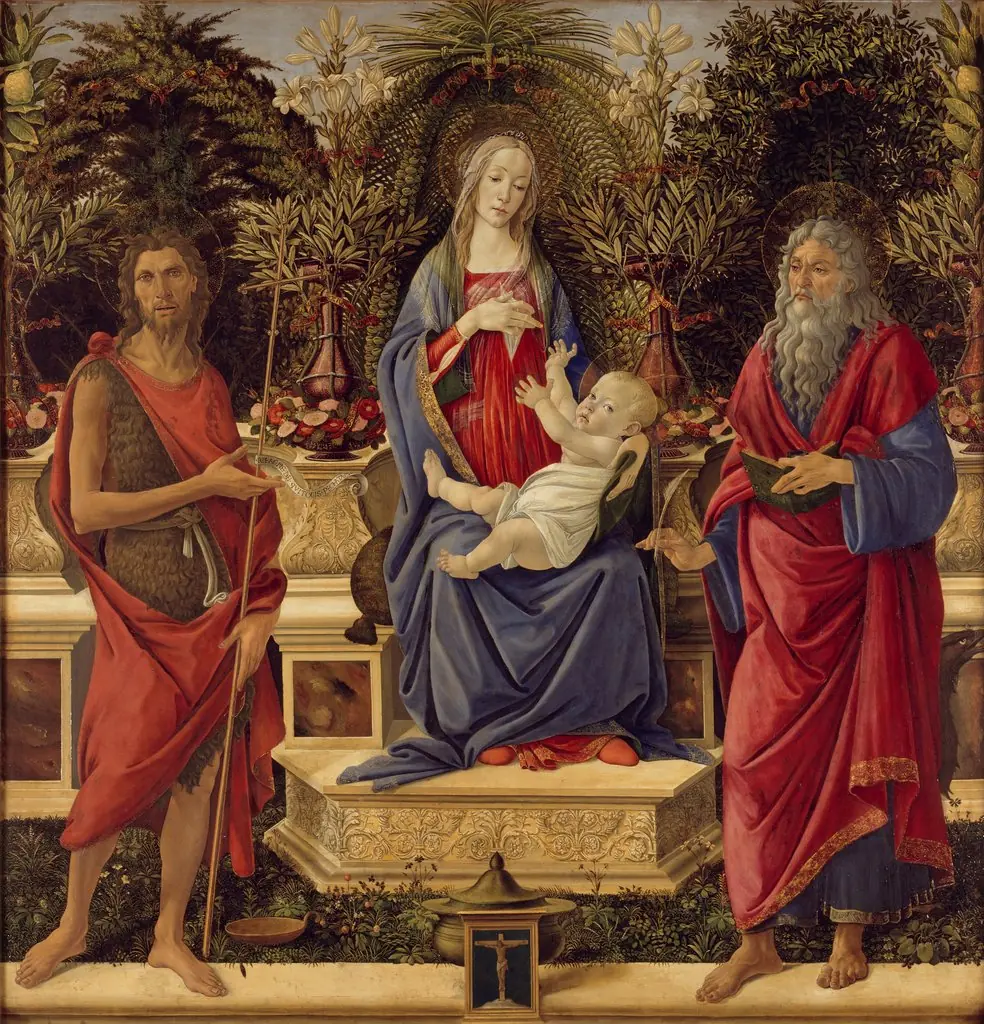 Madonna Bardi
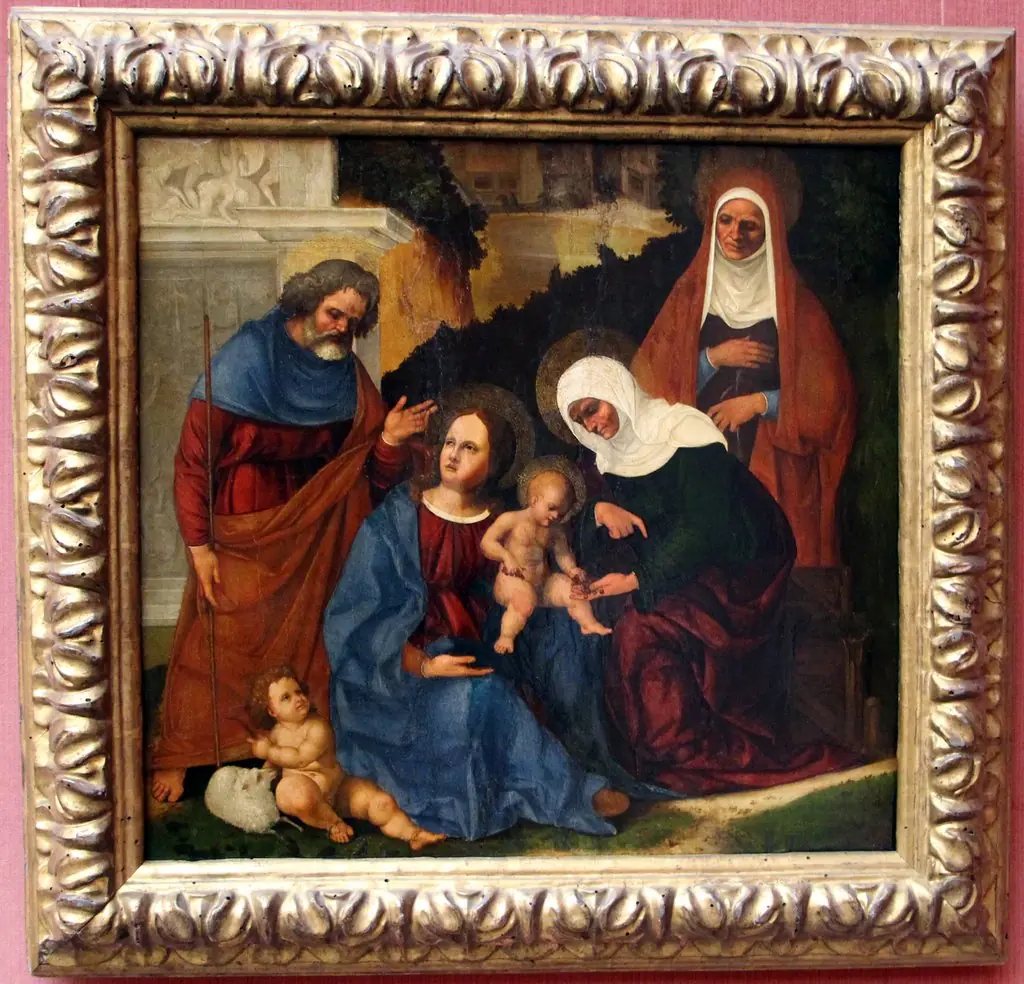 Die Heilige Familie mit Elisabeth, Anna und dem Johannesknaben
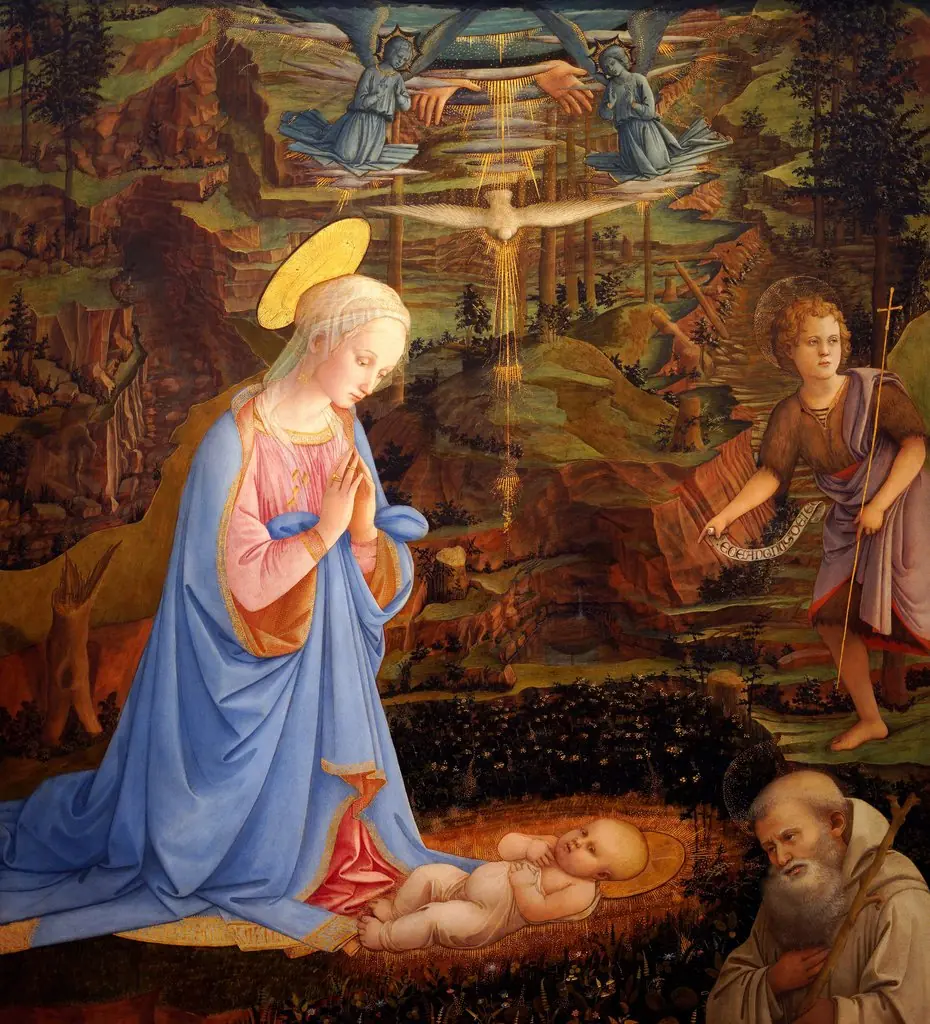 Adoration of Camaldoli
 Madonna and Child
 Adoration of the Magi
 The Adoration of the Kings
 Madonna and Child with Saint Jerome and Saint John the Baptist
 The Holy Family with Tobias and the Angel, Sts. Dorothy, and Infant John the Baptist