Artwork
Madonna and Child
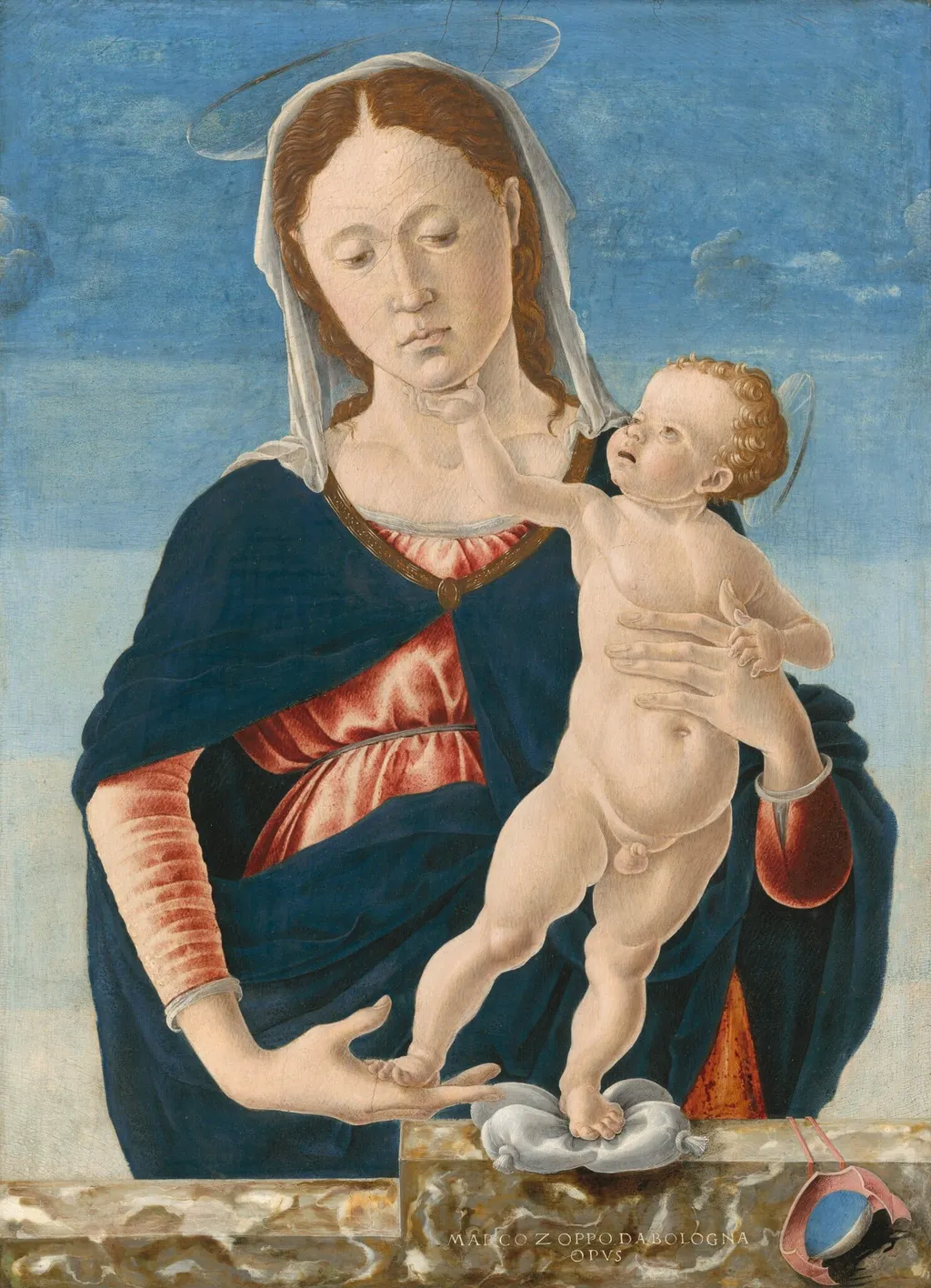
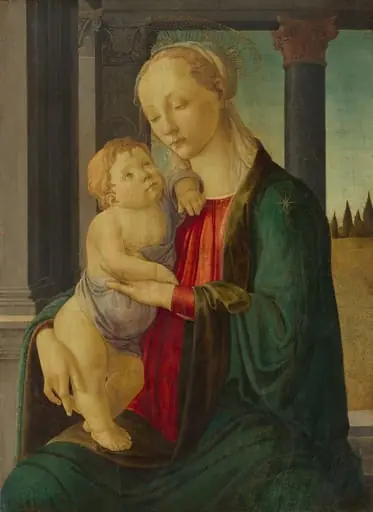
Madonna and Child is a tempera painting by the Early Renaissance artist Marco Zoppo. It dates from 1468 and is held in the collection of the National Gallery of Art.
- Inscription
- Inscribed:lower center on parapet: MARCO.ZOPPO.DA BOLOGNA / OPVS; hanging over the parapet, a coat of arms with an oval divided vertically in azure and white within a pink concave shield
About this work
Subject & Meaning
The work's primary iconography focuses on the maternal bond between mother and son, representing the theological concept of the Incarnation.
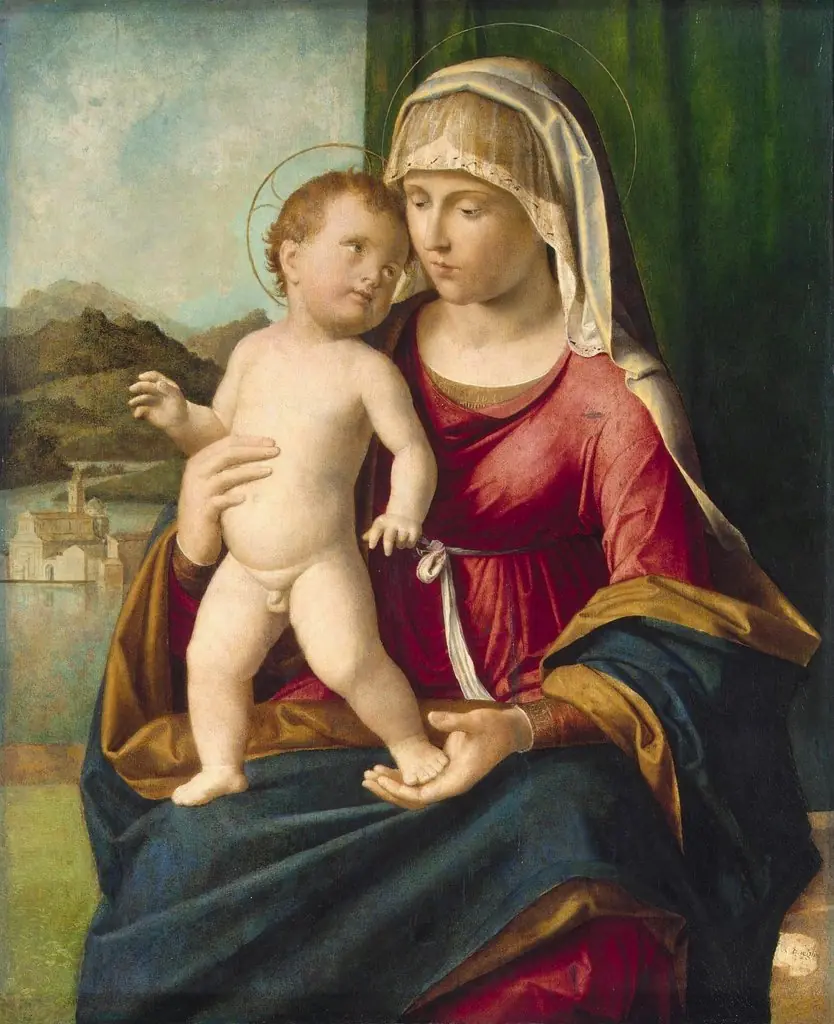
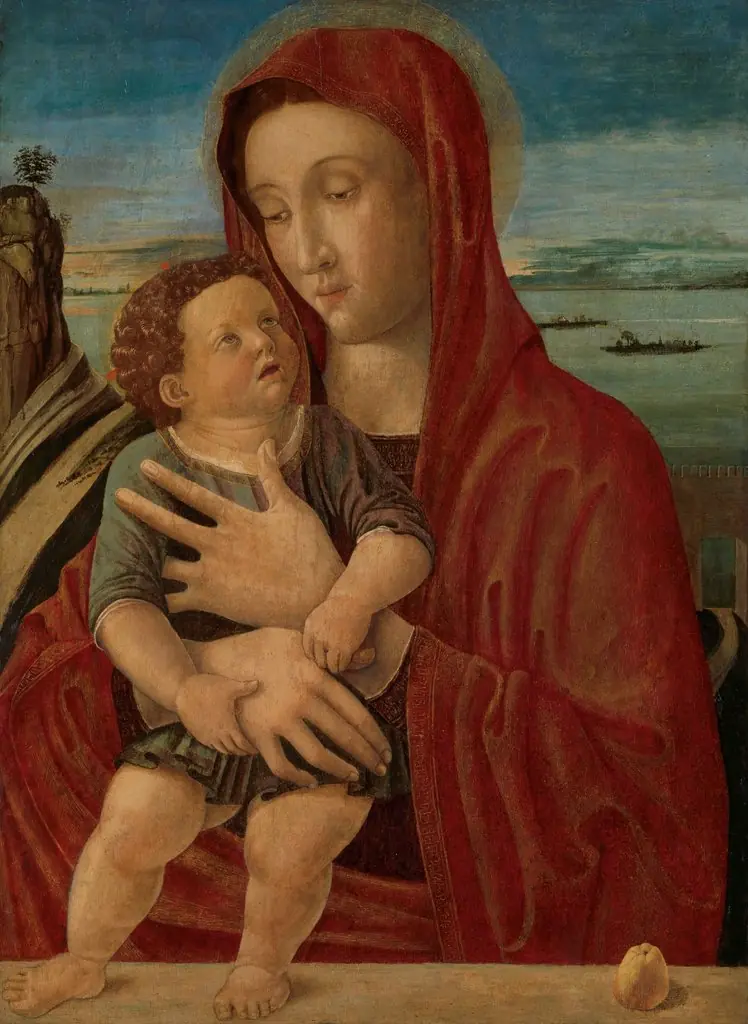
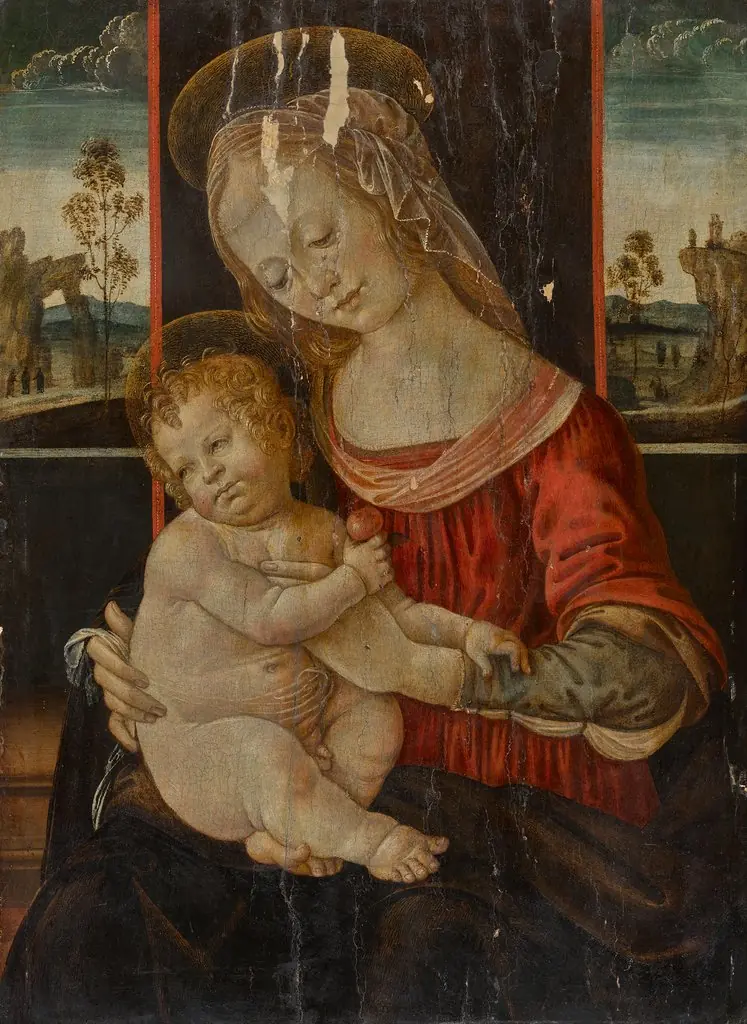
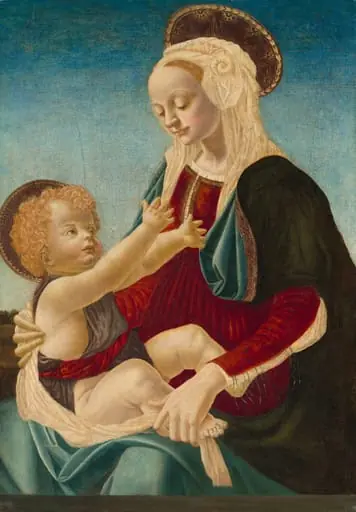
Created in 1468 by Marco Zoppo, this tempera painting on poplar panel depicts the Virgin Mary holding the Christ Child, a central subject in Christian religious art. The work's primary iconography focuses on the maternal bond between mother and son, representing the theological concept of the Incarnation. As a piece of religious genre painting, it serves as a devotional image intended to inspire contemplation of the holy figures.
The depiction aligns with traditional representations of the Madonna and Child, emphasizing their sacred roles within the Christian faith. The artwork's classification as religious art underscores its function as a visual expression of spiritual beliefs, where the figures of Mary and Jesus are presented to convey themes of divine love and salvation.
Technique & Style
Executed in 1468, this religious work utilizes tempera paint applied to a poplar panel support. The composition depicts the Virgin Mary holding the Christ Child, adhering to traditional iconography of the period. Physically, the panel measures 47 centimeters in height and 35.7 centimeters in width.
While specific details regarding surface condition or distinct handling techniques are not explicitly detailed in the available records, the choice of tempera on wood reflects standard fifteenth-century Italian workshop practices. The material composition remains consistent across historical documentation, confirming the use of organic pigments bound in egg on a wooden substrate.
History & Provenance
Created in 1468 by Marco Zoppo, this tempera on poplar panel originated in Bologna before being acquired from Ascoli by Sir John Charles Robinson in November 1880. Robinson sold the work to Sir Francis Cook in February 1882. It remained within the Cook family lineage at Doughty House, passing sequentially to Sir Frederick Lucas Cook, Sir Herbert Frederick Cook, and finally Sir Francis Ferdinand Maurice Cook.
In December 1953, the fourth baronet sold the painting to dealer Margaret Drey in London. Following a brief tenure with Rosenberg & Stiebel in New York, the Samuel H. Kress Foundation purchased the piece in January 1954. The foundation subsequently gifted the artwork to the National Gallery of Art in Washington, D.C., in 1961.
Context
Marco Zoppo's 1468 tempera on poplar panel Madonna and Child exemplifies early Italian Renaissance devotional painting, combining a gold-ground composition with intimate modeling of the Virgin and Child. The work's provenance traces a continuous ownership from Ascoli through the collections of Sir John Charles Robinson, Sir Francis Cook, and later the Cook family, before its acquisition by the Samuel H. Kress Foundation in 1954. Its attribution to Zoppo, an Emilian painter active in the late 15th century, underscores the diffusion of Florentine stylistic influences into northern Italian workshops.
Scholarship highlights the piece as an example of transitional iconography, where the intimate domestic setting of the Holy Family reflects evolving devotional practices in the late Quattrocento.
Overview
Marco Zoppo's Madonna and Child, created around 1468, is an early Renaissance painting executed in tempera on a poplar panel. This work depicts the Virgin Mary tenderly holding the Christ Child, presenting an intimate religious scene. Zoppo, an Italian painter primarily active in Bologna, contributed to the visual culture of his era through such devotional images.
Own this work as a print
Artist & collection
Artist
Marco Zoppo (1433 – 19 February 1498) was an Italian painter of the Renaissance period, active mainly in Bologna.