Artwork
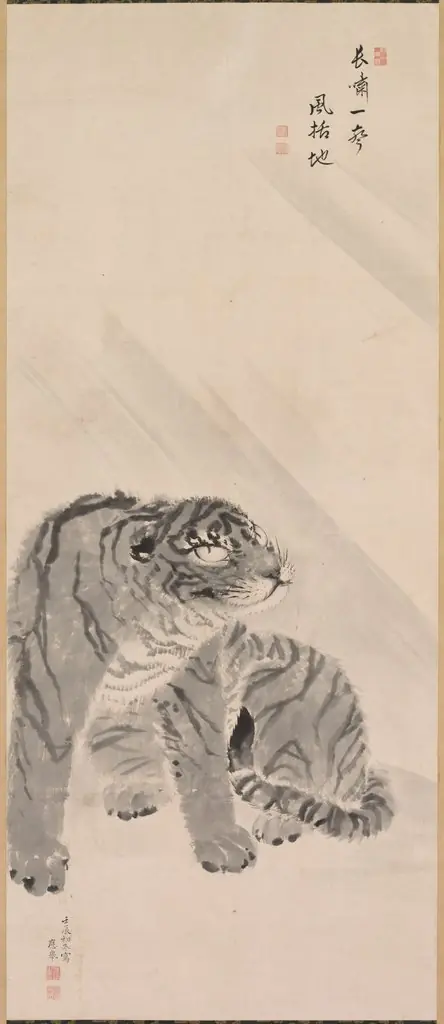
Tiger in Wind
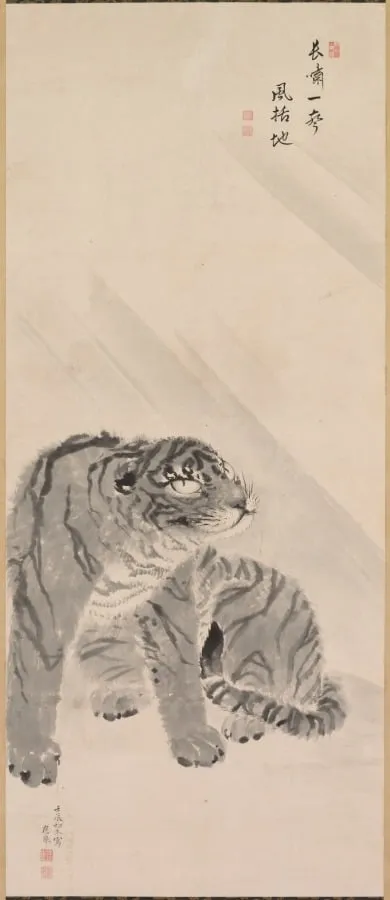
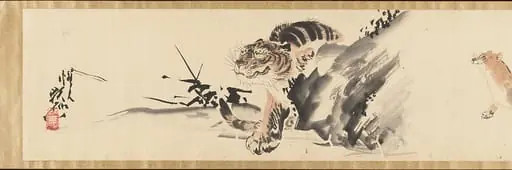
Tiger in Wind is an unspecified painting by the Rinpa school artist Maruyama Ōkyo. It is held in the collection of the Cleveland Museum of Art.
- Accession no.
- 1971.232
- Credit line
- Sundry Purchase Fund
About this work
Overview
The work titled “Tiger in Wind” is a Japanese painting dated 1772, attributed to the Edo‑period artist Maruyama Ōkyo. It depicts a tiger crouched low amid a gusting wind that bends grass and lifts dust, creating a dynamic scene that links the animal’s roar with the sound of the storm.
Subject & Meaning
The inscription, derived from a Yuan‑dynasty poem by Yu Ruyu, likens the fierce wind’s howl to the tiger’s roar, suggesting a symbolic connection between natural forces and the animal’s power. The text, placed at the top of the painting, serves as a poetic commentary rather than mere decoration.
Technique & Style
Ōkyo’s brushwork combines bold, expressive strokes with a restrained palette, reflecting the Edo‑period trend of integrating Chinese literary references into visual art. The rendering of the tiger’s striped coat and the swirling grasses demonstrates his skill in capturing movement and texture through ink and pigment.
History & Provenance
The seals on the painting indicate that the inscription was added by Prince Yūjō (1723–1773), an imperial scion who later became a Buddhist monk and abbot of Enman’in at Miidera. Yūjō was Ōkyo’s most influential early patron, and the painting bears Ōkyo’s signature, confirming its creation a year before the prince’s death.
Context
During the late 18th century, Japanese artists frequently paired Chinese poetry with dynamic brush techniques, a practice exemplified in this piece. The work likely represents an imagined collaboration between Ōkyo and Yūjō, echoing earlier commissions such as a set of handscrolls for which Yūjō wrote a preface.
Artist & collection

Artist
Maruyama Ōkyo (円山 応挙; Japanese pronunciation: , June 12, 1733 – August 31, 1795), born Maruyama Masataka, was a Japanese artist active in the late 18th century.