Artwork
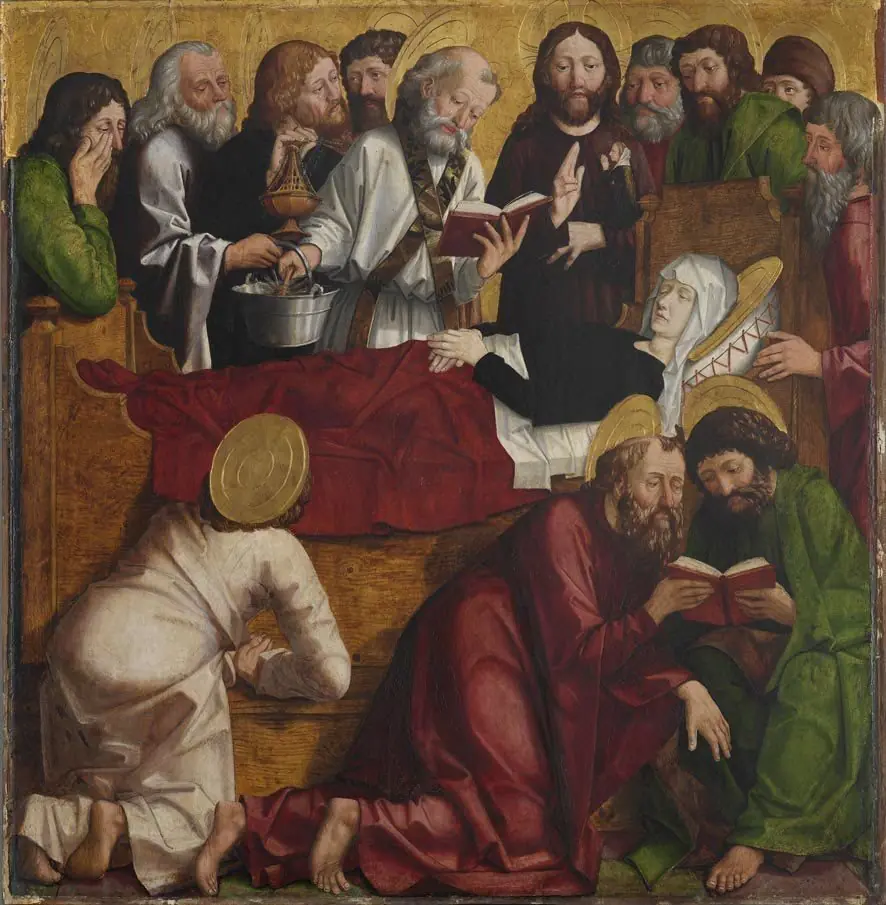
Death of the Virgin
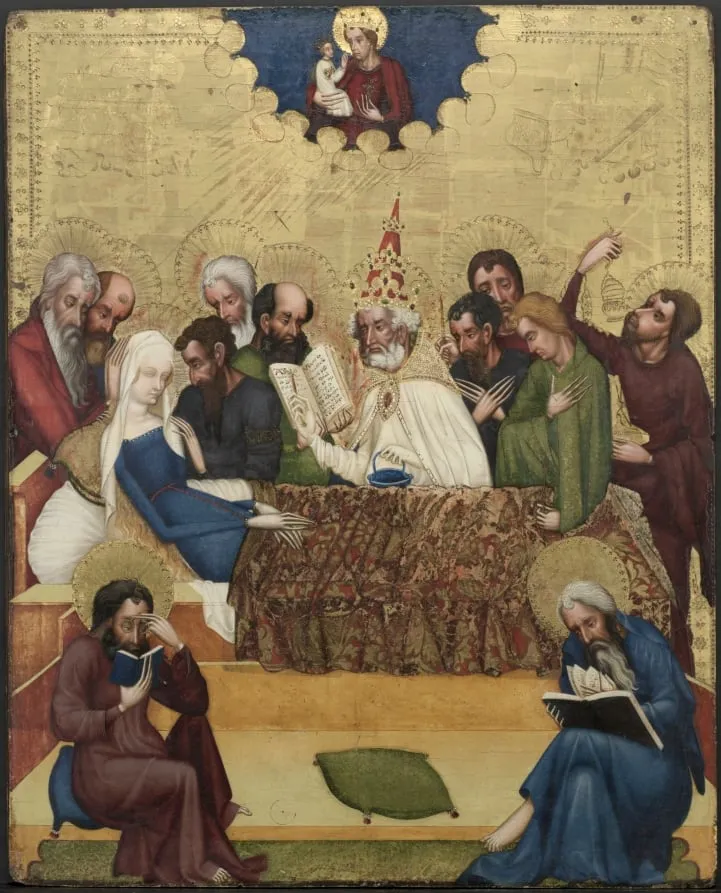
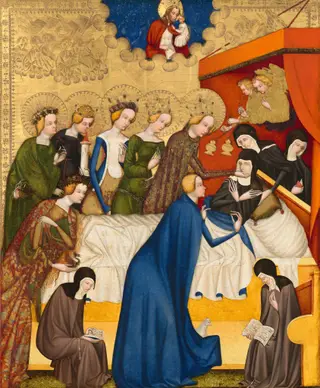
Death of the Virgin is an unspecified painting by the Gothic painting artist Master of Heiligenkreuz Abbey. It dates from 1400 and is held in the collection of the Cleveland Museum of Art.
- Accession no.
- 1936.496
- Credit line
- Gift of the Friends of The Cleveland Museum of Art in memory of John Long Severance
About this work
This painting was once half of a larger work, its twin, The Death of Saint Clare, now hangs in Washington, D.
You see a room full of grieving men in robes around a woman on her deathbed. Above her, tiny angels float against a shiny gold background.
This painting was once half of a larger work, its twin, The Death of Saint Clare, now hangs in Washington, D.C. The two panels may have been used in convent funerals, showing how saints die with grace. The gold leaf wasn’t just decoration; it was meant to glow by candlelight during services.
To see how other artists painted deathbed scenes, look up austria, possibly bohemia, early 15th century.
Overview
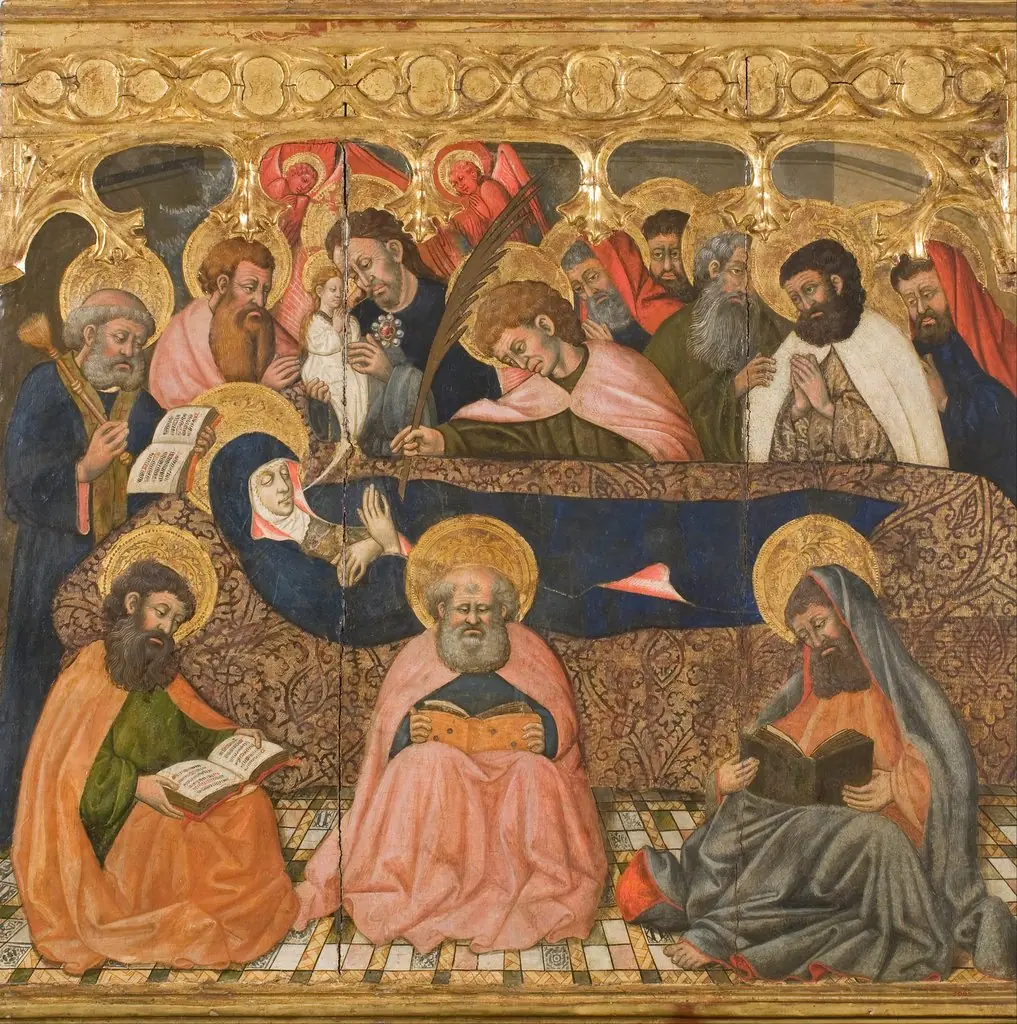
The panel depicts the Virgin Mary on her deathbed surrounded by apostles, with Saint Peter in white vestments and a papal tiara leading the funeral rites. Above the scene, a host of diminutive angels is set against a luminous gold background, suggesting the Virgin’s assumption. The composition was originally one half of a diptych, its counterpart portraying the death of Saint Clare.
Subject & Meaning
The work illustrates the moment of Mary’s passing, emphasizing the communal prayer of the apostles and the sanctified transition to heaven, as indicated by the angels. Saint Peter’s role underscores ecclesiastical authority in the rites, while the gold field above conveys divine presence and the heavenly realm awaiting the Virgin.
Technique & Style
Executed in tempera on panel, the painting employs gold leaf to create a reflective surface that would catch candlelight during liturgical use. Figures are rendered with linear precision, and the angels are rendered in miniature, their delicate forms contrasting with the solid, draped garments of the mourners.
History & Provenance
The diptych was likely commissioned for the convent of Clarissan nuns, serving as a visual aid in funeral ceremonies. The Virgin’s panel now resides in a European collection, while its companion, The Death of Saint Clare, is held by the National Gallery in Washington, D.C., reflecting the work’s divided post‑original journey.
Context
Created in the early 15th century in a Central European workshop, the painting aligns with contemporary devotional art that presented saintly death scenes for contemplation. Its use of gold background and hierarchical composition reflects the International Gothic aesthetic prevalent in Bohemian and Austrian courts of the period.
Artist & collection

Artist
The Master of Heiligenkreuz was an Austrian painter active at the beginning of the 15th century; a tentative lifespan of 1395 to 1430 has been put forth but this appears highly conjectural.