Artwork
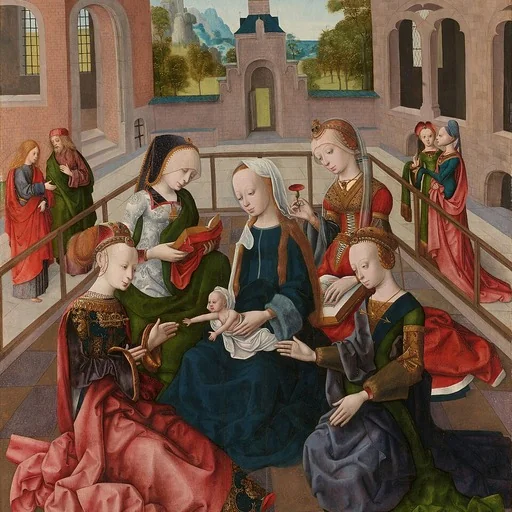
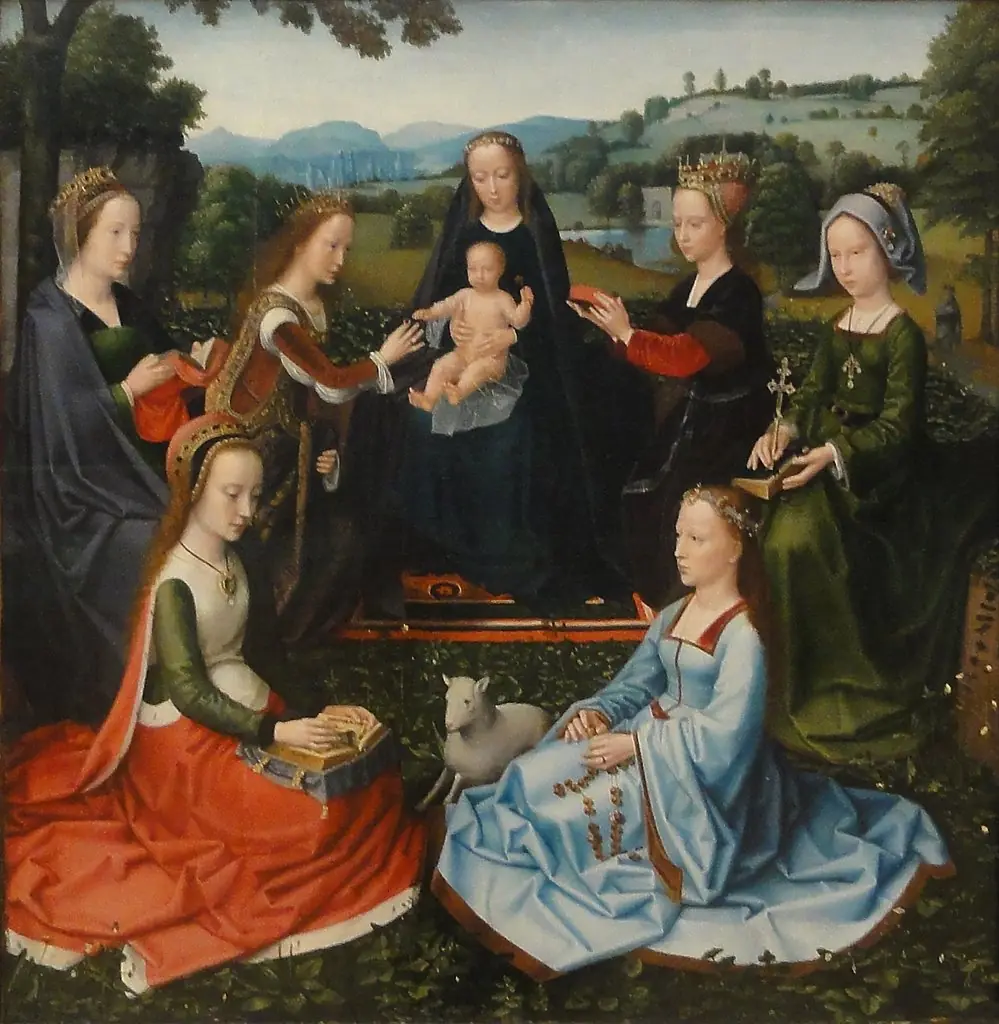
The Virgin and Child with Four Holy Virgins
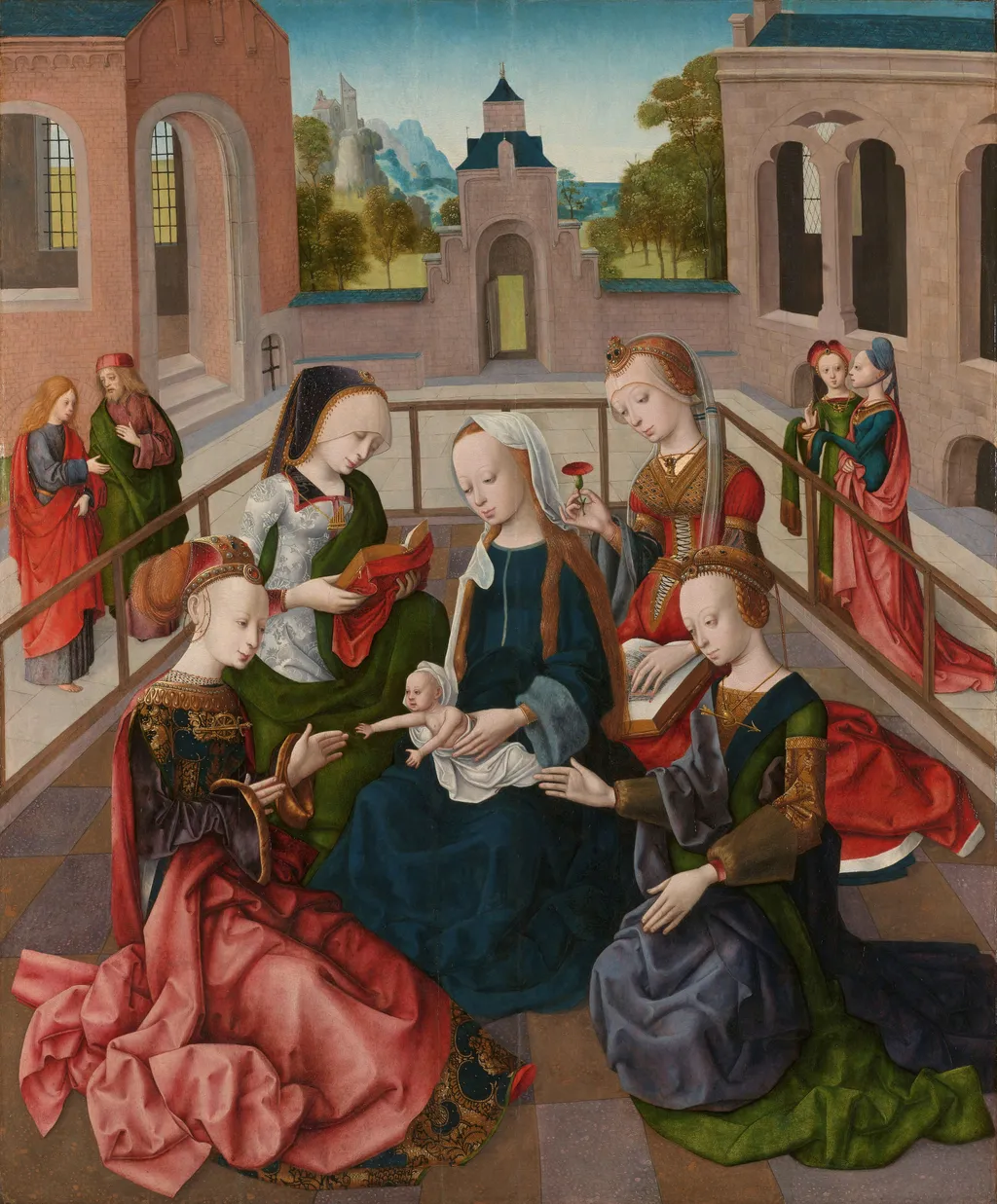
The Virgin and Child with Four Holy Virgins is an oil painting by the Northern Renaissance artist Master of the Virgo inter Virgines. It dates from 1496 and is held in the collection of the Rijksmuseum.
About this work
Subject & Meaning
The open gate of the courtyard distinguishes the setting and has been compared compositionally to a related work by the Master of the Spes Nostra.
The painting presents the Virgo inter Virgines theme, depicting the Virgin Mary with the Christ Child in the company of four virgin saints: Catherine of Alexandria, Cecilia, Ursula, and Barbara, gathered in holy communion. This iconographic formula, derived from the Song of Songs and popular in late medieval Netherlandish devotional imagery, is staged within an enclosed garden or courtyard, the hortus conclusus, a symbol of Mary's purity and chastity. The open gate of the courtyard distinguishes the setting and has been compared compositionally to a related work by the Master of the Spes Nostra.
Saint Ursula is given unusually prominent placement among the four saints, while two male figures remain difficult to identify. Originally an altarpiece for the convent of Koningsveld near Delft, the work served a devotional function for a religious community, embodying the ideals of sacred femininity, mystical union, and the contemplative life.
Technique & Style
The work is executed in oil paint on a wooden panel, a standard Netherlandish technique of the late fifteenth century. Its panel support measures 123.1 cm in height by 101.1 cm in width. Stylistically, the composition centers on a Virgo inter Virgines arrangement set within a hortus conclusus, an enclosed garden with an open gate that recalls compositional features of the Master of the Spes Nostra's panel, also held by the Rijksmuseum.
The painting is considered a late work of the Master of the Virgo inter Virgines, dated to the 1490s on the basis of its compositional details, and it originally served as the altarpiece of the Convent of Koningsveld near Delft before the convent's demolition in 1573. Unusual formal elements include the prominent placement of Saint Ursula and the inclusion of two difficult-to-identify male figures alongside the four virgin saints.
History & Provenance
Created in the 1490s, this oil-on-panel work by the Master of the Virgo inter Virgines was originally commissioned as an altarpiece for the Convent of Koningsveld near Delft. The convent was demolished in 1573, after which the painting's immediate history remains unrecorded until later centuries. For a time, the piece was misattributed to brothers Jan and Hubert van Eyck, a classification that persisted until Max J. Friedlander correctly identified the artist in 1903.
The work eventually entered the collection of Adriaan Leonard van Heteren Gevers, forming part of the Kabinet van Heteren Gevers. It subsequently became part of the National Art Gallery of the Netherlands and is currently held by the Rijksmuseum. While often associated with the year 1490, stylistic analysis characterizes it as a late work from that decade.
The work is held by the Rijksmuseum in Amsterdam, where it is recorded in the museum's collection and accessioned as part of its holdings. Its provenance leads back to Adriaan Leonard van Heteren Gevers, who owned the piece before it entered the museum; the painting began as an altarpiece for the convent of Koningsveld near Delft, a community dissolved in 1573. As part of the Rijksmuseum's permanent displays, the painting has been shown in several exhibitions that focus on Dutch Renaissance art and the broader context of late‑15th‑century religious imagery.
Context
The Virgin and Child with Four Holy Virgins holds a notable place in art history, largely due to its shifting attribution and its role in defining the oeuvre of the Master of the Virgo inter Virgines. Initially, scholars attributed the painting to the brothers Jan and Hubert van Eyck. However, in 1903, Max J. Friedländer reattributed the work, correctly identifying the anonymous master.
Scholarship highlights the painting's unusual iconographic features, particularly the prominent role of Saint Ursula and the enigmatic presence of two unidentifiable male figures. Stylistically, the work's enclosed garden (hortus conclusus) with an open gate shares compositional characteristics with paintings by the Master of the Spes Nostra. Art historians consider the piece a late work by the master, dating it to the 1490s based on compositional details.
Originally serving as an altarpiece for the Koningsveld convent near Delft, the painting survives as an important example of Northern Netherlandish religious art.
Legacy
The Virgin and Child with Four Holy Virgins exerted a lasting influence on Northern European devotional imagery, particularly through its depiction of the Virgo inter Virgines theme, which continued to appear in late-fifteenth-century Dutch and Flemish panel painting. Its compositional model, centering a hortus conclusus setting and the communion of female saints, was echoed in works by contemporaries such as the Master of Spes Nostra, suggesting the painting’s formal conventions shaped regional devotional art. The panel’s attribution history also reflects broader shifts in connoisseurship: once linked to Jan and Hubert van Eyck, it was reattributed to the Master of the Virgo inter Virgines by Max J. Friedlander in 1903, a reassessment that realigned critical understanding of this anonymous master’s oeuvre.
Its preservation in the Rijksmuseum’s collection has sustained scholarly attention, notably through Paula L. Pumplin’s 2010 study in The Rijksmuseum Bulletin, which analyzed its iconography and liturgical function.
Overview
The Virgin and Child with Four Holy Virgins is a 15th-century oil on panel painting by the artist known as the Master of the Virgo inter Virgines. Housed in the Rijksmuseum, this work is believed to date from the 1490s, representing a later period in the artist's career. It depicts the Virgin Mary and the Christ Child surrounded by four female saints, embodying a popular devotional theme of the era.
Own this work as a print
Artist & collection
Artist
Master of the Virgo inter Virgines
The Master of the Virgo inter Virgines was an Early Netherlandish painter and designer of woodcuts active around Delft between 1483 and 1498.

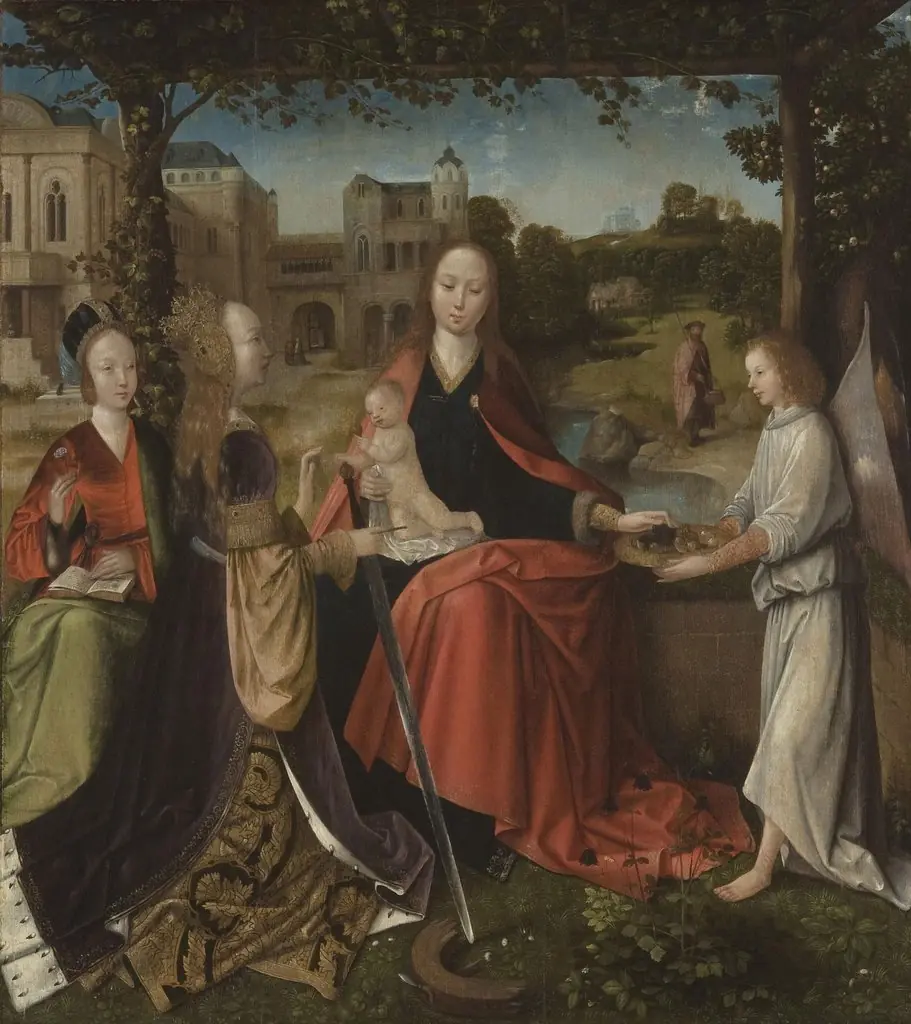 Virgin and Child, with Saint Catherine of Alexandria, a Female Saint, and an Angel
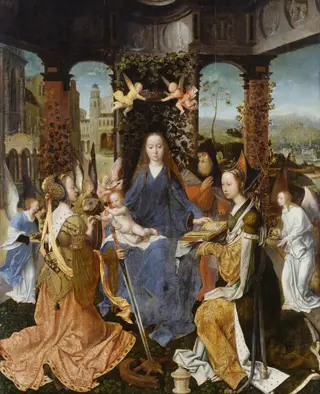 The mystic marriage of Saint Catherine
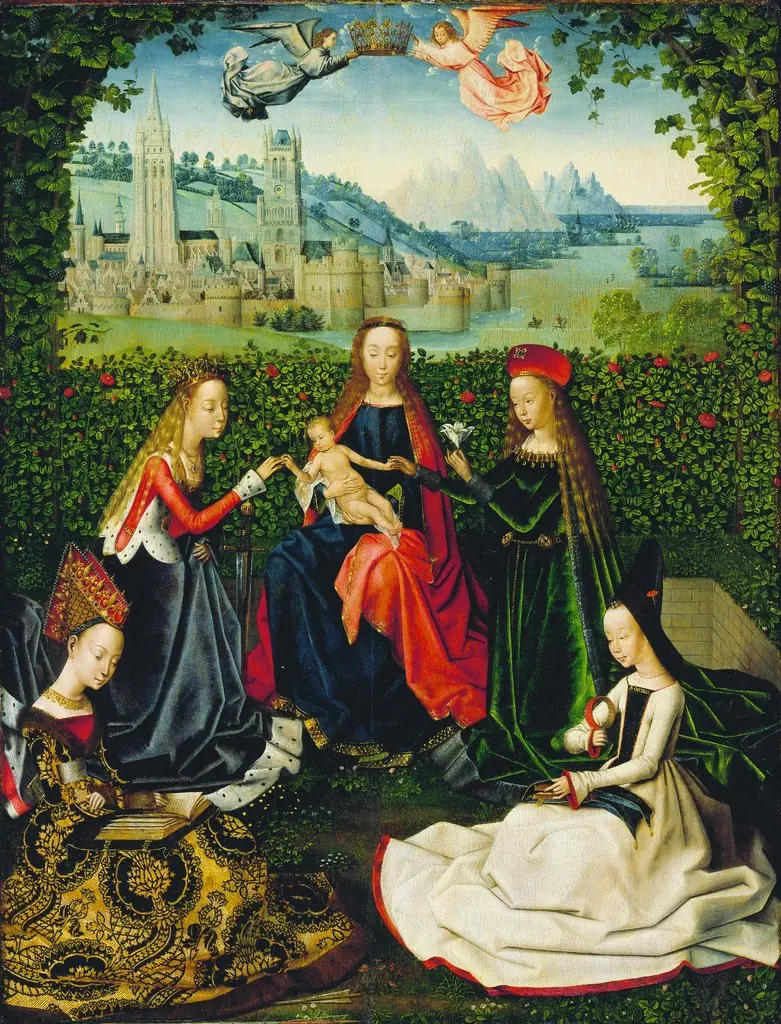 Virgin of the Rose Garden
 Madonna and Child with Saints Catherine and Barbara
 Virgin and Child with Saints Catherine of Alexandria and Barbara
 The Adoration of the Christ Child
 The Birth of the Virgin
 Madonna with Female Saint
 Lactatio of Saint Bernard of Clairvaux with Donors