Artwork
Return from the Hunt
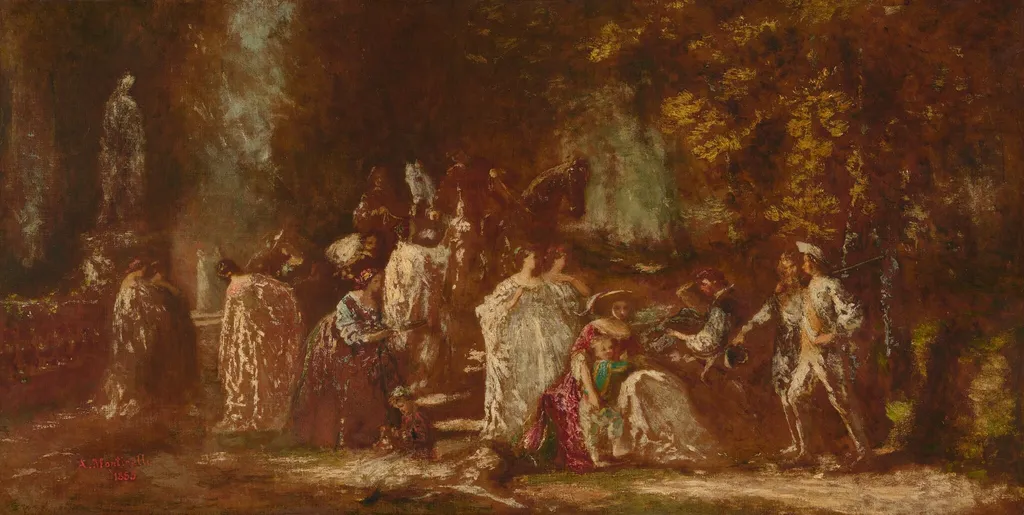
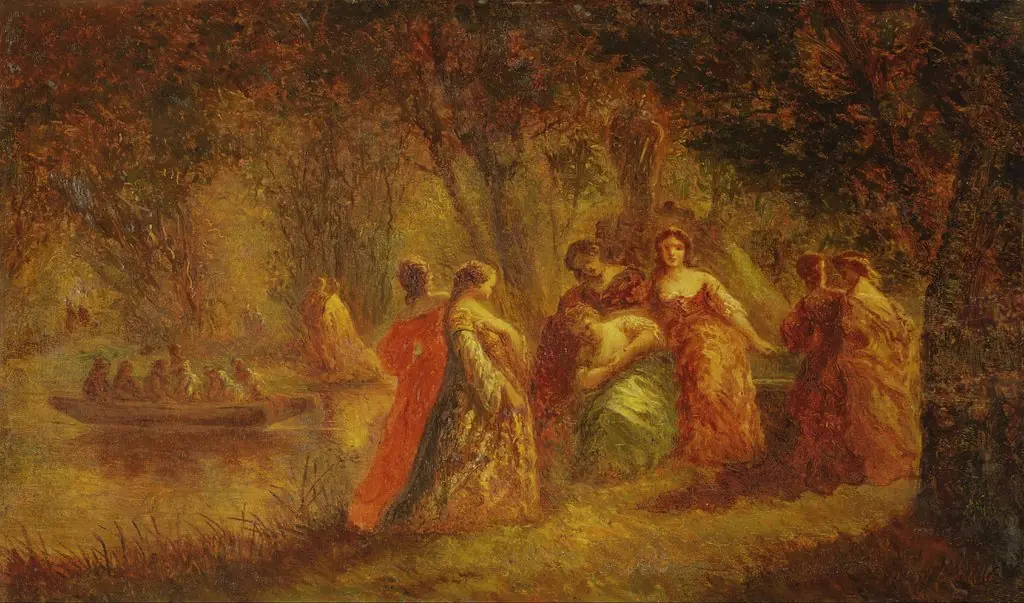
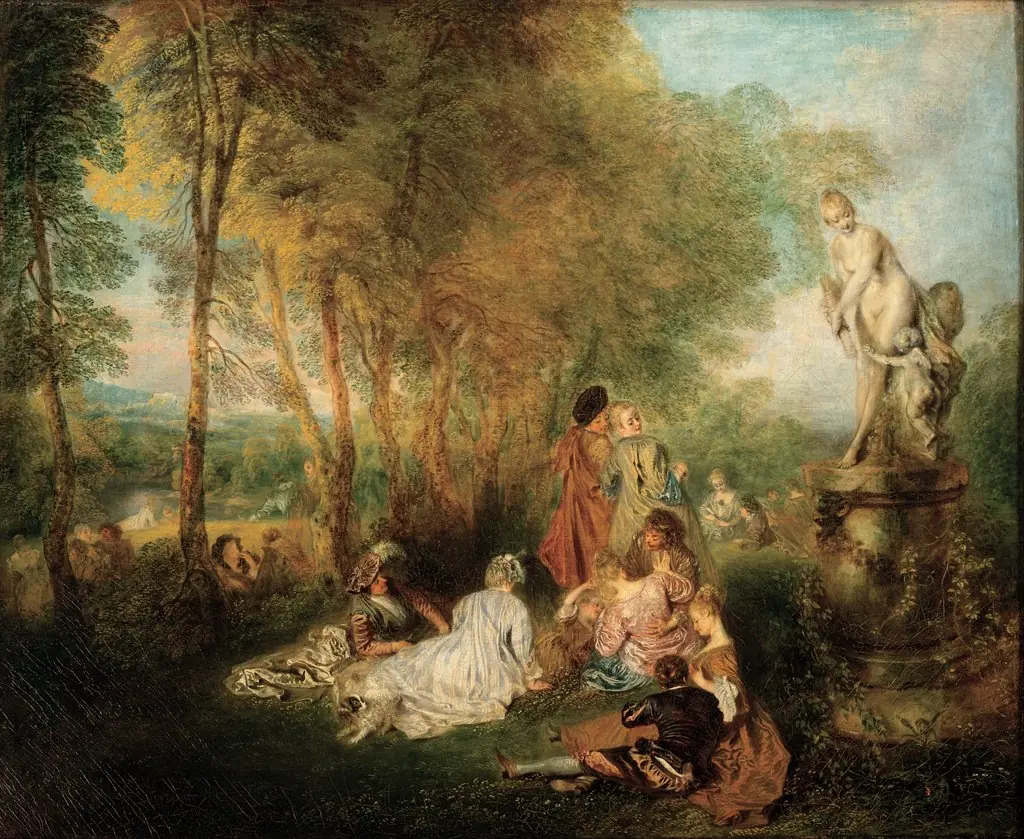
Return from the Hunt is an oil painting by the French Romanticist artist Adolphe Monticelli. It dates from 1860 and is held in the collection of the National Gallery of Art.
- Inscription
- Inscribed:lower left: A. Monticelli / 1855[1]
About this work
Technique & Style
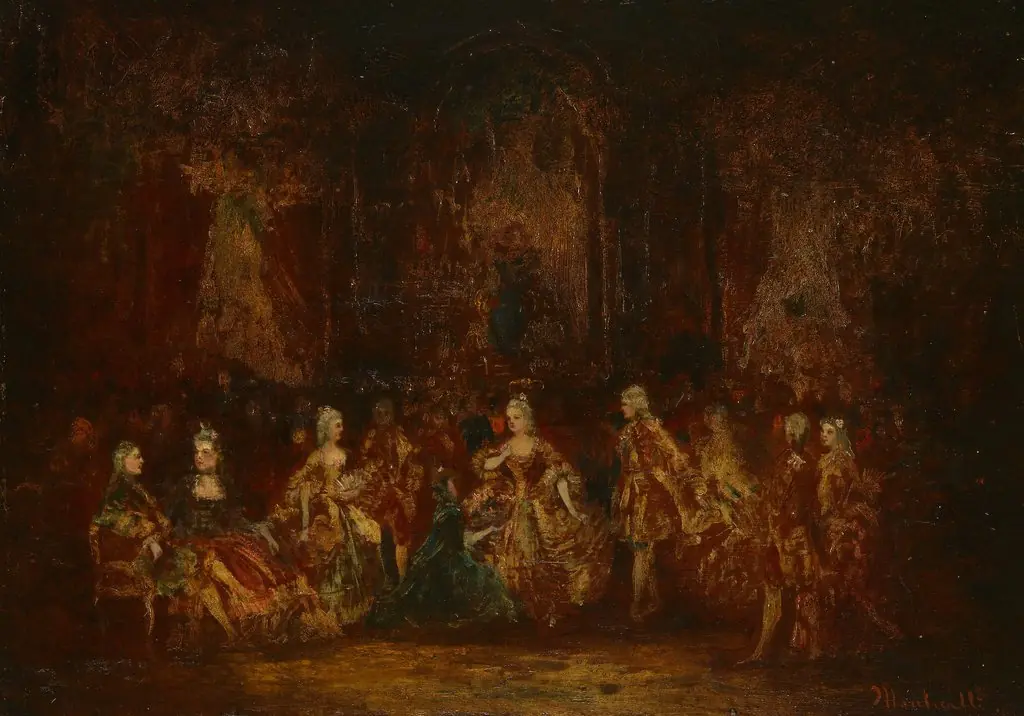
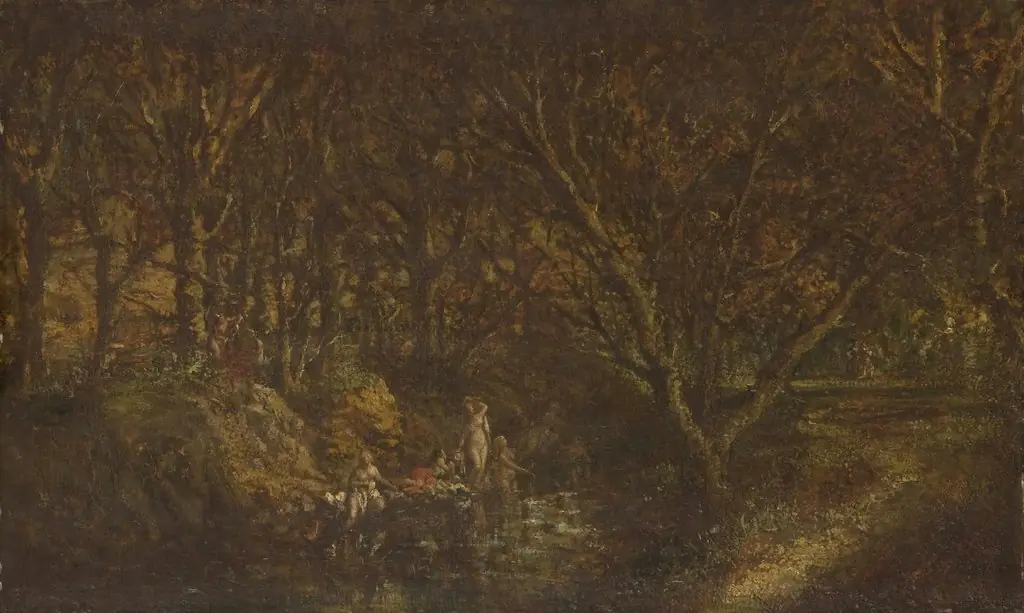
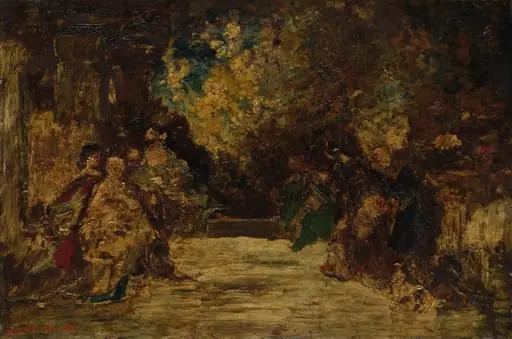
Contemporary accounts describe its handling as vigorous and textured, employing thick impasto to render foliage and drapery with a tactile surface.
The work is an oil painting executed on canvas, a medium typical of Monticelli's mature output. Contemporary accounts describe its handling as vigorous and textured, employing thick impasto to render foliage and drapery with a tactile surface. Stylistically, it combines Romantic compositional drama with a saturated palette, while the brushwork conveys movement in the figures' gestures and the surrounding landscape.
These material and visual qualities align with the artist's known technique of building up layered, almost sculptural applications of oil paint to achieve depth and luminosity.
History & Provenance
Return from the Hunt was commissioned by Léon Chave of Marseille on the occasion of his marriage, according to Alauzen and Ripert's 1969 monograph on Monticelli. The stretcher bears a stamp reading "L. Chave, Marseilles, Cours du Chapitre 27," confirming the original patron. The work remained with the Chave family by inheritance after its 1860 creation.
Around 1914, the painting was sold to the New York collector William A. Clark. A manuscript catalogue of Clark's holdings records that he acquired it from "T. Martin-Chave," likely Chave's daughter Isabelle Martin-Chave and her husband. According to Pierre Ripert, Clark purchased the painting through the dealers Gill and Boyer, and it was one of three Monticellis acquired from the Chave family.
Following Clark's death in 1925, the painting entered the Corcoran Gallery of Art in Washington through a bequest in April 1926. In 2015, the National Gallery of Art acquired the work, where it remains today.
Return from the Hunt is held by the National Gallery of Art in Washington, D.C., where it currently resides after being acquired by that institution in 2015. The work had previously belonged to the Corcoran Gallery of Art in Washington, which received it as part of a bequest in April 1926 from William A. Clark of New York. Clark had purchased the painting c. 1914 from the Chave family of Marseille, to whom it had passed by inheritance after its original commission by Léon Chave around 1860.
No exhibition history is documented in the available sources.
Legacy
Adolphe Monticelli's Return from the Hunt exerted limited documented influence on subsequent art movements, with its legacy primarily anchored in 20th-century collecting patterns rather than stylistic innovation. The work entered the collection of William A. Clark through the Chave family in 1914, later bequeathed to the Corcoran Gallery of Art in 1926 and acquired by the National Gallery of Art in 2015, reflecting evolving attitudes toward 19th-century French painting among American institutions. Its provenance illustrates shifting market dynamics for Monticelli's work during this period, particularly the role of private collectors in preserving mid-century French genre scenes.
The painting's technical approach to color and brushwork contributed to early discussions of Post-Impressionist materiality, though direct lineage to later movements remains unsubstantiated in primary sources. Its sustained presence in institutional holdings underscores its significance as a representative example of Monticelli's mature genre scenes, studied more for historical context than as a catalyst for artistic change.
Overview
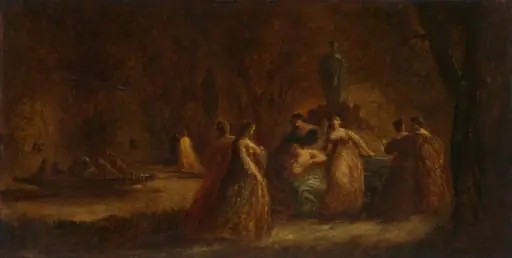
Adolphe Monticelli’s 1860 oil on canvas, Return from the Hunt, captures a bustling gathering in a forest clearing. A mixture of elegantly dressed figures and more modestly clothed participants mingle amid trees whose dark foliage is pierced by shafts of golden light. The composition centers on a seated individual on a rock, surrounded by standing and dancing companions, some holding musical instruments.
Subject & Meaning
The work portrays a moment of communal celebration following a hunt, juxtaposing the rustic setting with elements of refined attire. The presence of musicians and dancers suggests a festive ritual that bridges social classes, hinting at the shared joy of the hunt’s success and the cultural practices of rural gatherings in mid‑19th‑century France.
Artist & collection