Artwork
Saint Justina with the Unicorn, Venerated by a Patron
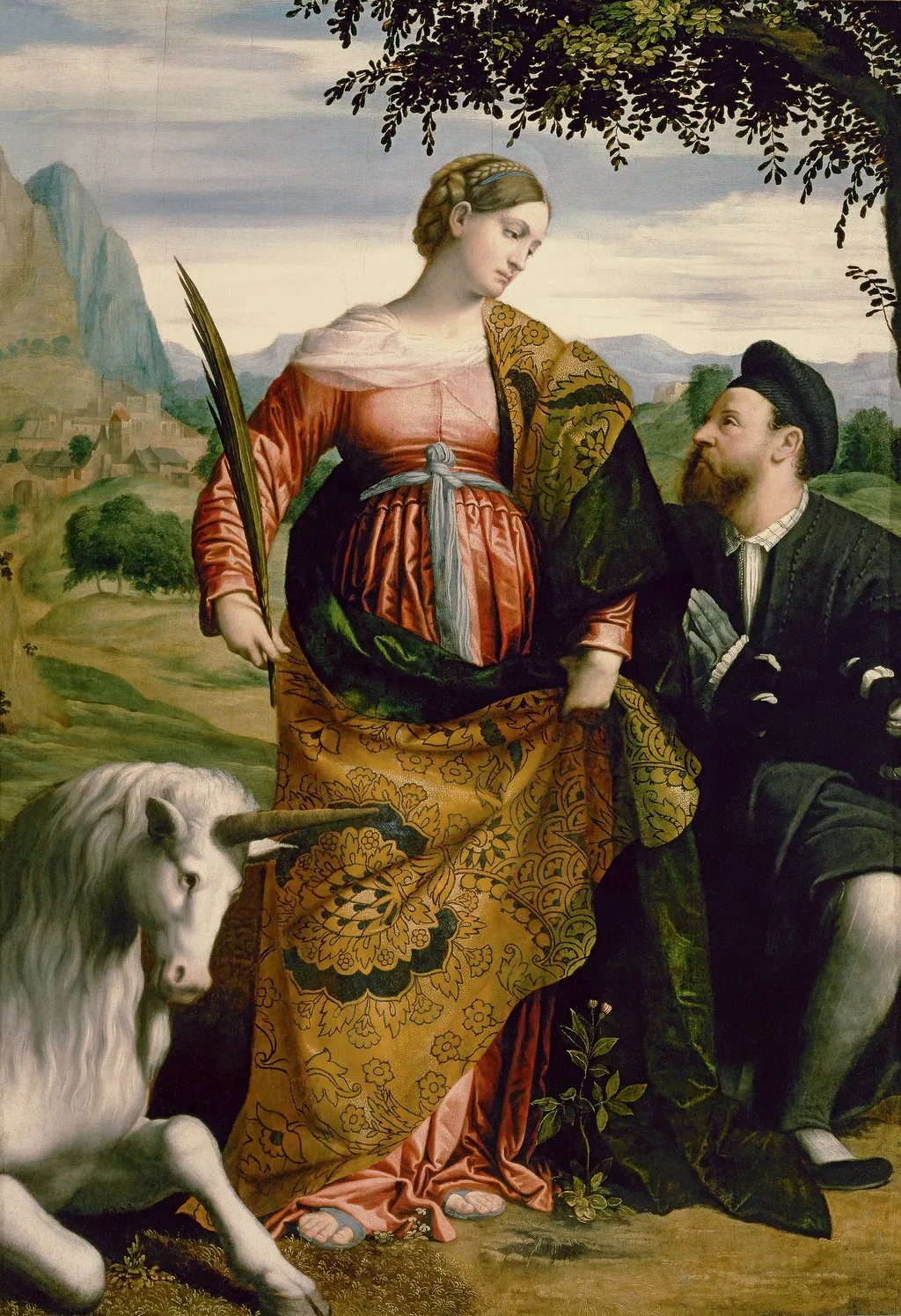
Saint Justina with the Unicorn, Venerated by a Patron is an oil painting by the Mannerist artist Moretto da Brescia. It dates from 1530 and is held in the collection of the Kunsthistorisches Museum.
About this work
Subject & Meaning
Seated to her left is a unicorn, a figure derived from classical mythology that represents virgin purity, a symbol well-known during the Renaissance.
The painting depicts Saint Justina of Padua, a martyr, standing centrally in rich attire consisting of a red dress, blue belt, white veil, and a gold brocade mantle with black embroidery. She holds a palm frond in her right hand, symbolizing her martyrdom, while her left hand grasps her mantle. Seated to her left is a unicorn, a figure derived from classical mythology that represents virgin purity, a symbol well-known during the Renaissance.
To the right, a male donor dressed in black kneels in an attitude of adoration. The three figures are positioned beneath a tree with foliage visible along the upper edge, set against a landscape featuring a distant town at the foot of steep mountains and a sky streaked with white clouds. The composition integrates the sacred figures with a naturalistic background, emphasizing the saint's status and the donor's devotion.
Technique & Style
The work is an oil painting executed on a wooden panel, measuring 200 × 139 cm. According to Italian-language scholarship, the painting marks the threshold between Moretto da Brescia's early maturity and his full maturity, with its compositional, formal, and chromatic handling testifying to a consolidated personal style that would characterize his subsequent production.
Crowe and Cavalcaselle admired the harmony of silvery tones combined with what they described as a "high and suave modeling," producing an effect of great freshness and splendor. Adolfo Venturi characterized the handling as increasingly "smooth and polished" compared with Venetian masters, noting the brocade of the saint's mantle reading like tooled leather in its subdued glow, while the silk of her gown shifts between pink and violet in oscillations of light. Giuseppe Fiocco observed that in this and other contemporary works, a stylistic integrity takes shape that would remain essentially unchanged until the painter's death.
History & Provenance
The original location and any record of commission for Saint Justina with the Unicorn are unknown; no surviving documents mention its patron or early provenance. The first surviving reference appears in a 1662 inventory recording the panel’s transfer from the Hofburg in Innsbruck to Ambras Castle, where it was then misattributed to Titian, while earlier inventories had called it a Raphael. A 1733 list reassigned the work to Pordenone, and it was not until 1845 that Carl Ransonnet correctly identified Moretto da Brescia as the artist.
Shortly after the Kunsthistorisches Museum opened in Vienna, the painting entered its collection in the late nineteenth century, where it remains. Stylistic and technical analysis supports a dating of circa 1530.
The painting is held by the Kunsthistorisches Museum in Vienna, where it was transferred in the late 19th century, soon after the museum's opening, and where it remains on display. Its original location is unknown, and no documents survive stating its provenance or commissioner.
The first surviving reference to the work is a 1662 document relating to its move from the Hofburg in Innsbruck to Ambras Castle, at which point it was already in the Holy Roman Empire's collections. That document ascribed it to Titian, while inventories immediately before the move attributed it to Raphael. A 1733 inventory re-attributed it to Pordenone. In 1845, Carl Ransonnet restored its correct attribution to Moretto da Brescia.
Context
The painting stands as one of Moretto da Brescia's most refined works, marking the threshold between his early maturity and his full artistic maturity, with its compositional, formal, and chromatic technique consolidating his earlier experience into a personal style that would characterize his subsequent production.
Critical reception began with Carl Ransonnet in 1845, who restored the correct attribution to Moretto after the work had been variously ascribed to Titian, Raphael, and Pordenone in earlier inventories. Joseph Archer Crowe and Giovanni Battista Cavalcaselle admired in 1871 the harmony of silvery colors combined with elevated, sweet modeling producing great freshness and splendor. Bernard Berenson, writing in 1907, judged the work to be among the heroic creations of Italian art, possessing an ancient grandeur and immediacy.
Roberto Longhi, by contrast, condemned in 1929 its confidential tone that brought the devotee too close to the patron saint. Adolfo Venturi, also in 1929, described the composition as a love duet at dawn, praising the luminous handling of the brocade mantle and landscape. György Gombosi, in 1943, situated the panel among the earliest Moretto works dispersed from their original context and likely acquired in Venice by the Archduke of Tyrol during the great seventeenth-century collecting fervor.
Legacy
The painting is regarded as one of Moretto da Brescia's most refined works, marking the threshold between his early maturity and his full maturity. According to Italian scholarship, its compositional, formal, and chromatic technique consolidated the painter's prior experience into a personal style that would characterize his entire subsequent production, remaining substantially unchanged until his death.
Its critical reception has shaped its standing in art history. Ransonnet's 1845 identification of the work's true authorship was followed by praise from Crowe and Cavalcaselle in 1871 for its silvery harmony and luminous modeling, and by Bernard Berenson's 1907 characterization of it as among the heroic creations of Italian art, possessing an ancient grandeur. Giuseppe Fiocco in 1939 likewise observed that the work embodies a stylistic integrity that endured throughout the painter's career, while Adolfo Venturi in 1929 analyzed its atmospheric landscape and the shimmering brocade of the saint's mantle.
Roberto Longhi's 1929 critique of the painting's overly familiar treatment of the donor diverged from the prevailing admiration but reinforced its prominence in the scholarly literature on Moretto.
Overview
Executed around 1530, this oil on panel by Moretto da Brescia portrays Saint Justina of Padua alongside a donor and a unicorn. The composition is now housed in Vienna’s Kunsthistorisches Museum, where it entered the collection in the late nineteenth century after the museum’s opening.
Own this work as a print
Artist & collection
Artist
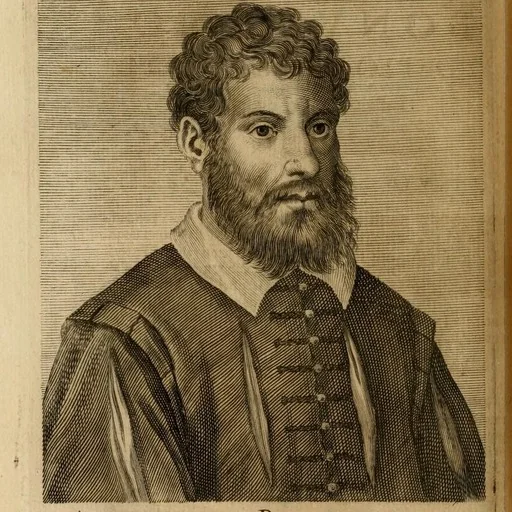
Alessandro Bonvicino (also Buonvicino) (c. 1498 – possibly 22 December 1554), more commonly known as Moretto, or in Italian Il Moretto da Brescia (the Moor of Brescia), was an Italian Renaissance painter from Brescia,…