Artwork
Pietà
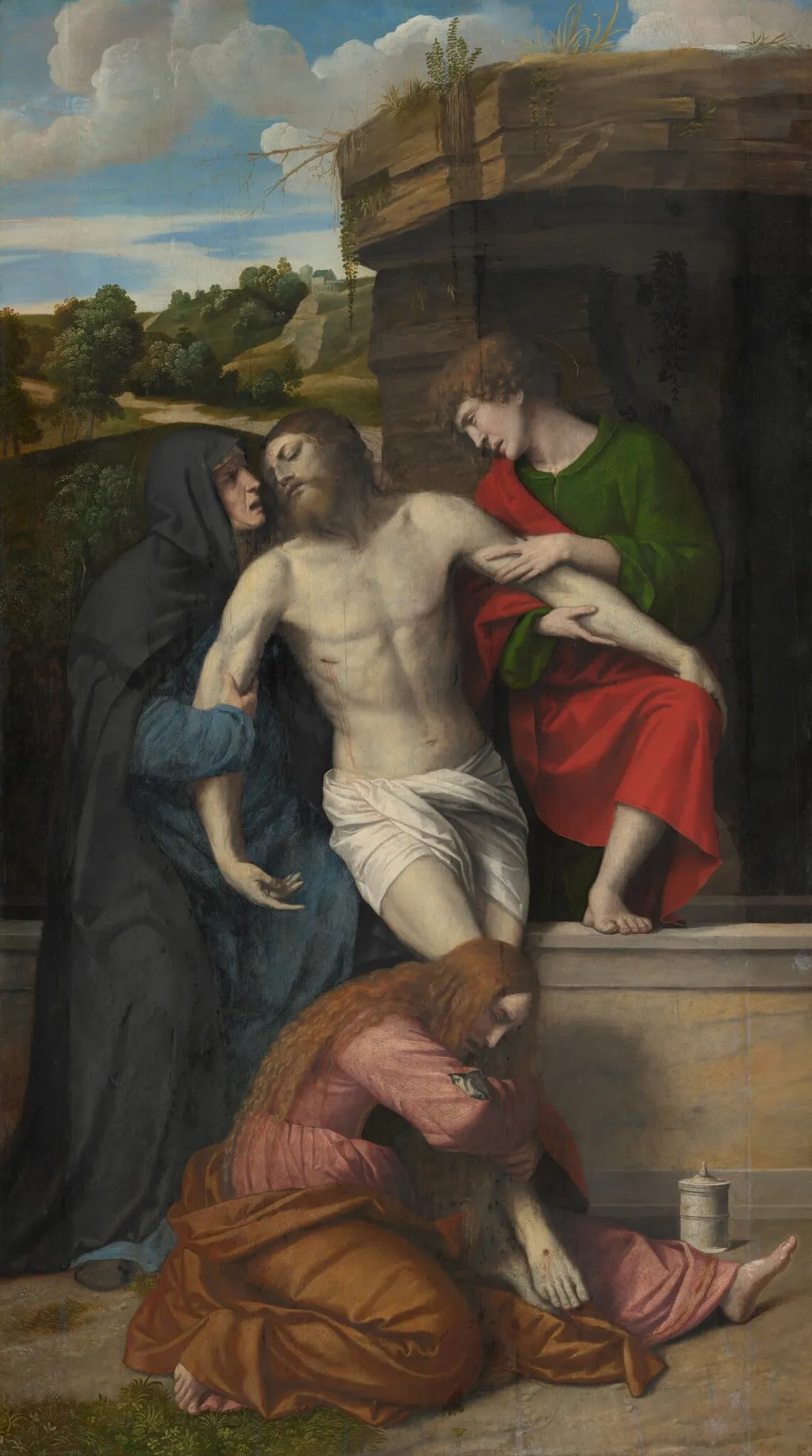
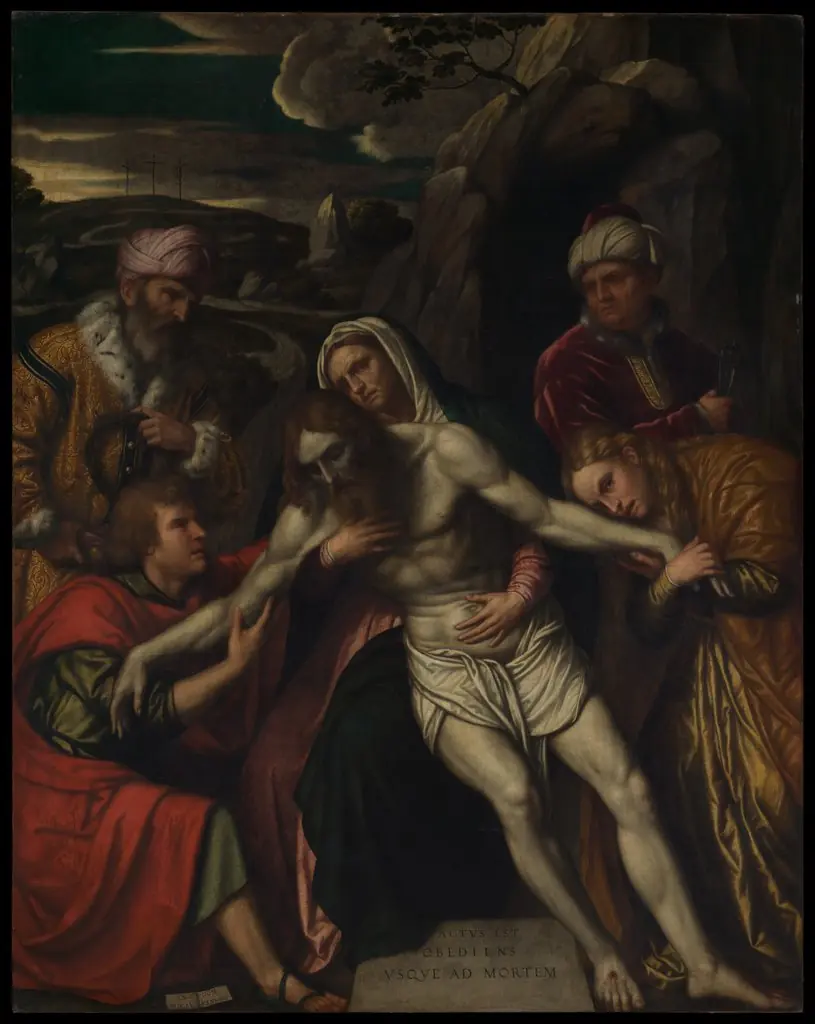
Pietà is an oil painting by the Early Baroque Italian artist Moretto da Brescia. It dates from 1524 and is held in the collection of the National Gallery of Art.
About this work
Subject & Meaning
John rests one foot on the open tomb into which Christ's body is being placed.
The painting depicts the entombment of Christ, showing the dead Jesus following the crucifixion surrounded by three mourning figures: the Virgin Mary at left, Saint John the Apostle at right, and the desperate Mary Magdalene at his feet. John rests one foot on the open tomb into which Christ's body is being placed. The scene opens into a hilly, overgrown landscape partially obscured by a rock wall behind Saint John, beneath a sky of vaporous clouds clearing toward the horizon.
Art historians have emphasized the work's emotional intensity, with Pietro Da Ponte describing it as notable for the great expression of melancholy in its figures, and Camillo Boselli observing how the figures cling to Christ's luminous body, turning to heighten the tragic and dynamic drama of the scene.
Technique & Style
The Pietà is rendered in oil, though sources disagree on its support: some describe it as oil on panel, others as oil on canvas. Stylistically, the work is noted for a strong expression of melancholy in its figures and for brighter, clearer coloring than the contemporary Deposition Altarpiece by Paolo Caylina the Younger. Critics highlight Moretto's use of an almost modern lighting that renders the scene with greater clarity and intensifies the tragedy.
The figures are described as clinging to the luminous body of Christ, turning to create a dynamic, dramatic composition, while exhibiting a restrained sweetness in their gestures and gazes.
History & Provenance
Dated to 1524, this oil painting by Moretto da Brescia lacks records regarding its original commission or location. The work first appears in historical documentation within the 19th-century collection of George Francis Wyndham, 4th Earl of Egremont, at Orchard Wyndham. Following the Earl's death, the painting remained with his widow and successor before being sold at Christie's in London on 26 November 1892.
Sir Francis Cook subsequently acquired the piece for his collection at Doughty House, where it remained through four generations of the Cook family. In February 1947, dealer Francis A. Drey sold the work to the Samuel H. Kress Foundation, which gifted it to the National Gallery of Art in Washington, D.C., in 1952.
Context
Scholarship on Moretto da Brescia's Pietà (1524) identifies the work as a pivotal piece from the artist's youth, illuminating his training and stylistic evolution. Early analysis by Pietro Da Ponte in 1898 highlighted the figures' profound melancholy, though he incorrectly attributed the panel to Cesare Magni. Tancred Borenius reconsidered the dating in 1913, linking the composition to Paolo Caylina the Younger's contemporary Deposition Altarpiece and noting thematic recurrences in Moretto's later Supper in the House of Simon the Pharisee.
The debate regarding which artist influenced the other was resolved in 1965 when Gaetano Panazza, following restoration of Caylina's work, determined that Moretto adopted specific chromatic and luminous effects from his peer. Camillo Boselli later emphasized the painting's modern lighting techniques, arguing that their clarity intensifies the scene's tragic drama. At least three known copies are extant.
Legacy
The Lament over the Dead Christ has exerted a lasting influence on Moretto's own artistic development, as motifs first explored here recur in his later works, offering insight into his training. Its appeal is evidenced by at least three extant copies, two in private Italian collections and one in the parish church of San Giovanni Battista in Coccaglio, Brescia. The painting's entry into the Samuel H. Kress Foundation collection and its subsequent display at the National Gallery of Art in Washington cemented its modern reputation.
Early twentieth-century scholars such as Pietro da Ponte, Tancred Borenius, Camillo Boselli and Gaetano Panazza studied its attribution, style and relationship to Paolo Caylina's Deposition altarpiece, further securing its critical legacy.
Overview
Moretto da Brescia's Pietà, painted between 1526 and 1530, is an oil on panel work depicting a solemn moment of lamentation. The painting, now held in the National Gallery of Art in Washington, captures a quiet scene of grief surrounding the dead Christ. Created during the artist's early career, it reflects his developing style and engagement with contemporary artistic trends.
Artist & collection
Artist
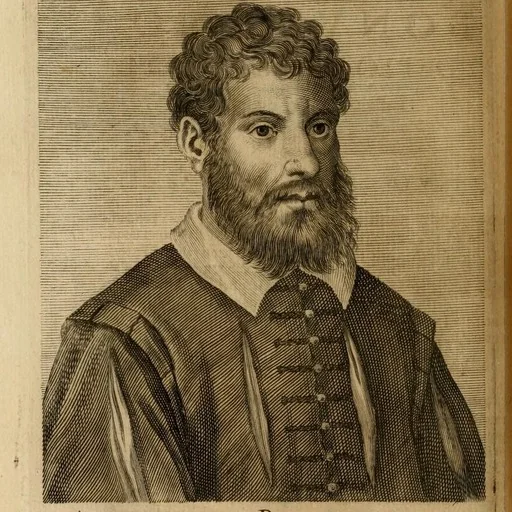
Alessandro Bonvicino (also Buonvicino) (c. 1498 – possibly 22 December 1554), more commonly known as Moretto, or in Italian Il Moretto da Brescia (the Moor of Brescia), was an Italian Renaissance painter from Brescia,…