Artwork
Misse and Luttine
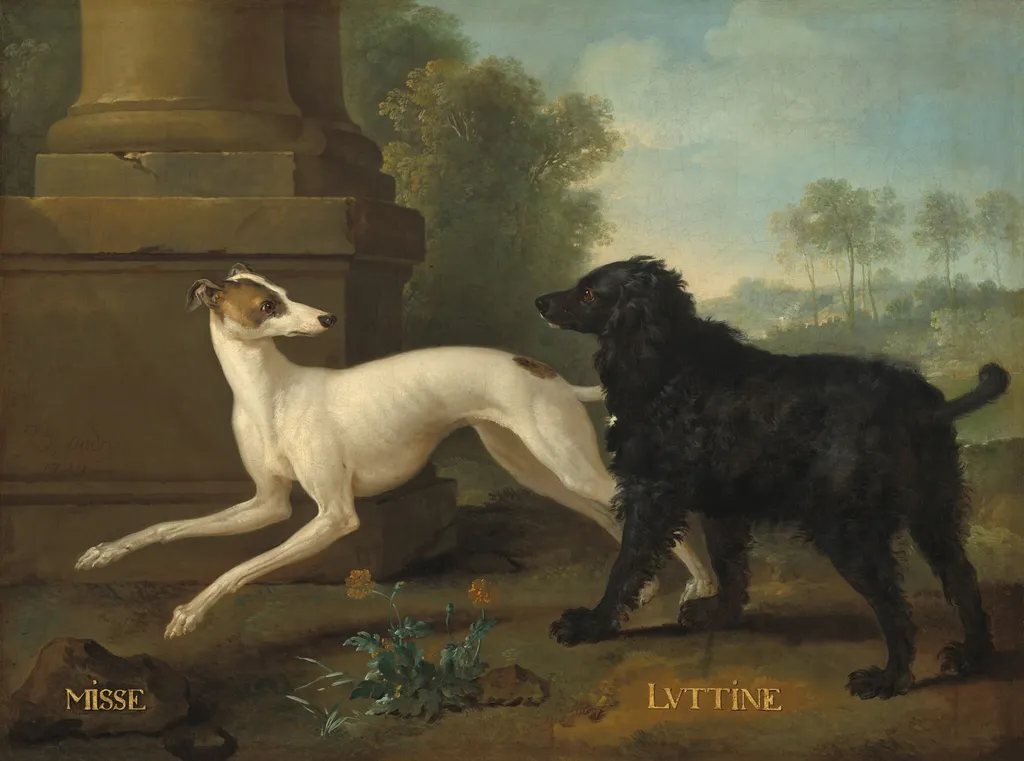
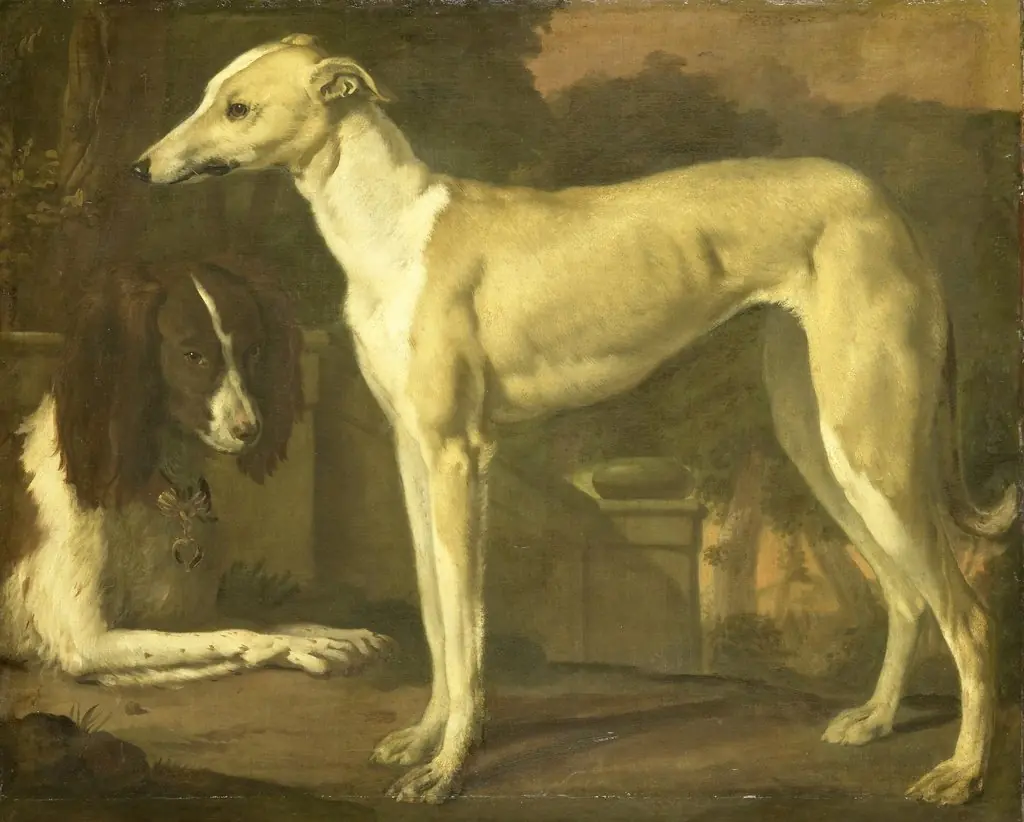
Misse and Luttine is an oil painting by the Baroque artist Jean-Baptiste Oudry. It dates from 1729 and is held in the collection of the National Gallery of Art.
- Inscription
- Inscribed:center left on socle: J.B, Oudry / 1729; across bottom under each dog: MISSE / LVTTINE
About this work
Subject & Meaning
The dogs are identified by name and breed through their distinctive markings and accompanying hunting equipment, reinforcing themes of ownership and mastery.
The work portrays two hunting dogs named Misse and Luttine, rendered in life‑size scale against a neutral landscape that emphasizes their status as royal companions. Their collars and alert postures signal both breed identity and the aristocratic pastime of the hunt, reflecting the broader cultural link between canine subjects and the prestige of Louis XV’s court. The painting thus functions as a visual record of elite leisure and the selective breeding practices of mid‑18th‑century France.
The dogs are identified by name and breed through their distinctive markings and accompanying hunting equipment, reinforcing themes of ownership and mastery. Their inclusion among a series of royal hunt portraits underscores a symbolic connection between the monarch’s authority and the controlled natural world, a motif common in French sporting art of the period.
The composition’s emphasis on realistic detail and naturalistic setting aligns with the Rococo interest in both scientific observation and decorative elegance, suggesting an intent to blend artistic refinement with documentary precision.
Technique & Style
Misse and Luttine is an oil on canvas painting by Jean-Baptiste Oudry, executed in 1729. The work measures 9 × 131.5 cm, indicating an unusually elongated, horizontal format that accommodates the full-length portrayal of the two canine subjects. As a royal commission for Louis XV, the painting exemplifies Oudry's specialized practice as an animalier, combining precise naturalistic observation with the ceremonial requirements of court portraiture.
The artist's handling renders the dogs' coats and anatomies with meticulous attention to texture and form, situating the work within the tradition of aristocratic pet portraiture while demonstrating the technical refinement characteristic of his paintings destined for Compiègne.
History & Provenance
Commissioned in 1729 by Louis XV, King of France, the painting was one of a group of dog portraits destined for the royal château at Compiègne. After leaving the French royal collection, it surfaced with an anonymous dealer in London. Peter Coats acquired the work around 1944 from a Sloane Street shop that had been damaged by wartime bombing, keeping it at Kelvedon Hall, Essex, and in London.
By 1977 it had passed to Mr. and Mrs. Eugene V. Thaw of New York, who gave it to the National Gallery of Art in 1994.
Commissioned in 1729 by King Louis XV for the royal château at Compiègne, this painting later entered the collection of an anonymous London dealer. Around 1944, Peter Coats acquired the work from a bomb-damaged shop on Sloane Street, subsequently housing it at Kelvedon Hall and in London. By 1977, the piece was owned by Eugene V. Thaw and his wife in New York, who donated it to the National Gallery of Art in Washington, D.C., in 1994.
The work is currently held in the collection of the National Gallery of Art.
Context
Oudry painted Misse and Luttine in 1729 as a royal commission for Louis XV, King of France, linking the work to a series of canine portraits destined for the Château de Compiègne. The painting entered the collection of the National Gallery of Art in Washington, D.C., through a series of transfers that included an anonymous London dealer, Peter Coats of Kelvedon Hall, and ultimately Eugene V. Thaw before being gifted in 1994. Scholarship connects the work to Oudry’s role in elevating animal portraiture within French Rococo art and his influence on later sporting painters, situating it within broader discussions of royal patronage and genre specialization in 18th-century European art.
Overview
Jean-Baptiste Oudry’s 1729 oil on canvas, Misse and Luttine, presents a quiet outdoor scene in which two dogs are the focal point. A white dog with brown patches is captured mid‑leap, while a black dog remains stationary. Behind them a classical column and a stand of trees frame the composition, and the animals’ names appear inscribed at the bottom of the work.
Own this work as a print
Artist & collection

Artist
Jean-Baptiste Oudry was a French Rococo painter, engraver, and tapestry designer. He is particularly well known for his naturalistic pictures of animals and his hunt pieces depicting game. His son, Jacques-Charles Oudry, was also a painter.