Artwork
Untitled
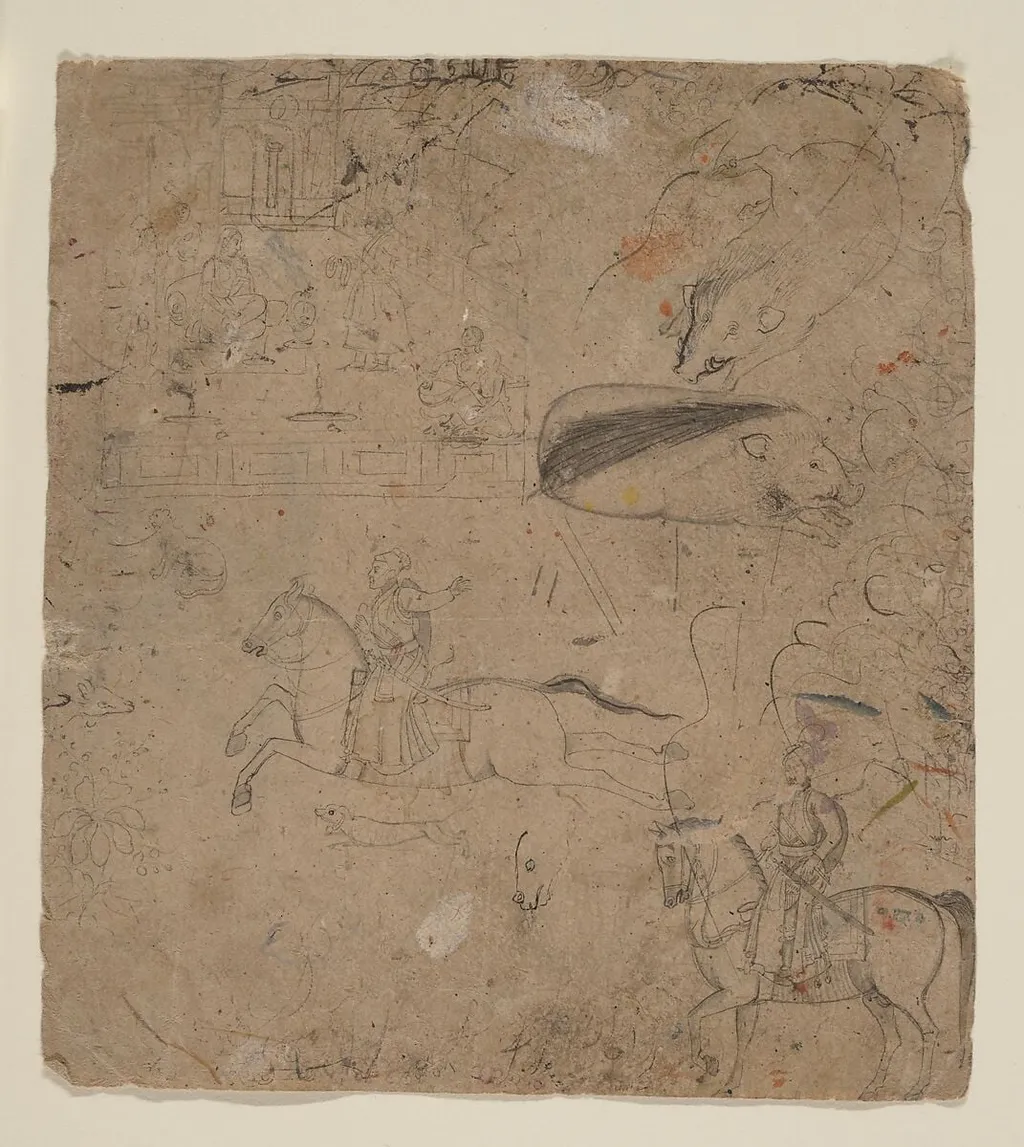
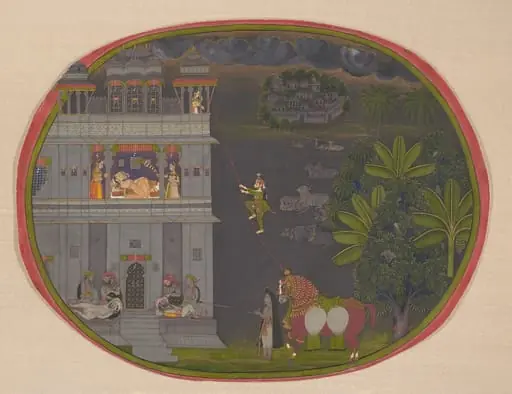
Untitled is an ink painting by the Mughal Painting artist Pandit Seu. It dates from 1783 and is held in the collection of the Metropolitan Museum of Art.
About this work
Subject & Meaning
The presence of the boar alongside the rider and the palace environment suggests a symbolic interaction or event central to the work's thematic intent.
The work Untitled, created in 1783 by Pandit Seu, is classified as an allegorical painting that depicts a specific narrative scene involving a wild boar (Sus scrofa) and an equestrian figure mounted on a horse within a palace setting. As an allegory, the composition utilizes these visual elements to convey a meaning beyond the literal representation of the animals and architecture. The presence of the boar alongside the rider and the palace environment suggests a symbolic interaction or event central to the work's thematic intent.
The imagery combines natural elements with courtly structures to construct a scene rooted in Indian artistic tradition, where the juxtaposition of the wild animal and the equestrian figure likely serves as the primary vehicle for the painting's allegorical message.
Technique & Style
The work Untitled, dated 1783, is executed in ink on paper and measures roughly 15.9 cm in height by 14.3 cm in width. It forms part of the Metropolitan Museum of Art’s collection and was produced in India. The piece belongs to the allegorical genre and portrays a Sus scrofa in an equestrian context set against a palace backdrop, combining figurative detail with a narrative composition.
The drawing’s line work and limited tonal range reflect the stylistic conventions of 18th‑century Indian manuscript illustration, while the dynamic pose of the horse and the architectural setting contribute to a balanced, formal composition.
History & Provenance
The work is dated 1783 and is attributed to the atelier of Pandit Seu, with Manaku often cited as a principal hand. It entered the Metropolitan Museum of Art as part of its holdings by the late nineteenth century, though no immediate pre-Metropolitan provenance is recorded in the cited sources. The painting’s small format, on paper, and its allegorical depiction of a boar, horse, and palace strongly suggest courtly or ceremonial patronage in eighteenth-century India.
The artwork Untitled, created by Pandit Seu in 1783, is currently held in the collection of the Metropolitan Museum of Art. While the specific inventory or accession number is not detailed in the provided records, the work's physical dimensions are recorded as 15.9 cm in height and 14.3 cm in width. The piece originates from India and is classified as an allegorical painting executed in ink on paper.
The available documentation does not list any specific past or future exhibition history for this work, nor does it provide further details regarding its provenance chain prior to its current location at the museum.
Legacy
The work Untitled (1783) by Pandit Seu and Manaku exemplifies the allegorical miniature tradition of the Pahari school and has helped shape scholarly narratives of 18th‑century Indian court painting. Its depiction of a Sus scrofa in an equestrian scene within a palace setting illustrates the blend of narrative and decorative motifs that influenced later regional artists. Held in the Metropolitan Museum of Art since its acquisition, the piece is frequently cited in studies of Mughal‑Pahari stylistic exchange and appears in major exhibitions on Indian miniature painting, reinforcing its reputation as a key reference point for understanding the evolution of allegorical imagery in South Asian art.
Overview
This untitled work, executed in ink on paper, presents a dynamic scene. It depicts a rearing horse, a wild boar, and the ruins of a palace situated on a hill. The composition, rendered entirely in black ink, showcases a meticulous approach to line work, creating a sense of movement and detailed observation within a confined space.
Artist & collection
Artist
Pandit Seu was an Indian painter of the Pahari tradition, active in the hill state of Guler in the Punjab Hills during the late seventeenth and early eighteenth centuries.

 Untitled
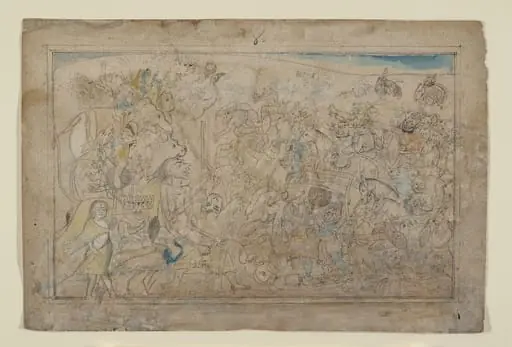 Untitled
 Album of Daoist and Buddhist Themes: Search the Mountain: Leaf 47
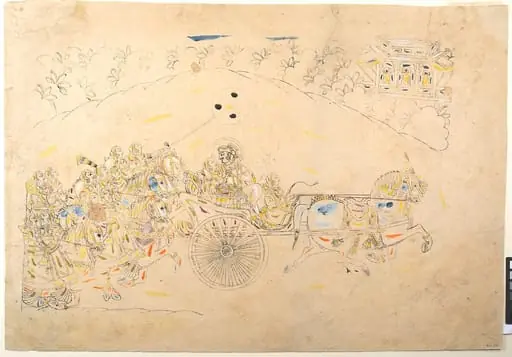 Untitled
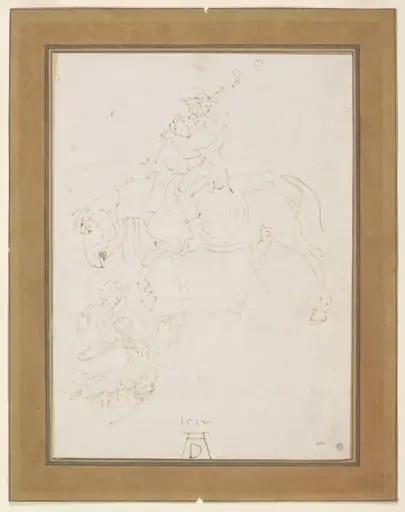 Madonna and Child with Cradle and a Bagpiper on Horseback
 Sketches of Horses and Riders (recto)
![Figure on Horseback and Other Studies [verso], by Winslow Homer](https://artifactworldgallery.com/img/winslow-homer--figure-on-horseback-and-other-studies-verso--3909dbf700a8f786-w320.webp) Figure on Horseback and Other Studies [verso]
Figure on Horseback and Other Studies [verso] Untitled
 Album of Daoist and Buddhist Themes: Search the Mountain: Leaf 45
 Untitled