Artwork
The Finding of Moses
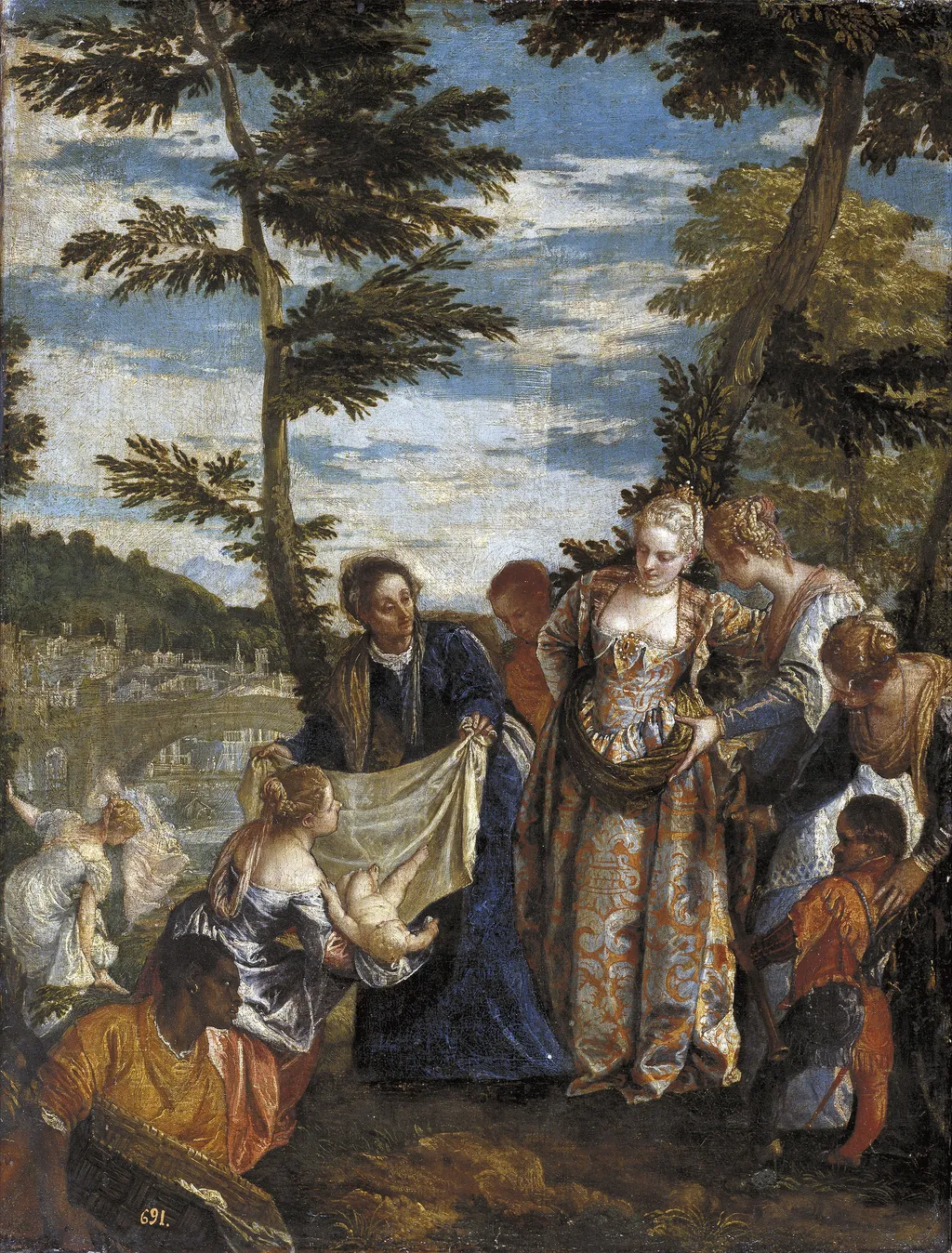
The Finding of Moses is an oil painting by the Mannerist artist Paolo Veronese. It is held in the collection of the Museo del Prado.
About this work
Subject & Meaning
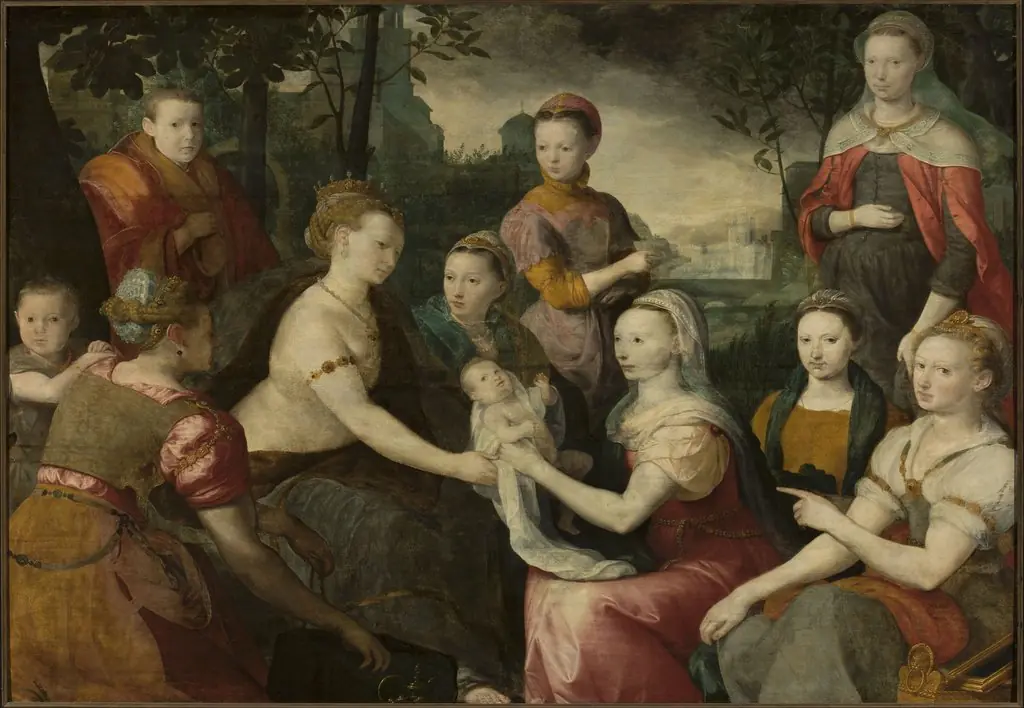
The painting depicts the biblical narrative of the Finding of Moses, where the infant is rescued from the Nile River after being placed in a basket of reeds by his mother to escape the Pharaoh's decree to kill Hebrew newborns. In this specific composition, a servant presents the child to the Pharaoh's daughter, while another figure approaches with a cloth, capturing a moment that the sources describe as a casual gathering rather than a solemn event. The work carries significant Christian typology, as the rescue of Moses was viewed by the Catholic Church as a prefiguration of Christ's resurrection, while the massacre of Hebrew infants parallels the Massacre of the Innocents in Bethlehem.
Visually, the scene avoids historical accuracy regarding Egypt, instead featuring Venetian costumes and a landscape with a bridge and city in the background, emphasizing the figures' interaction over the setting.
Technique & Style
Two V‑shaped trees frame the central action, and the pink‑clad attendants, a black servant with a basket, and a musician‑dwarf add narrative detail.
The work is executed in oil on canvas, a common support for large-scale religious paintings of the late Renaissance. Veronese applied delicate brushwork to render soft afternoon light that bathes the figures, creating transparent shadows and fine chromatic gradations typical of Venetian practice. The composition balances figures and landscape with natural harmony, echoing Tiziano’s influence, while the richly textured drapery and subtle color shifts anticipate later Baroque sensibilities.
Two V‑shaped trees frame the central action, and the pink‑clad attendants, a black servant with a basket, and a musician‑dwarf add narrative detail. The painting’s handling of gesture and texture reflects Veronese’s mastery of formalist arrangement and his ability to blend narrative clarity with decorative elegance.
History & Provenance
The Finding of Moses is an oil-on-canvas painting by Paolo Veronese, executed around 1580. The Spanish-language source notes that some scholars have proposed alternative dates, placing the work between 1560 and 1575, while others have suggested a later date of 1582.
The painting is held in the Museo del Prado in Madrid, where it is currently exhibited. It is one of at least eight variants of the subject of the finding of Moses produced by Veronese and his studio. The sources do not provide information on the original commissioner, the early ownership chain, or the circumstances of the work's creation.
The painting is held in the Museo del Prado, Madrid. Sources give its dimensions as 57 × 43 cm or alternatively 50 cm high by 43 cm wide. The Prado's website and general references confirm its presence in the collection, though no specific inventory or accession number is provided in the given sources. No exhibition history is documented in the available sources.
Context
The Finding of Moses is one of at least eight variants of the subject painted by Paolo Veronese and his studio, reflecting the sustained demand for this narrative across his career. The painting exemplifies Veronese's Venetian approach to religious subjects: the landscape and costumes are entirely Venetian rather than Egyptian, and the scene is stripped of solemnity in favor of an informal, almost leisurely gathering. Scholars have noted the soft afternoon light and the harmonious integration of figures and landscape as showing the influence of Titian.
The chromatic subtlety and delicate gradations have been seen as anticipating Velázquez, while the arrangement of figures and attention to rich textiles have invited comparison with Watteau's Rococo compositions a century later. The Catholic Church's interest in Moses as a prefiguration of Christ gave the subject particular resonance in Counter-Reformation art.
Legacy
The Finding of Moses has remained a focal point of scholarly discussion regarding Veronese’s role in shaping Mannerist visual storytelling. Contemporary accounts note its influence on later artists who adapted the composition’s dynamic grouping and theatrical lighting, particularly in the works of Rubens and later 18th‑century painters who cited the Prado version as a model for narrative clarity. The painting is frequently referenced in studies of the ‘Finding of Moses’ motif, underscoring its importance within the broader corpus of biblical subjects in European art.
Its reception over centuries reflects a sustained appreciation for Veronese’s technical innovation and the work’s symbolic resonance, especially in Catholic contexts where the scene was interpreted as a prefiguration of Christ’s resurrection. This enduring legacy continues to inform both academic curricula and museum displays, affirming the painting’s status as a benchmark for narrative complexity and stylistic mastery.
Overview
Paolo Veronese’s oil painting titled The Finding of Moses dates from around 1580 and is part of the collection of the Museo del Prado in Madrid. Executed by the master and his workshop, it belongs to a series of at least eight versions that treat the biblical episode of Moses’s discovery in the Nile.
Own this work as a print
Artist & collection
Artist
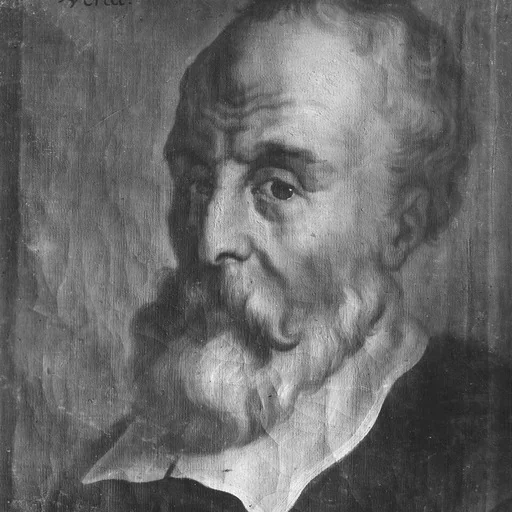
Paolo Caliari (1528 – 19 April 1588), known as Paolo Veronese ( VERR-ə-NAY-zay, -zee, US also -see; Italian: ), was an Italian Renaissance painter based in Venice, known for extremely large history paintings of…