Artwork
Beaulne (Beaune)
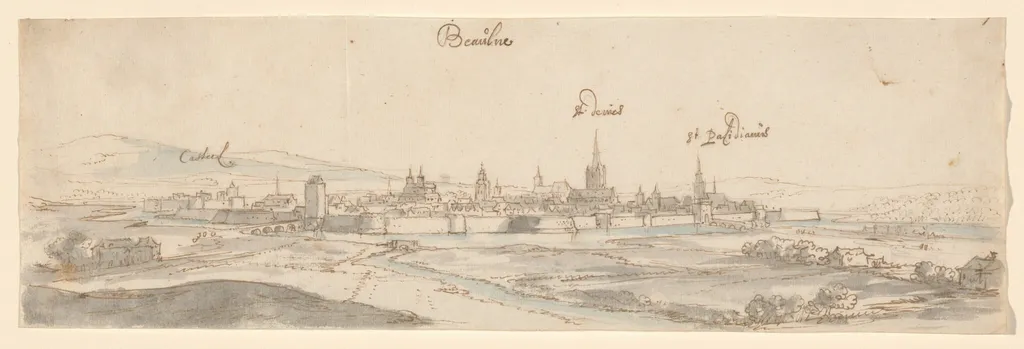
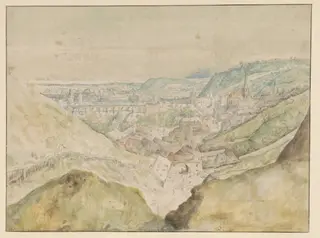
Beaulne (Beaune) is an ink drawing by the Baroque artist Peeters, Jan, I. It dates from 1650 and is held in the collection of the National Gallery of Art.
- Inscription
- Inscribed:in image, in pen and ink over graphite: Beaulne; Casteel; St Denis; St Paludianus
About this work
Overview
Created around 1650 by Jan Peeters I, this pen and brown‑ink drawing on laid paper combines graphite underdrawing with brown and blue washes. The work measures a modest size and records a tranquil riverside settlement, identified by the handwritten captions “Beaulne” and “St. Paradis.” Its quiet composition reflects the artist’s interest in topographical studies of European towns.
Subject & Meaning
The scene presents a small town set along a gently curving river. Steep‑roofed houses line the banks, while a prominent church spire dominates the central skyline. Trees rise on the surrounding hills, and the water appears placid, suggesting a moment of everyday calm rather than dramatic narrative.
Technique & Style
Peeters employs a delicate balance of pen line and ink wash. Light brown and blue washes create atmospheric shadows and a sense of depth, while cross‑hatching builds texture in the architecture and foliage. The underlying graphite sketch guides the composition, and the handwritten labels integrate cartographic annotation with artistic rendering.
History & Provenance
The drawing belongs to a series of topographical sketches produced by Jan Peeters I, a Flemish artist known for maritime and landscape views. Its dating to the mid‑17th century aligns with Peeters’ active period in Antwerp. The work has remained in private collections before entering its current museum holdings, where it is displayed as an example of early modern topographic drawing.
Artist & collection
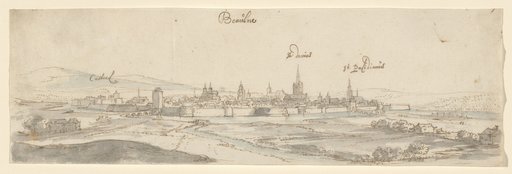

- View of Mons, Belgium
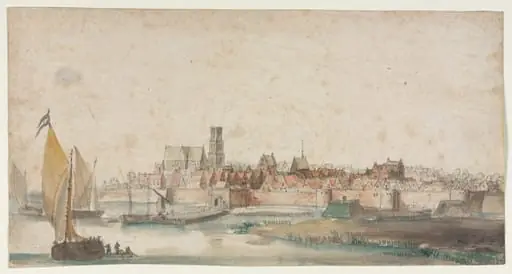 View of St. Geertruidenberg
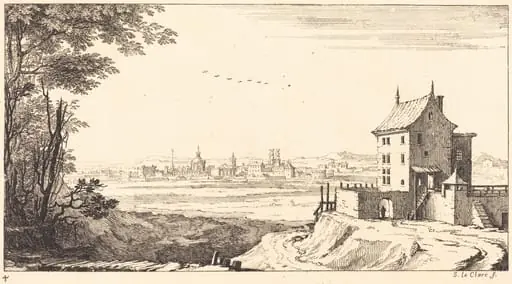 Landscape with City in Distance
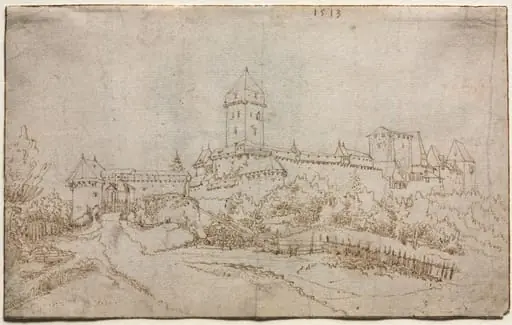 View of a Castle (recto)
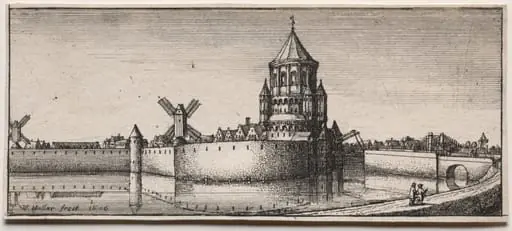 Moated Town Gate
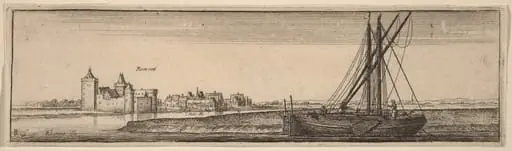 Roerort
 Recto: (above) Panoramic Views of Jerez de la Frontera; (below) Barcelona
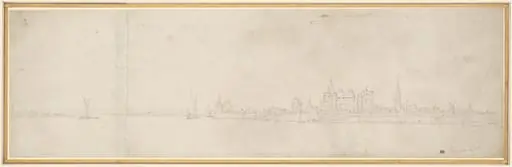 View of Orsoy
 Prospekt af byen Prag
![View of Scheveningen [recto], by Jan van Goyen](https://artifactworldgallery.com/img/jan-van-goyen--view-of-scheveningen-recto--0f9cb319c9b082d3-w320.webp) View of Scheveningen [recto]
View of Scheveningen [recto]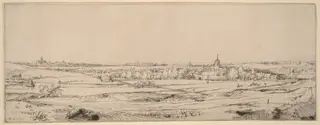 Landscape with a View toward Haarlem (The Goldweigher's Field)
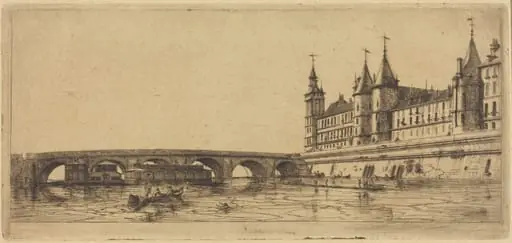 Le Pont-au-Change, Paris