Artwork
The Blue Envelope
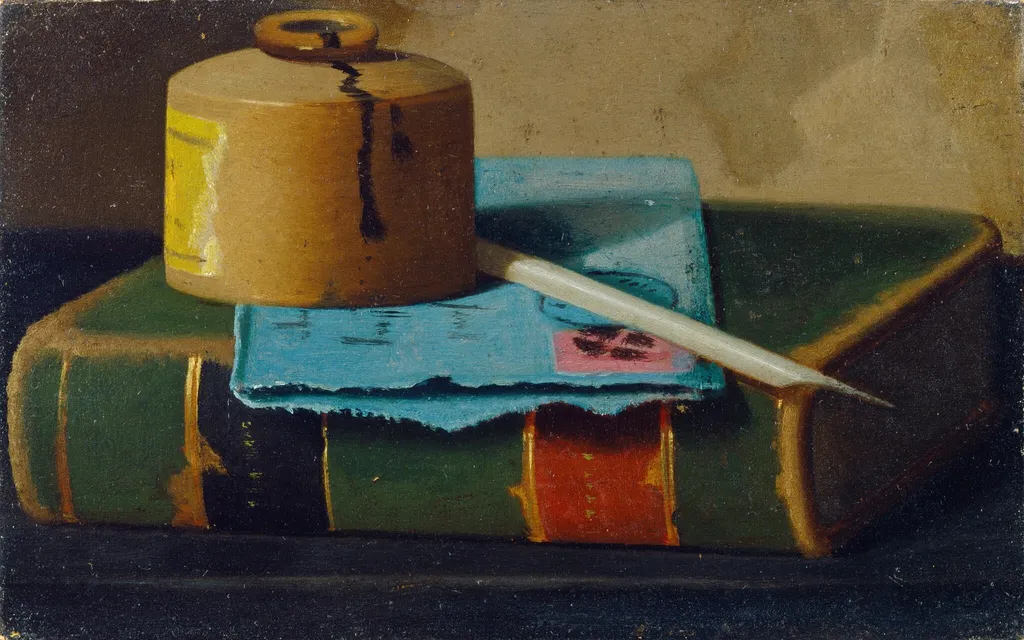
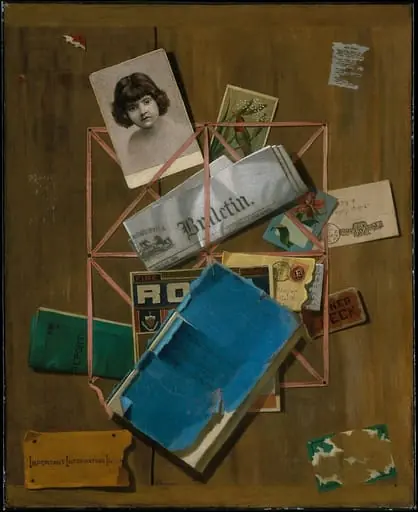
The Blue Envelope is an oil painting by the American Impressionist artist John F. Peto. It dates from 1894 and is held in the collection of the National Gallery of Art.
About this work
Subject & Meaning
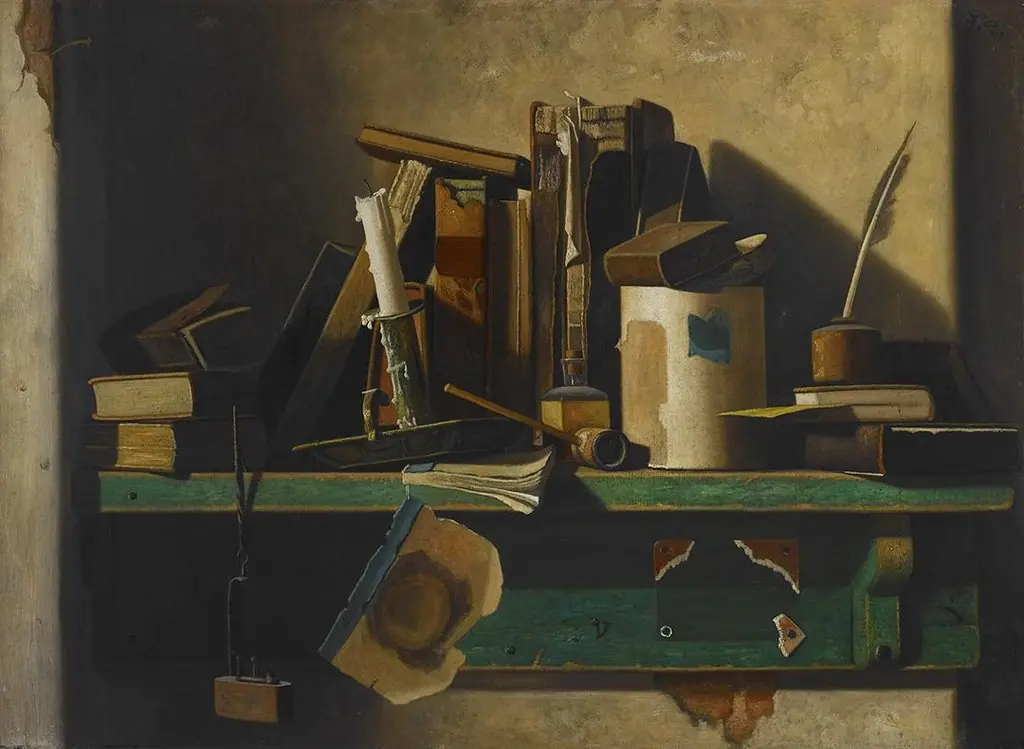
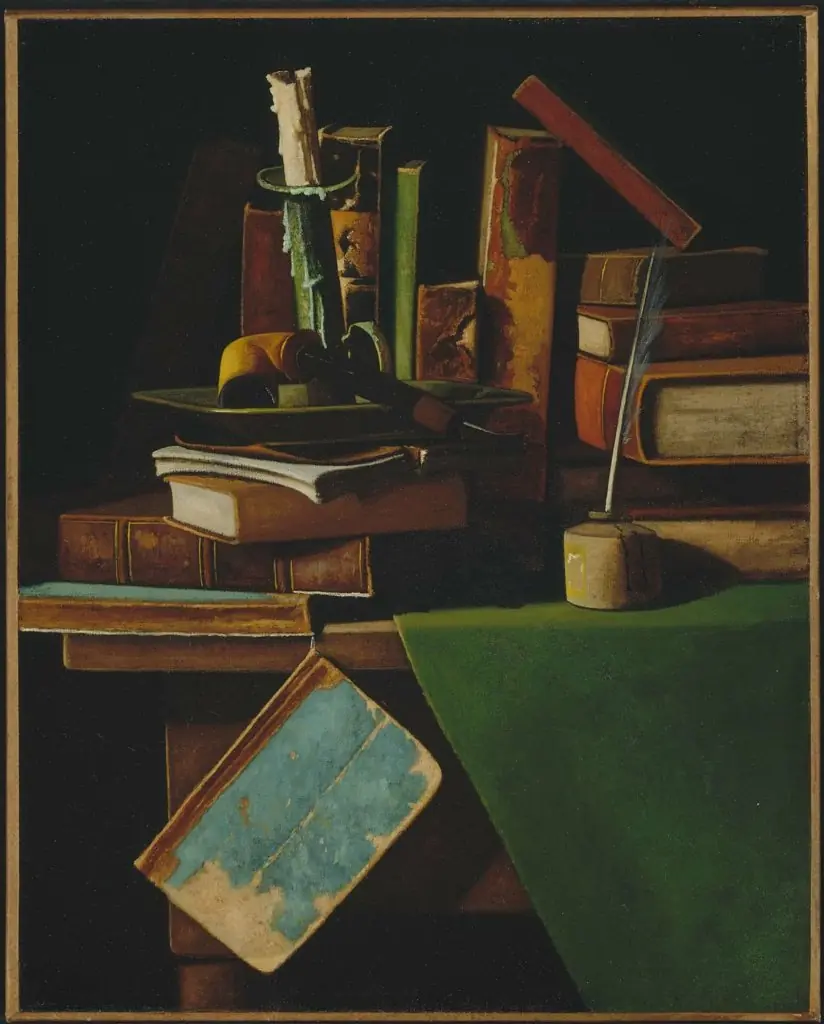
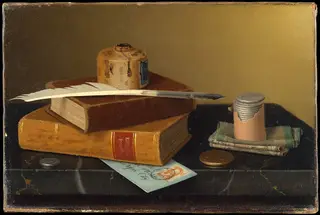
The Blue Envelope portrays a modest interior scene centered on a blue envelope that holds a folded letter, accompanied by a book, an inkwell, and a pen.
The Blue Envelope portrays a modest interior scene centered on a blue envelope that holds a folded letter, accompanied by a book, an inkwell, and a pen. These objects function as visual symbols of written communication, personal correspondence, and the everyday rituals of knowledge and reflection. By arranging a letter with its accompanying stationery alongside a book and writing implements, Peto suggests a moment of quiet intellectual exchange, inviting viewers to consider the intimacy of private messages and the material culture of late‑nineteenth‑century domestic life.
The painting thus conveys themes of nostalgia, the passage of time, and the silent narratives embedded in ordinary household items.
Technique & Style
Executed in 1890, this work is an oil painting applied to a wood panel support. The composition features a tightly cropped arrangement of everyday objects, specifically depicting a book, an inkwell, a letter, and a pen. Measuring 10.8 by 16.5 units, the small scale of the panel emphasizes the intimate nature of the still life.
The artist, John Frederick Peto, utilized the oil medium to render the textures of these stationary items with precision. The classification as a painting on panel distinguishes it from canvas works, suggesting a smooth surface suitable for the fine detail characteristic of Peto's trompe-l'œil style. The specific combination of writing implements and paper creates a unified subject matter focused on correspondence and intellectual labor.
History & Provenance
The Blue Envelope is an oil on wood painting by John Frederick Peto, created in 1890 and classified as a work of painting that shows a book, inkwell, letter and pen. Its early ownership passed through Bernard Danenberg Galleries in New York and Maxwell Galleries in San Francisco before being owned by Mr. and Mrs. Oscar Salzer in Los Angeles. The painting was sold at Sotheby’s Los Angeles auction on 13‑17 June 1977 (lot 789) and acquired by Davis & Long Co. for Paul Mellon and his wife.
In 1999 the work was bequeathed to the National Gallery of Art, where it remains on display in Washington, D.C.
The Blue Envelope is held by the National Gallery of Art (NGA), Washington, D.C., accessioned as a bequest from Mr. and Mrs. Paul Mellon in 1999. It entered the NGA’s collection following its purchase by Davis & Long Co., New York, for the Mellons at Sotheby’s, Los Angeles (13–17 June 1977, 3rd day, lot 789). Prior to Mellon acquisition, the work passed through Bernard Danenberg Galleries, New York; Maxwell Galleries, San Francisco; and the collection of Mr. and Mrs. Oscar Salzer, Los Angeles.
Overview
John Frederick Peto's "The Blue Envelope" is an oil painting on wood that depicts a quiet still life. The composition features common objects, an old inkwell, a pen, and a closed book, arranged on a simple wooden table under soft illumination. A distinctive blue envelope, positioned near the edge, serves as a focal point within the muted scene. This work is part of the collection at the National Gallery of Art in Washington.
Own this work as a print
Artist & collection

Artist
John Frederick Peto (May 21, 1854 – November 23, 1907) was an American trompe-l'œil ("fool the eye") painter who was long forgotten until his paintings were rediscovered along with those of fellow trompe-l'œil artist William Harnett.