Artwork
Still Life with Cake, Lemon, Strawberries, and Glass
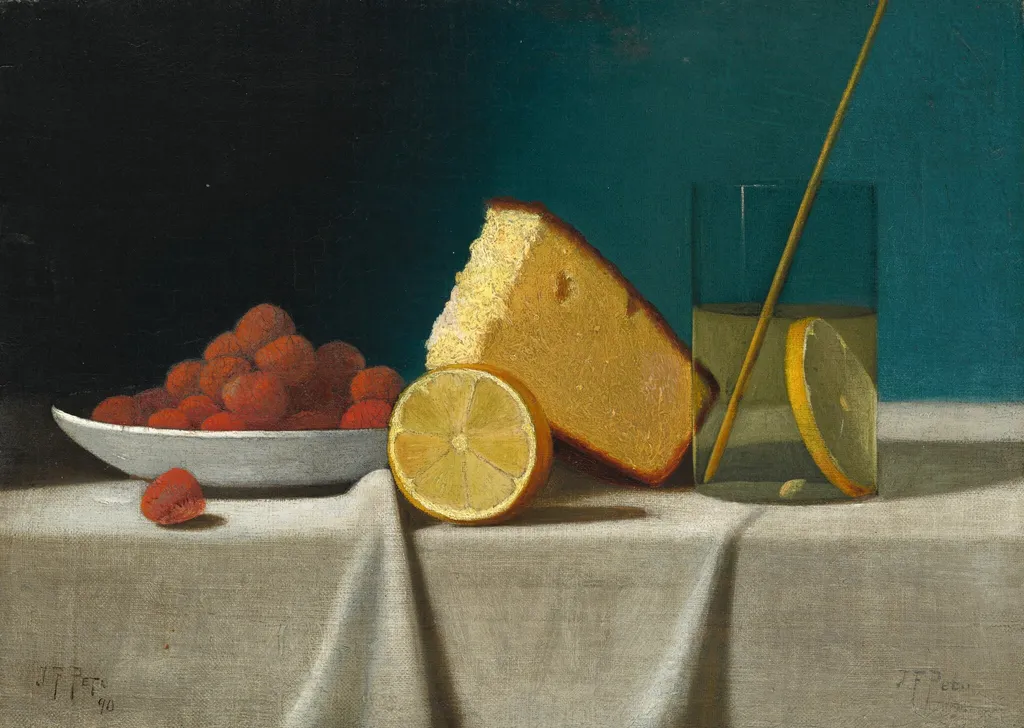
Still Life with Cake, Lemon, Strawberries, and Glass is an oil painting by the American Impressionist artist John F. Peto. It dates from 1890 and is held in the collection of the National Gallery of Art.
- Inscription
- Inscribed:lower right: J.F PETO; lower left: J F PETO / 90
About this work
Technique & Style
The grouping balances naturalistic detail with a muted tonality, evoking the quiet, introspective mood characteristic of Peto's mature works.
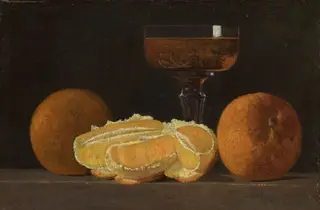
The work is executed in oil on canvas, adhering to the still-life genre's tradition of depicting everyday objects with heightened realism. Peto's handling emphasizes subtle gradations of light and shadow across the surfaces of the cake, lemon peel, and berries, using fine, controlled brushwork to articulate textures from the translucency of the glass to the matte crust of the cake.
Formal qualities center on a restrained palette of muted greens, ochers, and whites, arranged in a shallow, centralized composition that directs attention to the interplay between the objects rather than spatial depth. The grouping balances naturalistic detail with a muted tonality, evoking the quiet, introspective mood characteristic of Peto's mature works.
History & Provenance
John Frederick Peto created the oil-on-canvas painting Still Life with Cake, Lemon, Strawberries, and Glass in 1890. The work measures 25.72 cm in height and 35.4 cm in width. Its provenance traces to Paul Mellon (1907–1999) of Upperville, Virginia, who held the painting with a life interest reserved for his wife, Rachel Lambert Mellon (1910–2014).
Upon Paul Mellon's death in 1999, the piece was bequeathed to the National Gallery of Art in Washington, D.C., where it entered the collection as part of the Paul Mellon Bequest (accession no. 1999.80.1). It has not been recorded as lent to any temporary exhibitions in the sources provided.
Overview
John Frederick Peto created Still Life with Cake, Lemon, Strawberries, and Glass in 1890. This oil on canvas painting exemplifies the artist's focus on everyday subjects. It presents a domestic scene, characteristic of still life compositions from the late 19th century, inviting viewers to observe common items arranged on a surface.
Subject & Meaning
The painting depicts a modest arrangement of household items on a table. A bowl holds fruit, while a slice of cake, a halved lemon, and a glass containing a straw and a lemon slice complete the composition. Peto's choice to render these ordinary objects with straightforward attention reflects a common artistic trend of the era, elevating the mundane to a subject worthy of careful observation.
Own this work as a print
Artist & collection

Artist
John Frederick Peto (May 21, 1854 – November 23, 1907) was an American trompe-l'œil ("fool the eye") painter who was long forgotten until his paintings were rediscovered along with those of fellow trompe-l'œil artist William Harnett.