Artwork
Charity
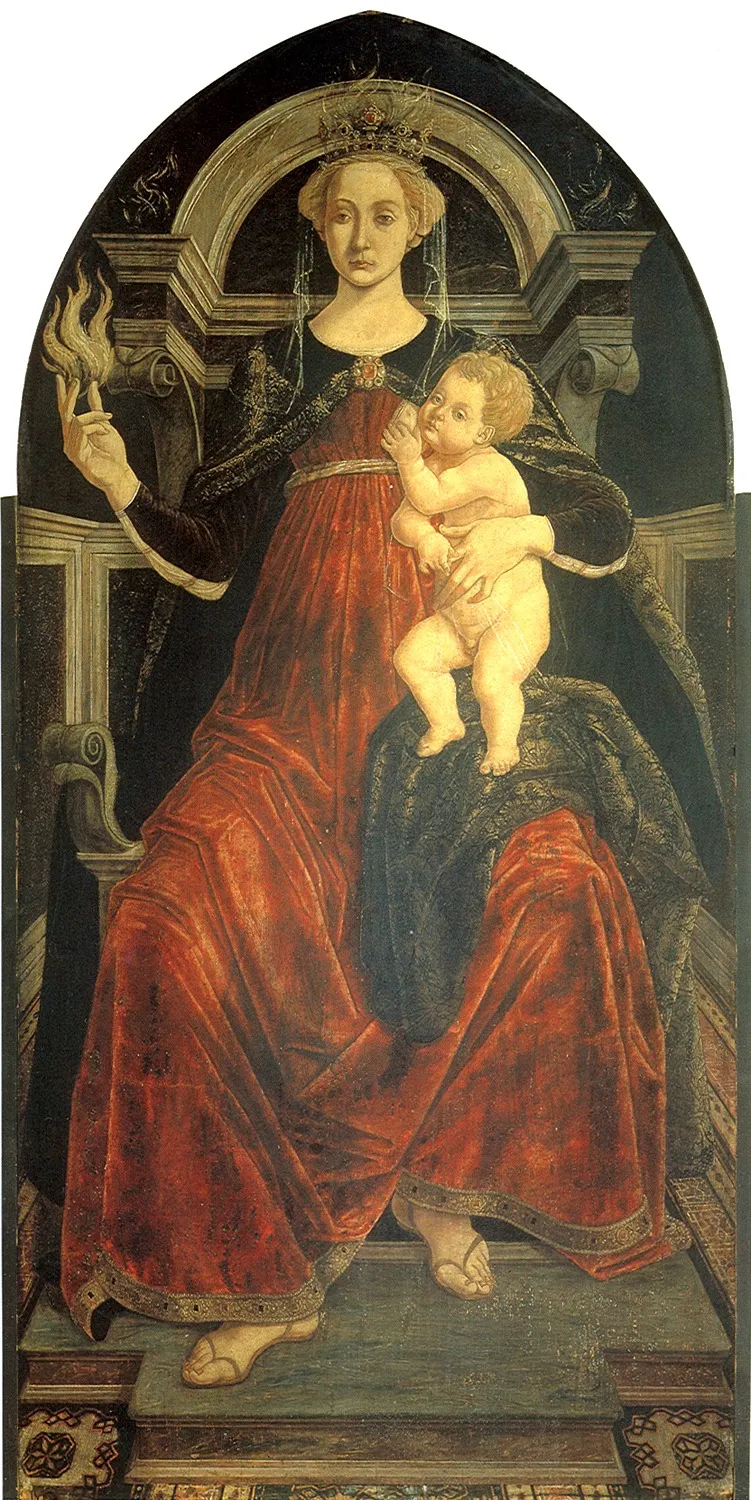
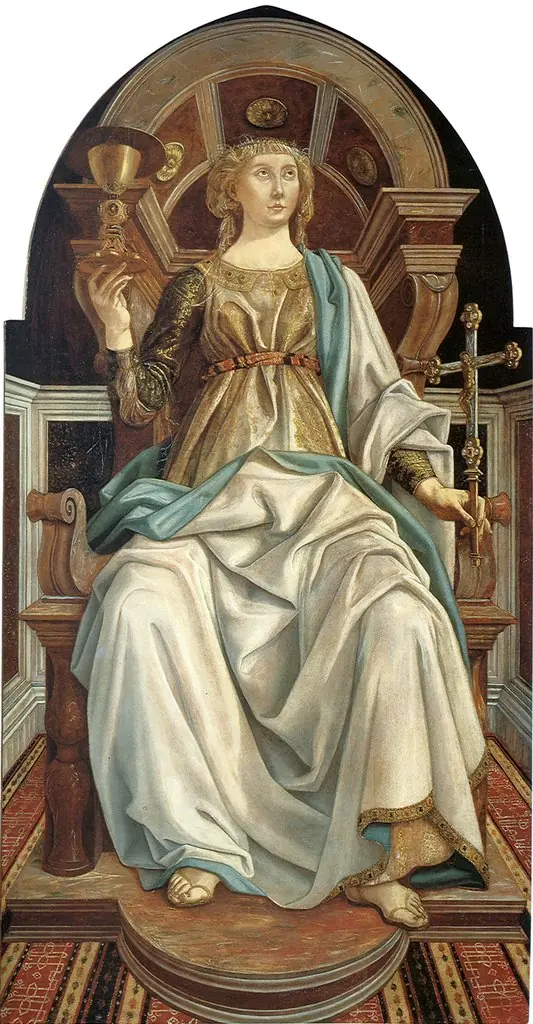
Charity is an oil painting by the Early Renaissance artist Piero del Pollaiuolo. It dates from 1469 and is held in the collection of the Uffizi Gallery.
About this work
Subject & Meaning
The composition reflects a complex perspective designed for high placement, featuring a throne with marble inlays and a crown adorned with precious stones.
The painting serves as an allegorical personification of the virtue of Charity, depicting a woman seated on a throne while breastfeeding an infant. This act of nursing symbolizes selfless love and care for others. The figure is further identified by a flaming torch held in her right hand, a traditional attribute distinguishing the virtue.
The composition reflects a complex perspective designed for high placement, featuring a throne with marble inlays and a crown adorned with precious stones. The work was commissioned by the Tribunale della Mercanzia to represent one of the cardinal virtues, intended to decorate the audience hall of the guilds' governing body in Florence.
History & Provenance
Commissioned by Florence's Tribunale della Mercanzia to decorate seat-backs in its audience hall, this work is part of a cycle depicting the cardinal virtues. The initial contract dates to 18 August 1469, with Charity being the first panel completed and delivered by December of that year. Although the commission was briefly transferred to Sandro Botticelli following delays, protests from Piero and his brother Antonio secured a second contract returning the project to Piero's workshop for the remaining six pieces.
Scholarly debate persists regarding the specific contributions of Antonio versus Piero, with attributions ranging from entirely Piero's hand to designs by Antonio executed by Piero. After the magistracy was suppressed, the painting entered the Uffizi Gallery collection in 1717. It suffered significant deterioration by the 19th century, remaining in storage until a restoration funded by the Fratelli Piccini jewellers was undertaken in 2003.
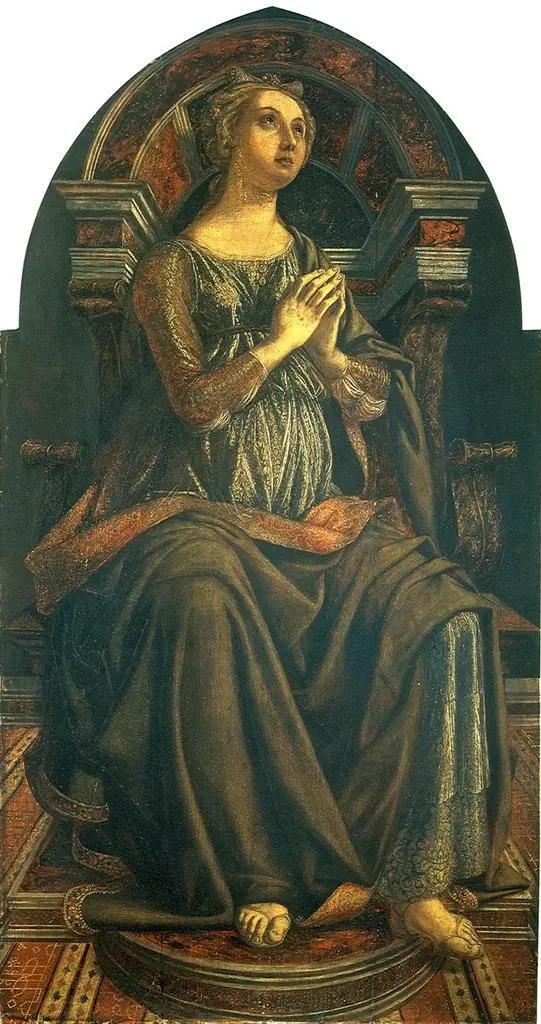
The painting has been held by the Uffizi Gallery in Florence since 1717, when it arrived there after the suppression of the Tribunale della Mercanzia, the Florentine magistracy that had originally commissioned it. By the nineteenth century the panels were in such poor condition that only Prudence from the cycle was on display, and the work was restored in 2003 thanks to a donation from the Fratelli Piccini jewellers of Florence, made in honour of the centenary of their shop on the Ponte Vecchio opened by Pirro Piccini in 1903.
No specific inventory or accession number is recorded in the available sources.
Context
Painted in 1469 for Florence's Tribunale della Mercanzia, Charity was the first of seven cardinal virtues commissioned to ornament seat-backs in the magistracy's audience hall on piazza della Signoria. The commission was briefly reassigned to the young Botticelli, likely after a delay by Pollaiuolo, before protests from Piero and his brother Antonio returned it to Piero's studio, which completed six of the seven panels while Botticelli painted the seventh, Fortitude.
Attribution between the brothers has long divided scholars. Document-based arguments by Billi, Albertini, and Cruttwell assign the whole cycle to Piero, while Ullman and others attribute all six works to Antonio on stylistic grounds, comparing them with his signed prints; a third view credits Antonio with the compositions and Piero with their execution. After the Tribunale was suppressed, the panels entered the Uffizi in 1717.
By the nineteenth century their poor condition restricted display to Prudence alone, until a 2003 restoration funded by the Florentine jewellers Fratelli Piccini marked the painting's recovery.
Legacy
The painting Charity by Piero del Pollaiuolo exerted lasting influence through its role in the series of virtuous allegories commissioned by Florence's Tribunale della Mercanzia in 1469. Its reception was shaped by prolonged disputes over authorship between Piero and his brother Antonio, with scholars divided between attributions to either hand. After the magistracy relocated to the Uffizi, the work entered public view from 1717, though 19th-century conservation concerns limited display to Prudence until a 2003 restoration enabled broader exhibition.
Contemporary assessments note its complex composition, innovative use of perspective, and detailed decorative elements reflecting Northern European influences, cementing its status as a key example of Early Renaissance allegory.
Overview
Created in 1469, Charity is a tempera panel by the Florentine painter Piero del Pollaiuolo. The composition shows a seated woman in a red, flowing gown, crowned and holding a child and a flaming heart, set against a dark backdrop. The work is part of the Uffizi Gallery’s collection and exemplifies early Renaissance allegorical painting.
Technique & Style
Executed in tempera, the painting displays the crisp linearity and careful modeling characteristic of Pollaiuolo’s workshop. The artist’s interest in anatomical precision is evident in the naturalistic rendering of the infant’s hand and the drapery’s folds. A limited palette of deep reds, golds, and a stark background heightens the figure’s presence and the symbolic flame.
Artist & collection
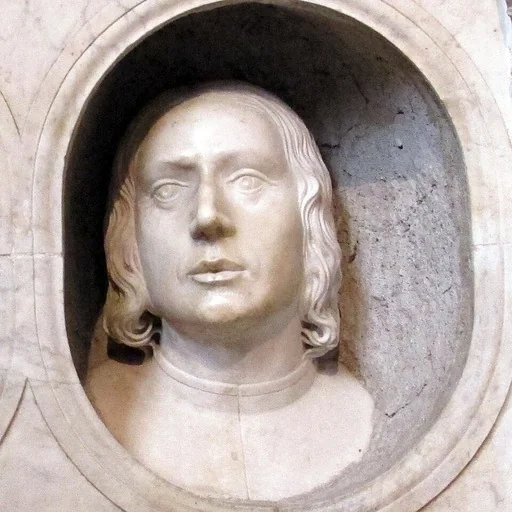
Artist
Piero del Pollaiuolo (UK: POL-eye-WOH-loh, US: POHL-, Italian:; also spelled Pollaiolo; c.

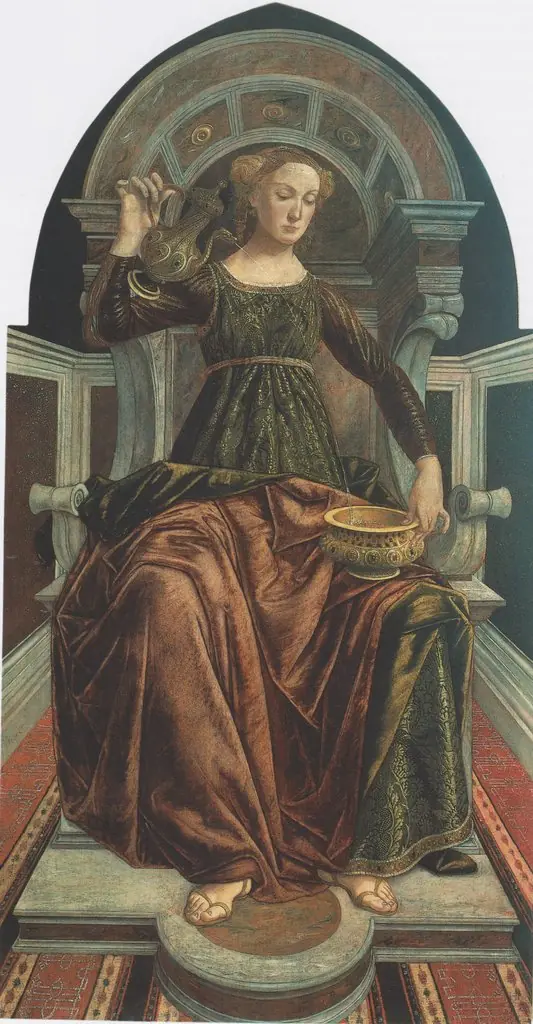
- Hope
 Central panel San Cassiano Altarpiece
 Mary enthroned with child
 Madonna and Child Enthroned with Two Angels and a Donor
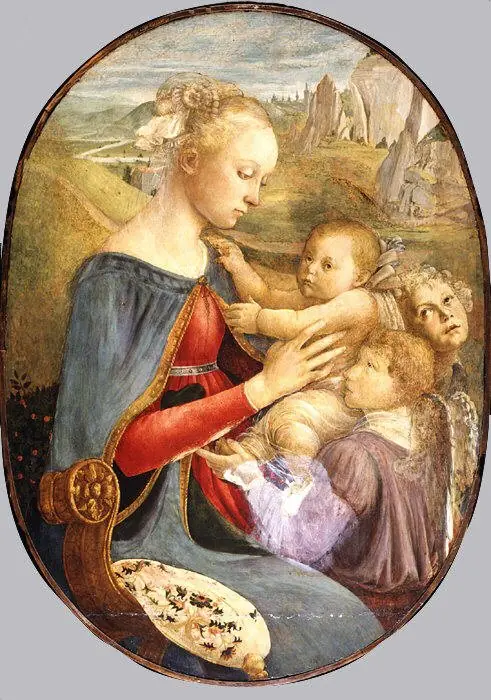 Madonna and Child with Two Angels
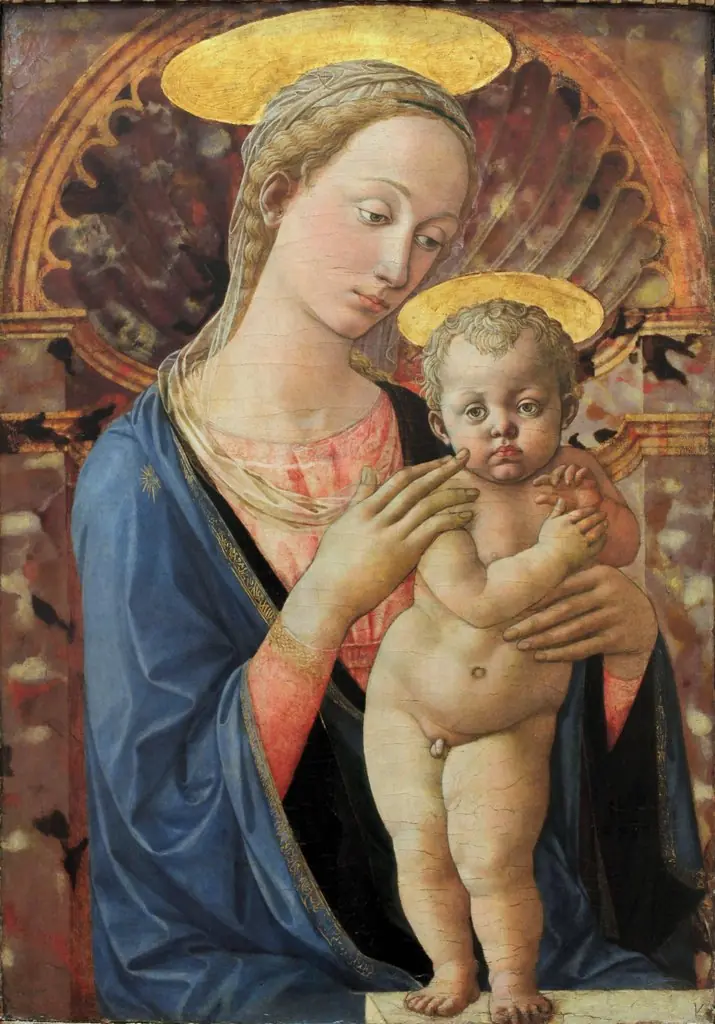 Virgin and child
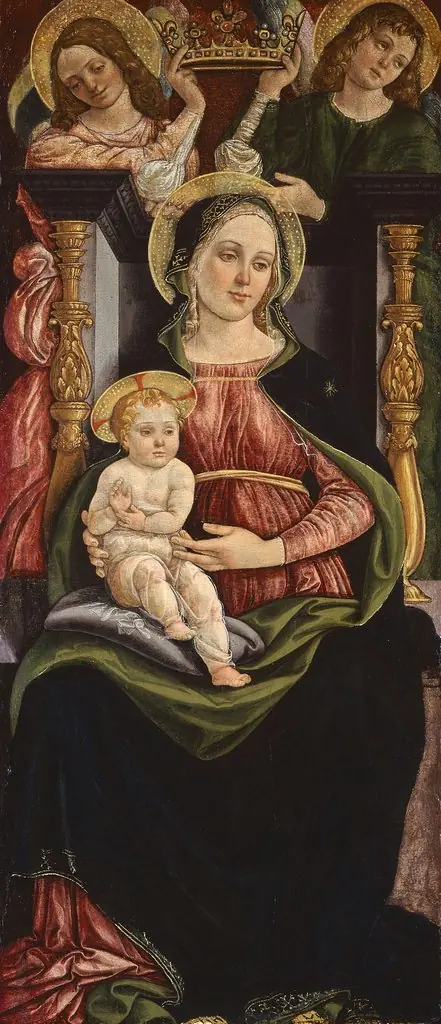 Virgin and Child Enthroned with Two Angels Holding a Crown
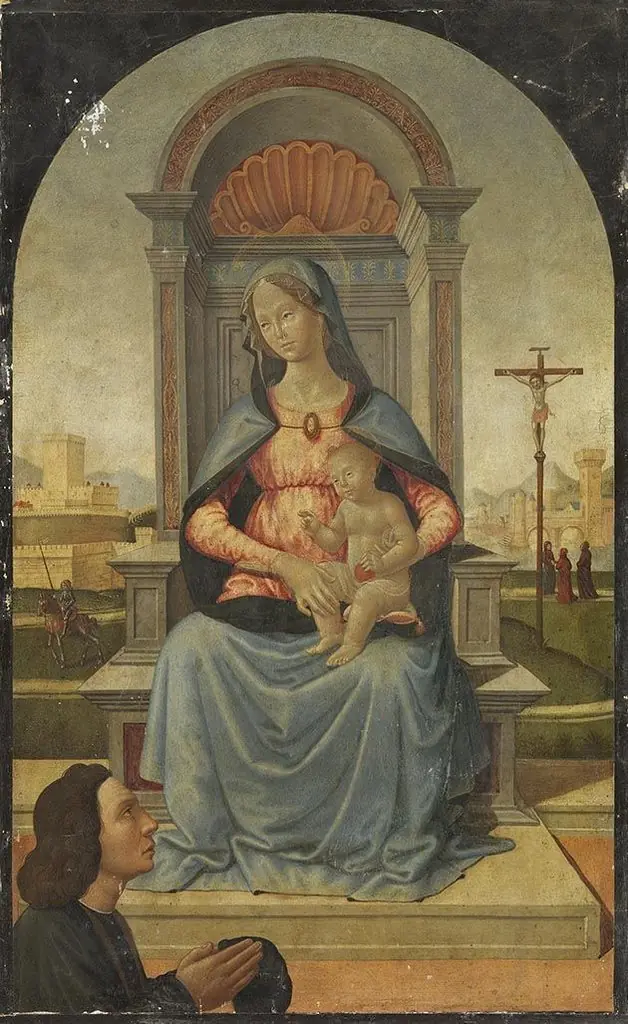 Maria mit Kind
 Madonna and Child
 Virgin and Child on the Throne
 Virgin and Child