Artwork
Saint Apollonia
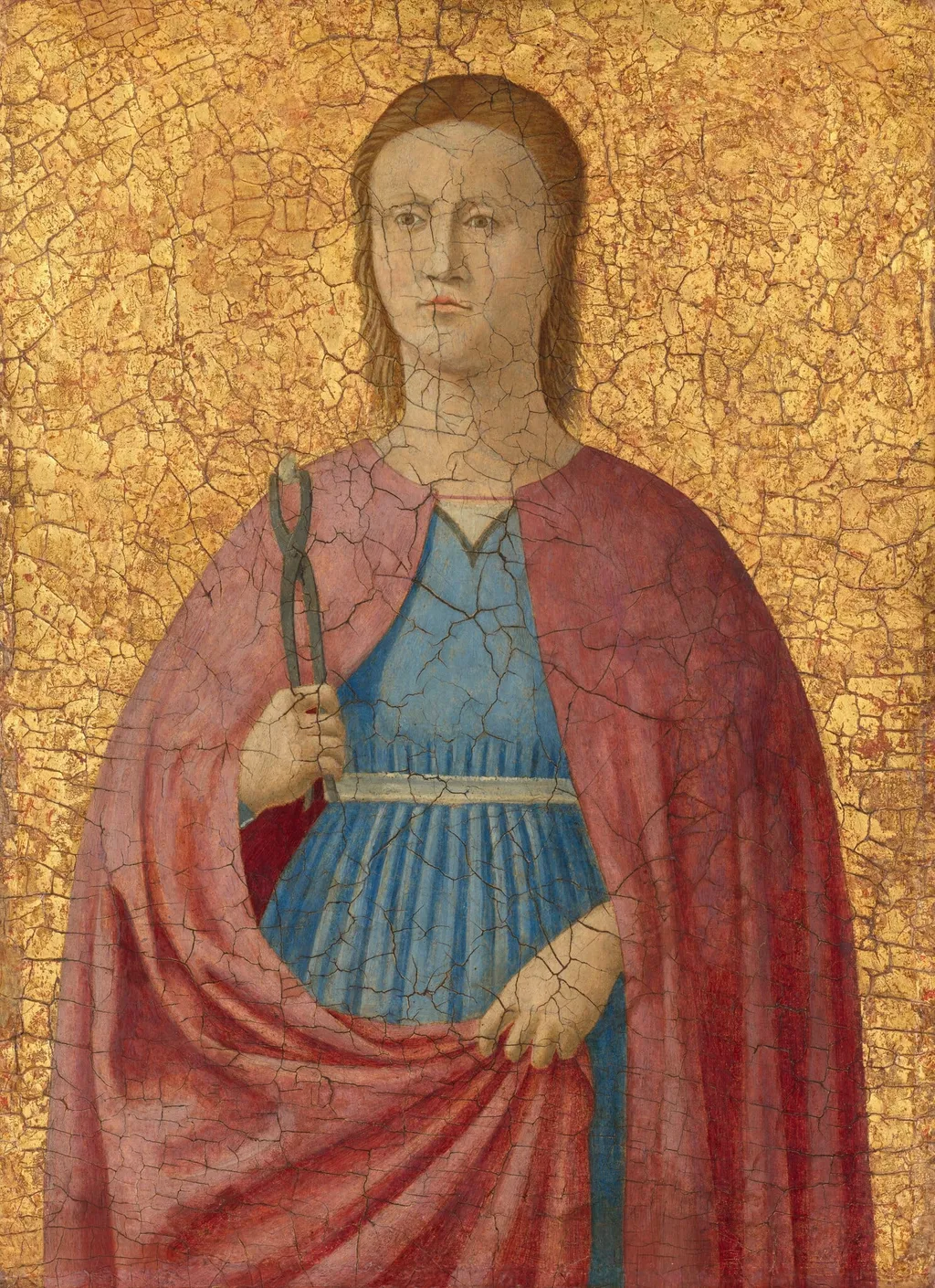
Saint Apollonia is a tempera painting by the Early Renaissance artist Piero della Francesca. It dates from 1458 and is held in the collection of the National Gallery of Art.
About this work
Subject & Meaning
Saint Apollonia is depicted as a young martyr holding a pair of forceps with a tooth, the instrument of her torture, signifying her steadfast faith.
Saint Apollonia is depicted as a young martyr holding a pair of forceps with a tooth, the instrument of her torture, signifying her steadfast faith. She wears a vivid red mantle over a blue tunic, a visual contrast that emphasizes her sanctity within the polyptych. The work belongs to the Early Renaissance and was originally part of Piero della Francesca's Sant'Agostino altarpiece, commissioned for the church of Sant'Agostino in Borgo San Sepolcro in 1454 and later dismantled after 1652. Its iconography links her to the Augustinian community and underscores themes of sacrifice and divine protection.
Technique & Style
The work is executed in tempera on a poplar panel, a support typical of early fifteenth-century Italian altarpieces. The figure's pose is calm and monumental, reflecting a composed, sculptural modeling, while the handling of drapery is somewhat schematic and rigid. Saint Apollonia holds a pair of forceps, with a vivid red mantle and blue tunic that contrast against the darker habits of the surrounding saints.
History & Provenance
The panel was commissioned by the friars and lay patrons of the church of Sant'Agostino in Borgo San Sepolcro, with a contract dated 4 October 1454 and final payment recorded before 21 May 1470. Originally positioned on the main altar of Sant'Agostino, it was transferred with the Augustinian community to the Pieve di Santa Maria in 1555 and remained there until the altarpiece was dismantled sometime after 1652. Ownership subsequently passed through the Duci brothers, Giuseppe Franceschi Marini (by 1835), his son Piero Franceschi Marini (until at least 1904), the dealer F. Kleinberger & Co., Philip Lehman (1914), the Samuel H. Kress Foundation (1943), and was gifted to the National Gallery of Art in 1952 (accession number 1952.1.15).
The panel was exhibited in 1985 at the Frick Collection, New York, and again in 2007 at the National Gallery of Art in the exhibition "Piero della Francesca: The Altarpiece of the Augustinian Church."
Context
Saint Apollonia is one of the dispersed lateral panels from Piero della Francesca's dismantled Sant'Agostino Altarpiece, originally commissioned in 1454 and completed by 1469. Its attribution remains debated: while the composition reflects Piero's hallmark solemnity, the schematic handling of folds and some rigidity have prompted discussion of workshop participation. The panel's later history, moved between churches, dismembered after 1652, and surfacing on the nineteenth-century antiquarian market, underscores the broader fate of such polyptychs.
Its inclusion in the Samuel H. Kress collection and subsequent transfer to the National Gallery of Art has anchored scholarly discussion of Piero's late production and the reception of his workshop's output among American collectors in the early twentieth century.
Overview
Piero della Francesca's painting, titled Saint Apollonia, was created around 1458. This tempera on poplar panel work depicts the Christian martyr Saint Apollonia and is characteristic of the Early Renaissance period. The artwork showcases the artist's meticulous approach to figural representation, presenting a serene portrayal of a figure known for her steadfast faith and suffering.
Own this work as a print
Artist & collection


![Saint Catherine of Alexandria, with an Angel [right panel], by Pietro Lorenzetti](https://artifactworldgallery.com/img/pietro-lorenzetti--saint-catherine-of-alexandria-with-an-angel-right-panel--8acb359f1d360041-w320.webp)

![Saint Mary Magdalene, with an Angel [left panel], by Pietro Lorenzetti](https://artifactworldgallery.com/img/pietro-lorenzetti--saint-mary-magdalene-with-an-angel-left-panel--c015f106a0790d0d-w320.webp)