Artwork
The Visit
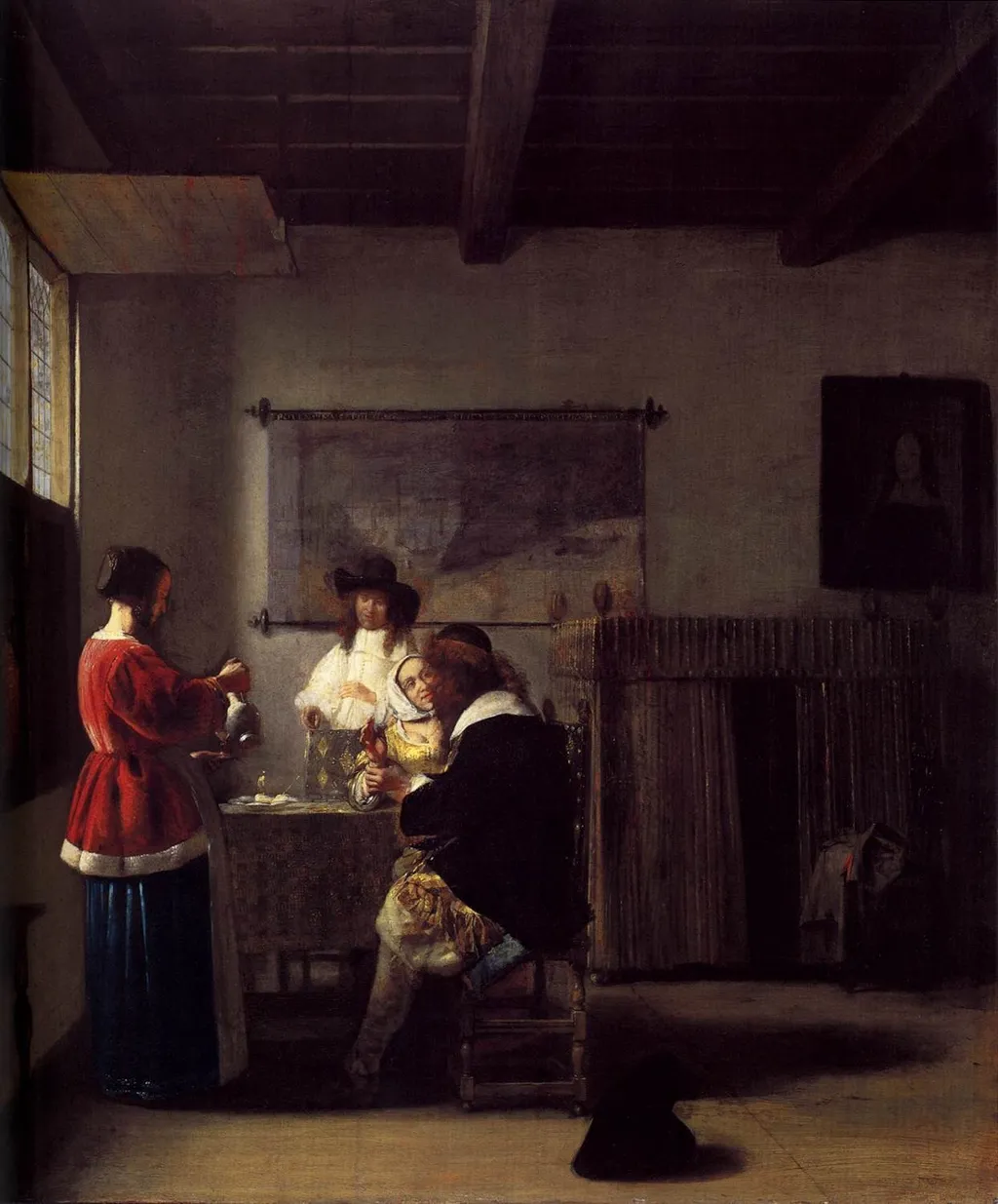
The Visit is an oil painting by the Dutch Golden Age artist Pieter de Hooch. It dates from 1657 and is held in the collection of the Metropolitan Museum of Art.
About this work
Four people enjoy each other's company in a sunlit room. Pieter de Hooch painted this about 1657 in oil, not as portraits but as a shared moment, the kind of scene the Dutch called a Merry Company. Light and space do much of the work in setting the mood.
Subject & Meaning
Further symbolism includes a map hanging on the rear wall and a bowl of oysters on the table, traditionally associated with aphrodisiac qualities.
Also known as Merry Company with Two Men and Two Women, this 1657 work exemplifies the Dutch Golden Age genre of the merry company, depicting figures enjoying social interaction rather than specific portraits. The scene shows four individuals in an interior: a maid pouring wine while a gentleman observes her, and another man holding the arm of a seated woman who returns a mischievous glance. Iconographic details suggest a narrative of courtship; scattered clothing, the physical contact between the seated couple, and the serving of alcohol imply a love scene.
Further symbolism includes a map hanging on the rear wall and a bowl of oysters on the table, traditionally associated with aphrodisiac qualities. The painting serves as a transitional piece in de Hooch's career, merging his earlier tavern scenes with sophisticated domestic interiors.
Technique & Style
The Visit, painted in 1657 and classified as a genre painting, is executed in oil on a wooden panel measuring roughly 68 × 58 cm. The smooth, lightly grained panel supports thin layers of oil paint, allowing fine glazing that creates luminous effects of light and color. De Hooch arranges the figures in a carefully constructed interior, using linear perspective in the floorboards, window frame, and wall paneling to suggest depth, while a large window modulates illumination from the left. The handling of brushwork is restrained, with details such as the fur-trimmed jacket and the reflective surface of the wine glass rendered with precise strokes that emphasize texture. The composition demonstrates the artist's transition toward more complex spatial schemes in the late 1650s.
History & Provenance
Created circa 1657 by Pieter de Hooch, The Visit (also titled Merry Company with Two Men and Two Women) is an oil-on-panel work documenting a pivotal moment in the artist's shift toward domestic interiors. Its provenance begins with a likely 1784 sale in Amsterdam before the work entered the collection of Baron François-Marie Delessert in Paris by 1833. It was subsequently auctioned to B. Narischkine in 1869 and to Eugène Secrétan in 1889.
In July 1889 the dealer Paul Durand-Ruel acquired the piece for the Havemeyer collection in New York. Following the death of Louisine Havemeyer, the work was bequeathed to the Metropolitan Museum of Art in 1929, where it is held under accession number 29.100.7.
Context
The Visit (c. 1657) serves as a pivotal work in Pieter de Hooch's career, marking his transition from tavern scenes to domestic interiors, a shift aligning him with contemporaries such as Johannes Vermeer. Although the painting retains elements of the 'merry company' genre, its spatial depth and bourgeois setting foreshadow the artist's mature style. Nineteenth-century scholarship occasionally misattributed the work to Vermeer, a view noted by the critic Thoré-Bürger in 1866.
Modern analysis, such as that by Walter Liedtke, identifies the painting as a bridge between de Hooch's earlier output and his later focus on light and perspective. The work's significance is underscored by its high-profile provenance, including an 1889 sale that made it one of the most expensive Dutch paintings of the era.
Legacy
The Visit has been cited as a transitional work in Pieter de Hooch's oeuvre, marking a shift from tavern scenes to refined domestic interiors that anticipated later Dutch Golden Age interior painting. Nineteenth-century attributions to Johannes Vermeer attest to its reception as a masterpiece of light and color. Its market trajectory, selling for 150,000 francs in 1869 and reaching 276,000 francs by 1889, elevated its status among Dutch paintings of the period.
Since entering the Metropolitan Museum of Art in 1929 as part of the Havemeyer bequest, it has been treated as a key example of genre painting, frequently discussed in relation to Vermeer's interiors and cited in scholarship such as Walter Liedtke's 2001 study Vermeer and the Delft School.
Overview
Pieter de Hooch's painting, The Visit, executed around 1657, captures a domestic scene in oil on panel. Also known by the title Merry Company with Two Men and Two Women, this work is a notable example of Dutch Golden Age genre painting. It currently resides in the collection of The Metropolitan Museum of Art in New York, offering insight into 17th-century social depictions.
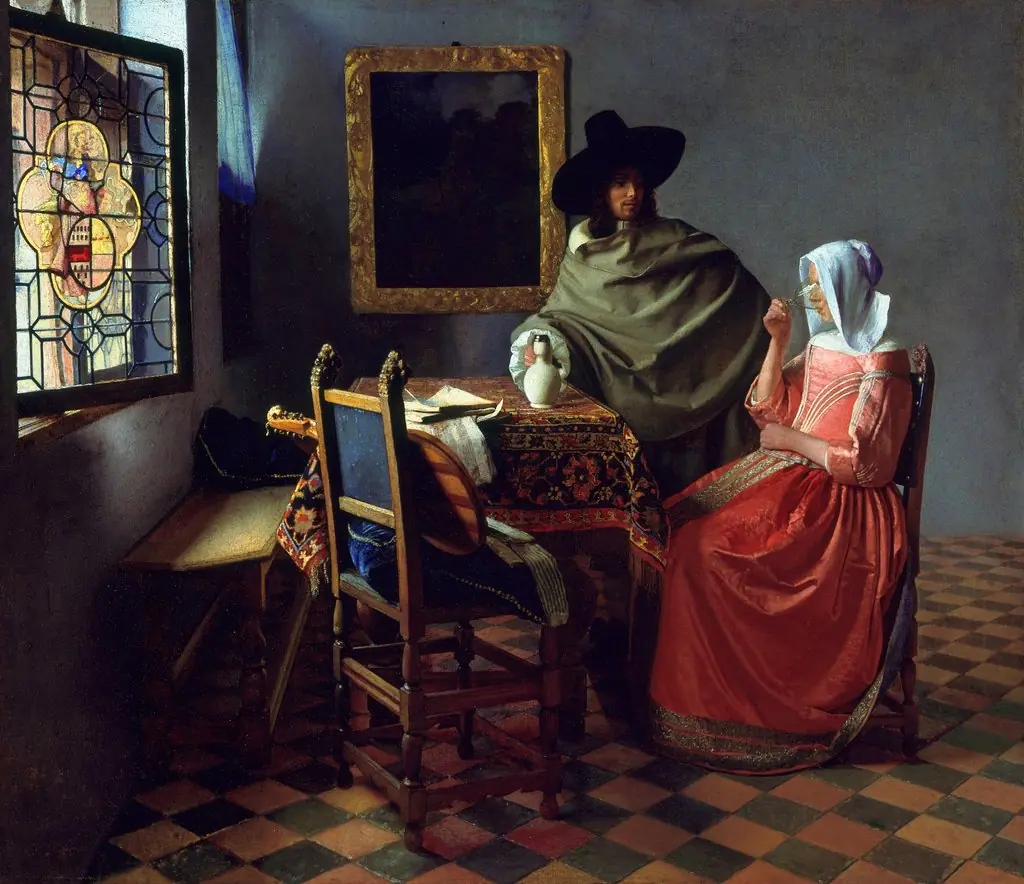
Own this work as a print
Artist & collection
Artist
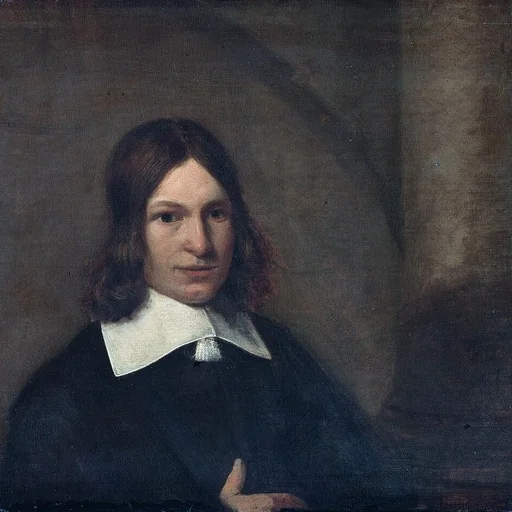
Pieter Hendricksz. de Hooch (Dutch:; also spelled Hoogh or Hooghe; bapt. 20 December 1629 – after 1683), was a Dutch Golden Age painter famous for his genre works of quiet domestic scenes with an open doorway. He was a…

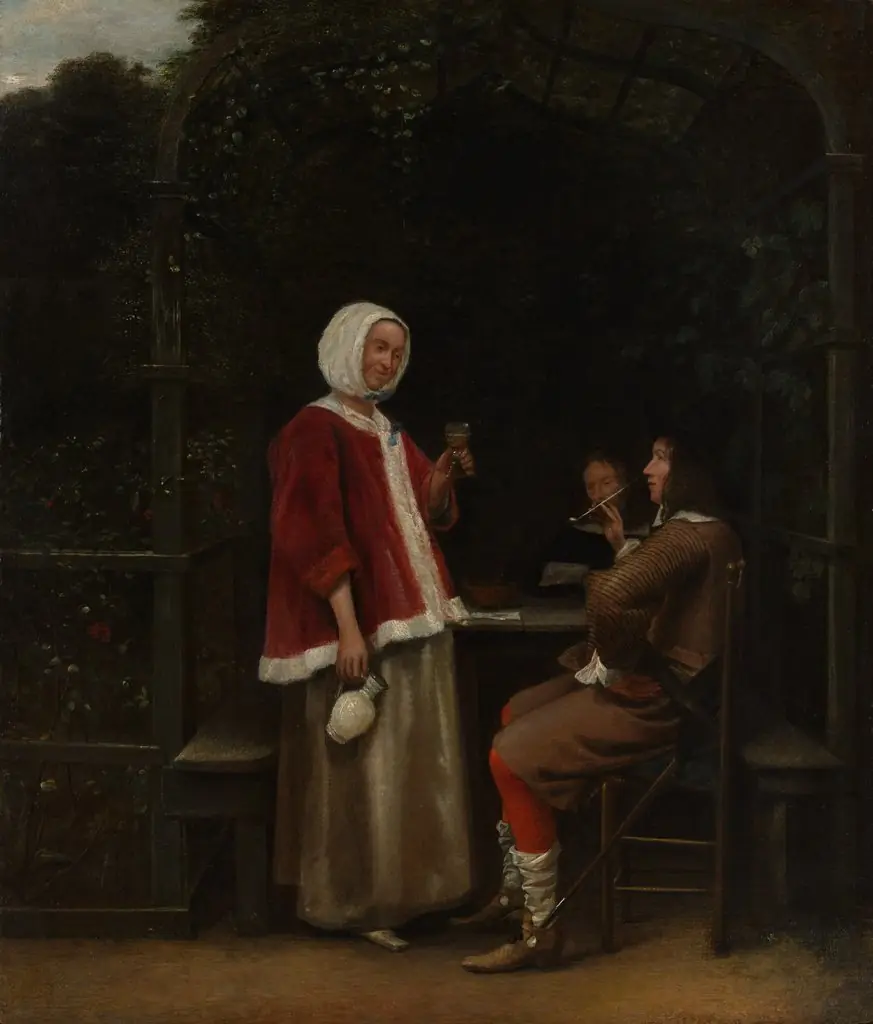
- The Wine Glass
 Officer in a Cloth Shop
 The Game of Cards
 Distribution of Charity in the Alms-House
 Family Group in an Interior
 Soldiers Beside a Fireplace
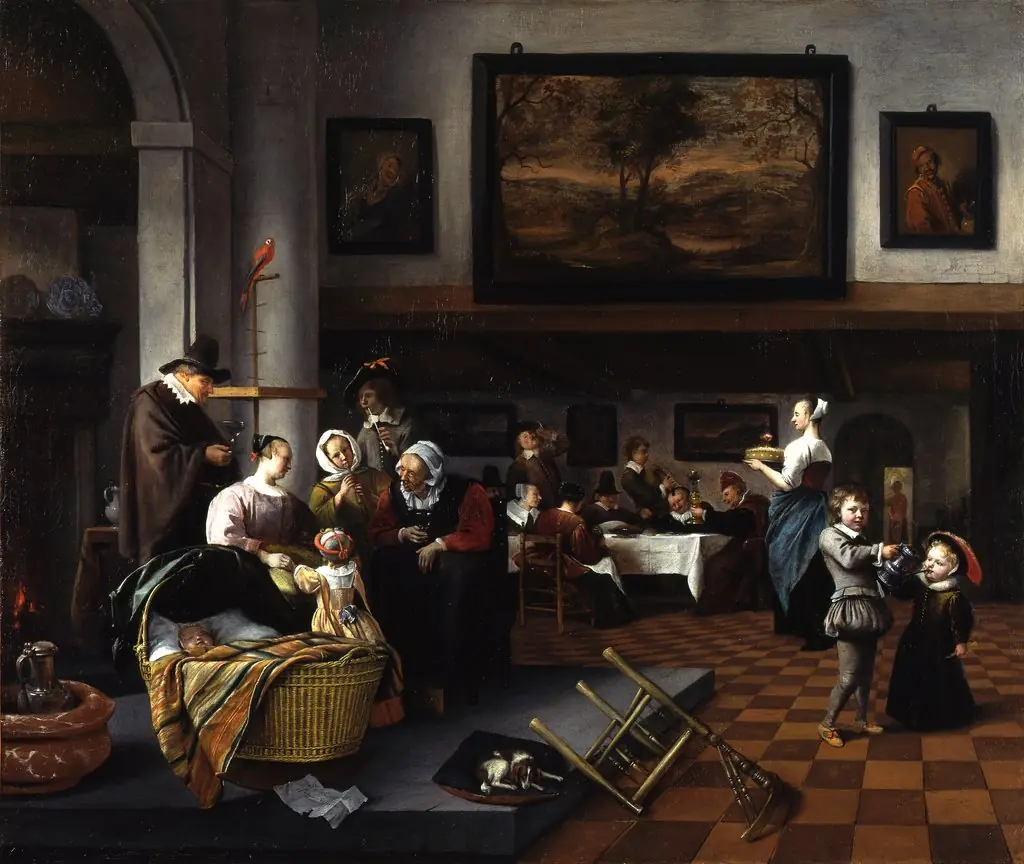 The Christening
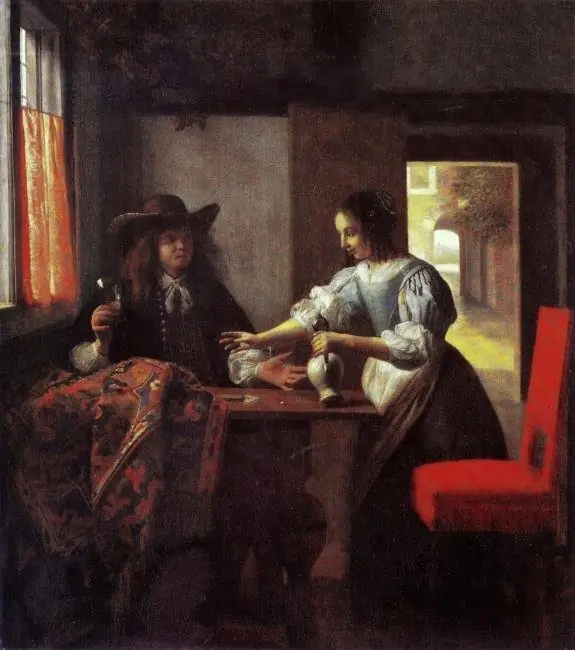 Man with a glass and a woman with a jug in an interior
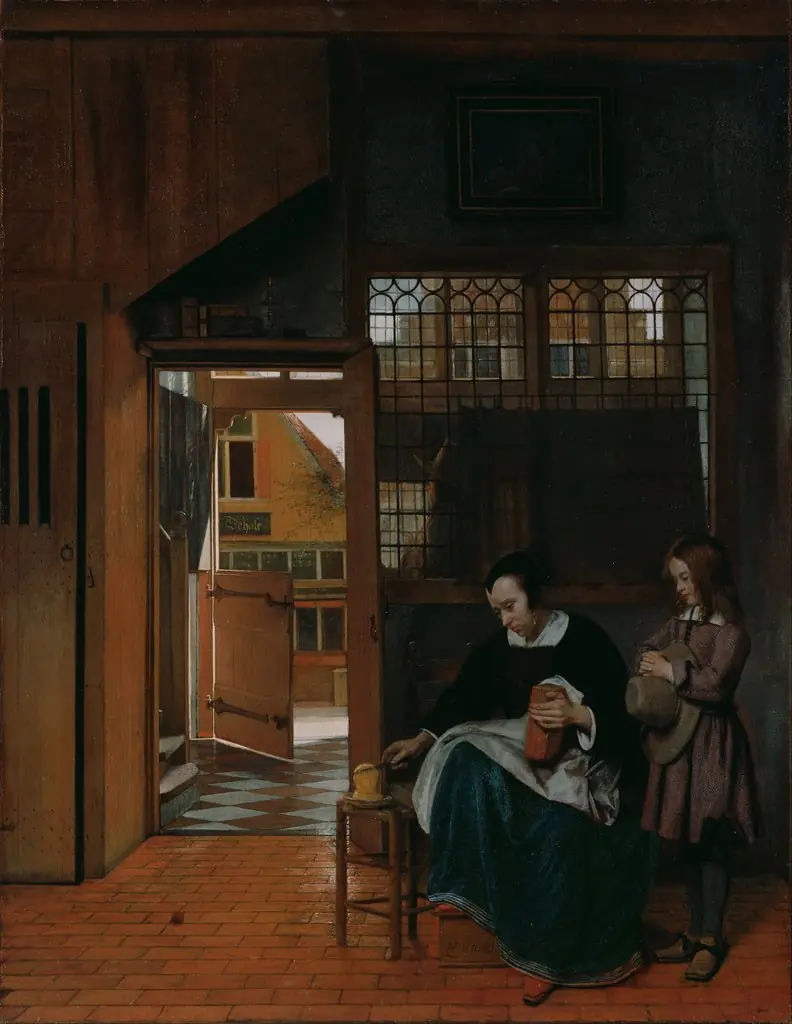 A Woman Preparing Bread and Butter for a Boy
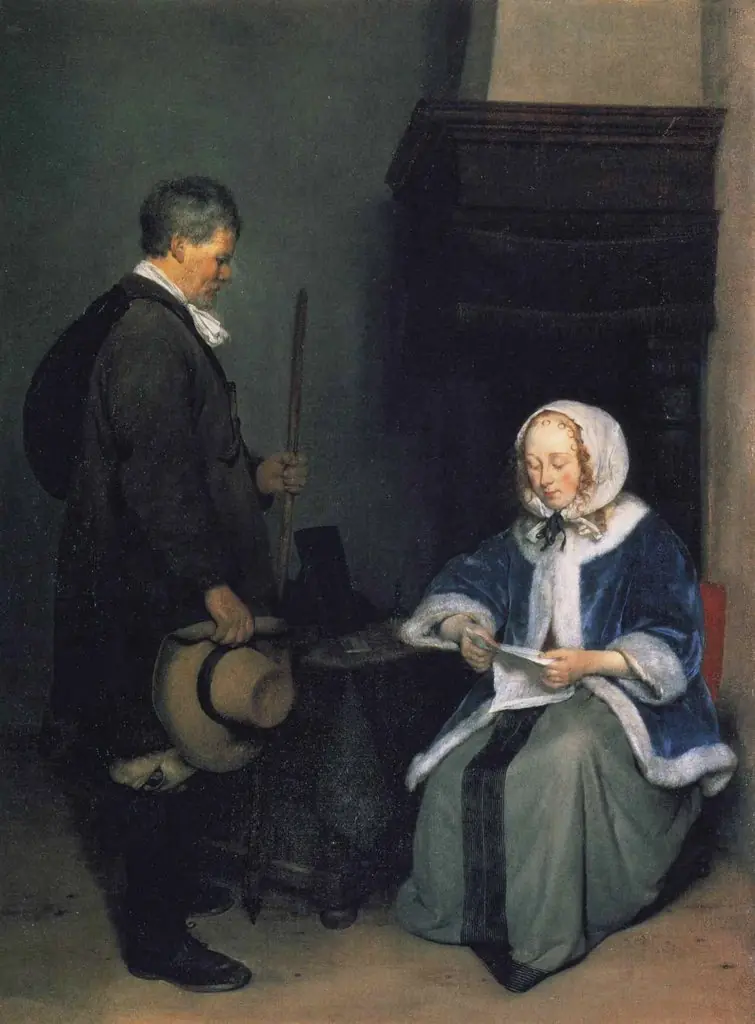 Sitting Lady Reading a Letter with a man
 Brothel Scene
 Interieur mit drei Frauen und einem Mädchen