Artwork
Possibly William Sheldon
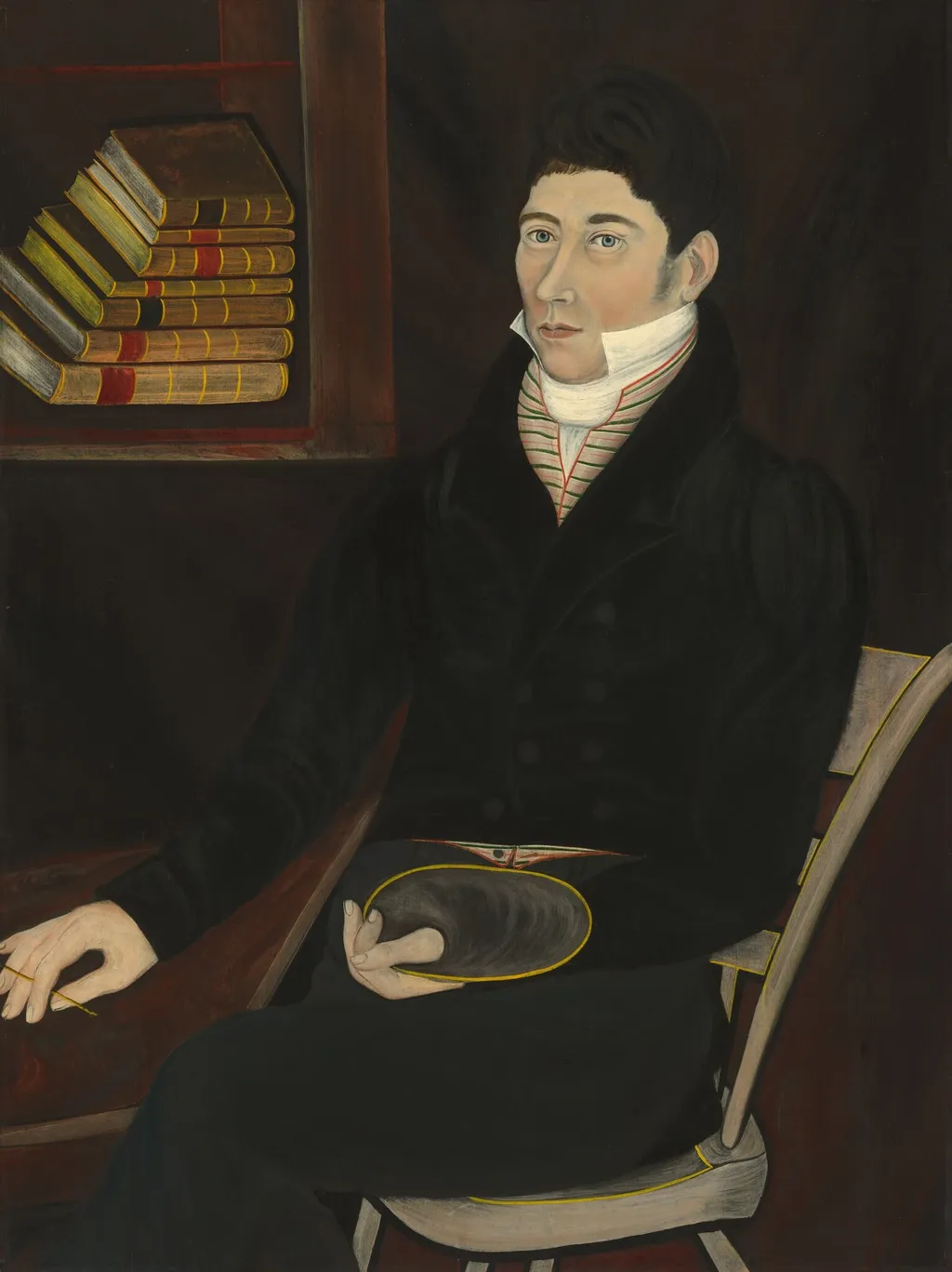
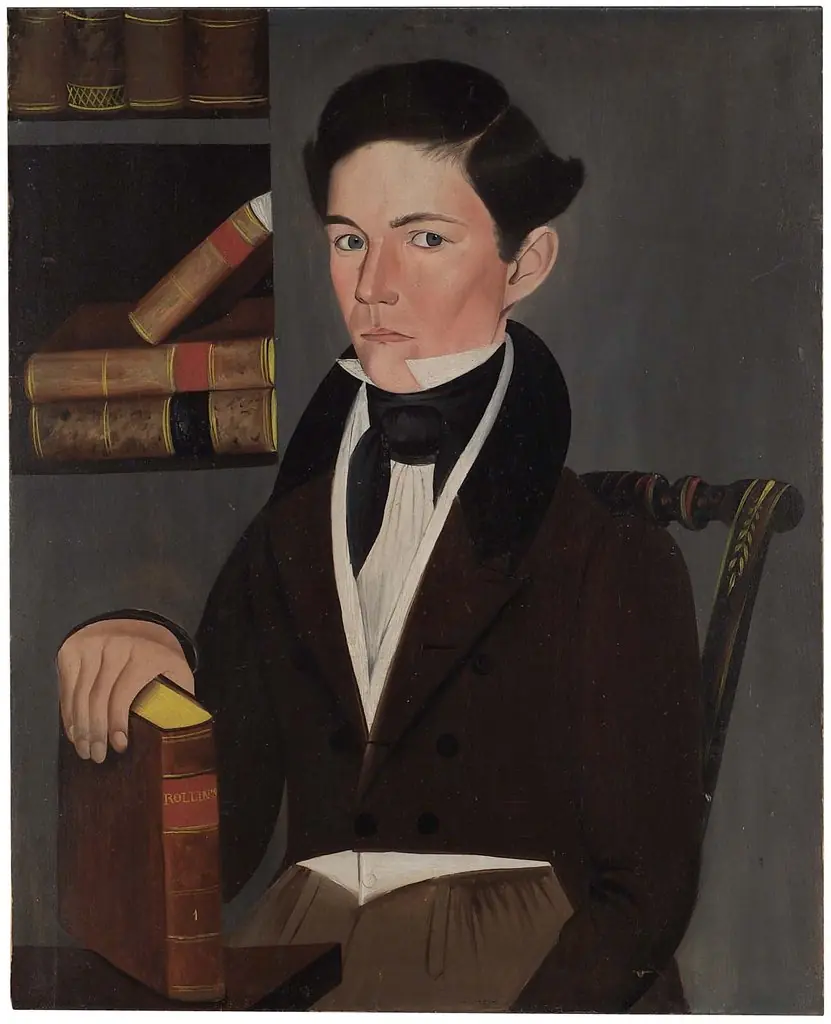
Possibly William Sheldon is an oil painting by the Romanticist artist Asahel Powers. It dates from 1831 and is held in the collection of the National Gallery of Art.
About this work
Overview
7 centimeters (41 1/8 by 31 inches), the painting is now held in the collection of the National Gallery of Art, Washington, as accession number 1953.
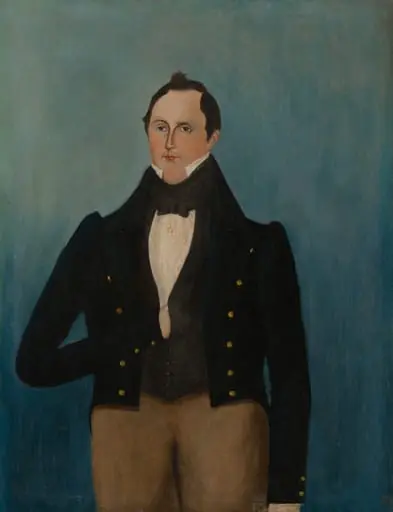
Possibly William Sheldon is an oil-on-wood portrait painted circa 1831 by Asahel Powers, an American itinerant artist active in New England during the early nineteenth century. Measuring 104.4 by 78.7 centimeters (41 1/8 by 31 inches), the painting is now held in the collection of the National Gallery of Art, Washington, as accession number 1953.5.50, following its acquisition in 1953 as a gift from Edgar William and Bernice Chrysler Garbisch. The work exemplifies Powers' early portraiture and occupies an important place in the study of American naive painting, though the identity of its sitter remains uncertain despite long-standing assumptions.
Subject & Meaning
The portrait depicts a seated gentleman occupying the right two-thirds of the composition, his body turned toward the viewer while his face looks slightly left. He wears a black coat, dark trousers, a white high collar, and a red and green striped cravat, with a black hat featuring a yellow band held in his left hand. His right hand rests on a wooden table edge, grasping a small dark object. Behind him to the left, a wooden shelf holds eight stacked books with gold, red, and black spines. The iconography of dress and accessories signals respectable middle-class status: the formal coat and cravat, the hat as a gentleman's accessory, and particularly the books, which suggest literacy and intellectual pursuits. The sitter's direct, composed presentation and the inclusion of these status symbols follow conventions of early American portraiture, where objects encoded social identity. The painting's title reflects enduring uncertainty about the sitter's identity. An inscription on the reverse of a companion portrait, now no longer visible but known through a photograph, reads Mrs. J.B. Sheldon / Unionville, O, leading to long-standing identification of the pair as Mr. and Mrs. J. B. Sheldon of Unionville, Ohio. However, research by residents of J. B. Sheldon's home demonstrated that these Sheldons were later owners rather than sitters, and comparison with Powers' handwriting confirmed that another hand added the inscription. The true identity of the gentleman remains unknown.
Technique & Style
Powers executed the portrait in oil on wood panel, a support characteristic of his early works and common among itinerant American painters of the period. The technique displays the hallmarks of naive or folk painting: smooth brushwork with flat color areas, crisp edges in the clothing and books, and forms outlined and filled with unmodulated color rather than modeled through gradual tonal transitions. Light falls evenly on the face and hands with minimal shadow, and no visible brushstrokes suggest atmospheric effects. The palette is dominated by black, deep brown, and white, with touches of red, green, and yellow appearing in the cravat, book spines, and hat band. The chair features light-colored wooden rails with yellow trim, while the floor appears as reddish brown and the background as a flat dark brown. This handling prioritizes clarity and pattern over illusionistic depth, with the two-dimensional arrangement of shapes and colors creating a direct, unmediated presence that distinguishes Powers' approach from academically trained contemporaries.
History & Provenance
The painting's documented ownership begins with Mrs. Jerome Bonaparte Sheldon (née Caroline Grover, circa 1829-1872 or later) of Unionville, Ohio. It was later purchased in Clyde, New York, by the Downtown Gallery, New York, which sold it in 1948 to Edgar William and Bernice Chrysler Garbisch, the prominent collectors of American folk art. The Garbisches gave the portrait to the National Gallery of Art in 1953. The work has been exhibited extensively, beginning with The American Family, Folk Paintings 1750-1850 at the Downtown Gallery in 1948, where it appeared as Mr. J. B. Sheldon. It featured in three exhibitions at the National Gallery of Art between 1954 and 1957 as part of presentations of the Garbisch collection, and returned to the Gallery in 1955 for American Primitive Paintings. Later exhibitions include Asahel Powers, Painter of Vermont Faces at the Abby Aldrich Rockefeller Folk Art Center in Williamsburg in 1973; American Folk Painters of Three Centuries at the Whitney Museum of American Art in 1980; American Naive Paintings from the Garbisch Collection at the Taubman Museum of Art in Roanoke, Virginia, in 2010; and Edith Halpert: The Downtown Gallery and the Rise of American Art at the Jewish Museum, New York, in 2019-2020.
Context
Asahel Powers was born in Springfield, Vermont, in 1813 and began his career as an itinerant portraitist at an exceptionally young age; by eighteen, he had already established a reputation, with his first attributed work, a portrait of Dr. Joel Green of Rutland, Vermont, also dated 1831. During the 1830s, he traveled through Vermont, Massachusetts, and New Hampshire, working in New York's Clinton and Franklin counties from 1839 to 1841 before moving to Olney, Illinois, where he died in 1843. No known works survive from his Illinois period. Powers belongs to the tradition of American naive or folk portraiture, produced by self-taught artists working outside academic institutions. Scholarly attention to his work was significantly advanced by Nina Fletcher Little, whose 1973 exhibition and catalogue Asahel Powers, Painter of Vermont Faces at the Abby Aldrich Rockefeller Folk Art Center established foundational documentation of his career. Deborah Chotner and colleagues included the portrait in the 1992 systematic catalogue American Naive Paintings for the National Gallery of Art, providing detailed analysis of its place within Powers' oeuvre and the broader Garbisch collection. The misidentification of the sitter as J. B. Sheldon, corrected only in 1989 through research by Jim and Gerri Regan, illustrates the challenges of provenance research for itinerant painters' works and the ways in which later inscriptions can obscure rather than clarify historical identity.
Legacy
Possibly William Sheldon has contributed to the evolving understanding of Asahel Powers and American naive portraiture through its inclusion in major exhibitions and scholarly publications over more than seven decades. Its 1948 exhibition at the Downtown Gallery, a pioneering commercial venue for American folk art under Edith Halpert, helped establish the critical and market recognition of such works. The portrait's inclusion in the Garbisch collection and subsequent gift to the National Gallery of Art ensured its preservation and accessibility for study. Its appearance in the 2019-2020 Jewish Museum exhibition on Halpert and the Downtown Gallery underscored its significance in narratives of American art dealership and collection. The eventual correction of its sitter's identity, displacing the long-accepted J. B. Sheldon attribution, serves as a cautionary example within the field about the need to verify inscribed provenance against documentary and material evidence. As a representative early work by Powers, the painting continues to support scholarship on the visual culture of the American Northeast in the decades before the rise of photography, when itinerant portraitists provided the primary means of visual self-representation for middle-class Americans.
Own this work as a print
Artist & collection
Artist
Asahel Lynde Powers (February 28, 1813 – 1843) was an American painter active in New England.