Artwork
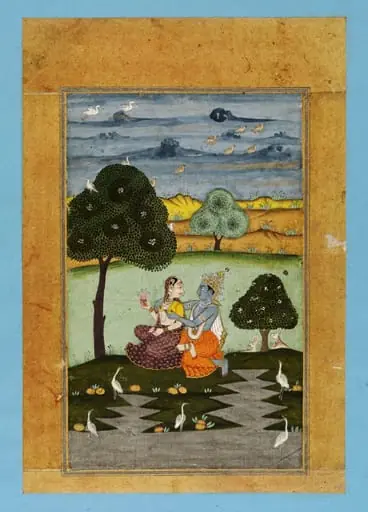
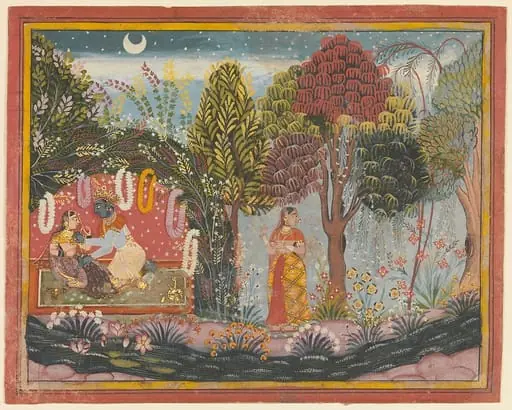
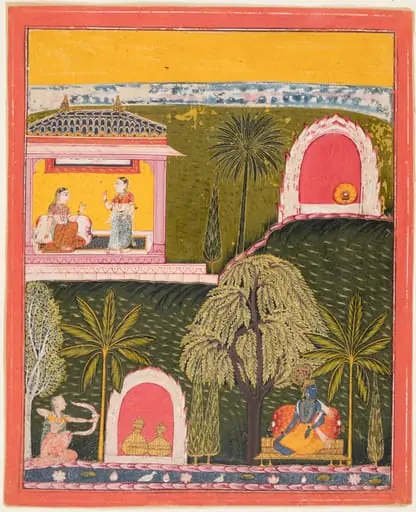
Sakhi persuades Radha to meet Krishna, from a Gita Govinda (Song of the Cowherd) of Jayadeva
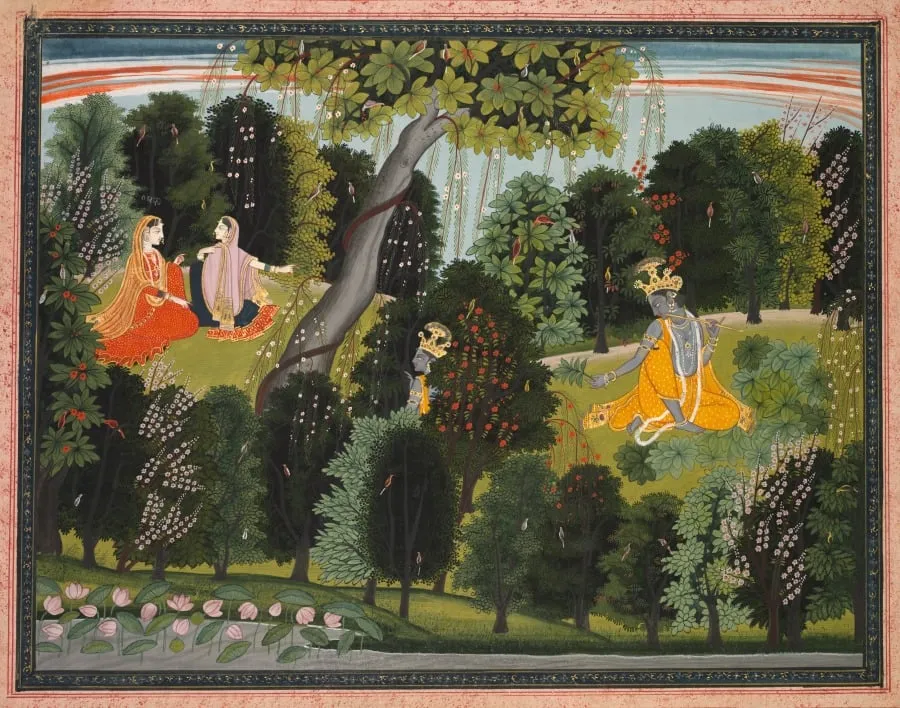
Sakhi persuades Radha to meet Krishna, from a Gita Govinda (Song of the Cowherd) of Jayadeva is an unspecified painting by the Indian Miniature artist Purkhu of Kangra. It dates from 1822 and is held in the collection of the Cleveland Museum of Art. This painting illustrates a scene from the Gita Govinda, a 12th-century devotional poem by Jayadeva.
- Accession no.
- 1989.334
- Credit line
- Bequest of Mrs. Severance A. Millikin
About this work
Overview
This painting illustrates a scene from the Gita Govinda, a 12th-century devotional poem by Jayadeva. It captures a private moment between Radha, Krishna, and Radha’s confidante, the sakhi, set in a forest at twilight. The composition condenses multiple stages of the narrative into a single image, using spatial and temporal layering to convey unfolding emotion without movement.
Subject & Meaning
Radha, Krishna’s beloved, is portrayed as reluctant, urged forward by her sakhi, who acts as both messenger and moral guide. Krishna appears twice: once preparing a leafy bed for their meeting, and again observing her from concealment. This duality reflects the tension between divine longing and human hesitation, central to the poem’s theme of yearning as spiritual devotion.
Technique & Style
The artist employs delicate brushwork and luminous pigments to contrast the warm hues of Radha’s garments and the fading sky with Krishna’s deep blue form.
The artist employs delicate brushwork and luminous pigments to contrast the warm hues of Radha’s garments and the fading sky with Krishna’s deep blue form. The forest is rendered with rhythmic, stylized trees that frame the figures, enhancing the intimacy of the scene. The use of twilight as a backdrop heightens the emotional weight, while the repetition of Krishna’s figure creates a visual rhythm that guides the viewer through the narrative.
History & Provenance
Produced in the Pahari region of northern India, likely in the 18th century, this work belongs to a tradition of illustrated manuscripts inspired by Jayadeva’s poetry. These paintings were commissioned by local rulers and courtly patrons who valued devotional literature. The style reflects the influence of Mughal naturalism blended with indigenous Himalayan aesthetics, common in the hill kingdoms of Kangra and Guler.
Context
The Gita Govinda was widely circulated in devotional circles across North India, inspiring visual and performative arts. Its portrayal of divine love as intimate and earthly resonated with Bhakti movement ideals, which emphasized personal devotion over ritual. In Pahari courts, such paintings served both spiritual and aesthetic purposes, reinforcing cultural identity through lyrical storytelling.
Legacy
This painting exemplifies how Pahari artists translated poetic imagery into visual form with subtlety and emotional precision. Its influence extended to later regional styles and continues to inform contemporary interpretations of Indian miniature painting. The integration of narrative complexity within a single frame remains a hallmark of the tradition, preserving the poetic spirit of Jayadeva’s verses across centuries.
Artist & collection
Artist
Purkhu (fl. 1780–1820), also spelt as Purkhoo or Parkhu, and also known as Purkhu of Kangra, was a Pahari painter who specialized in the Kangra-style. He painted both courtly and religious themes.

- Sakhi Persuades Radha to Meet Krishna, from a Gita Govinda (Song of the Cowherd) of Jayadeva
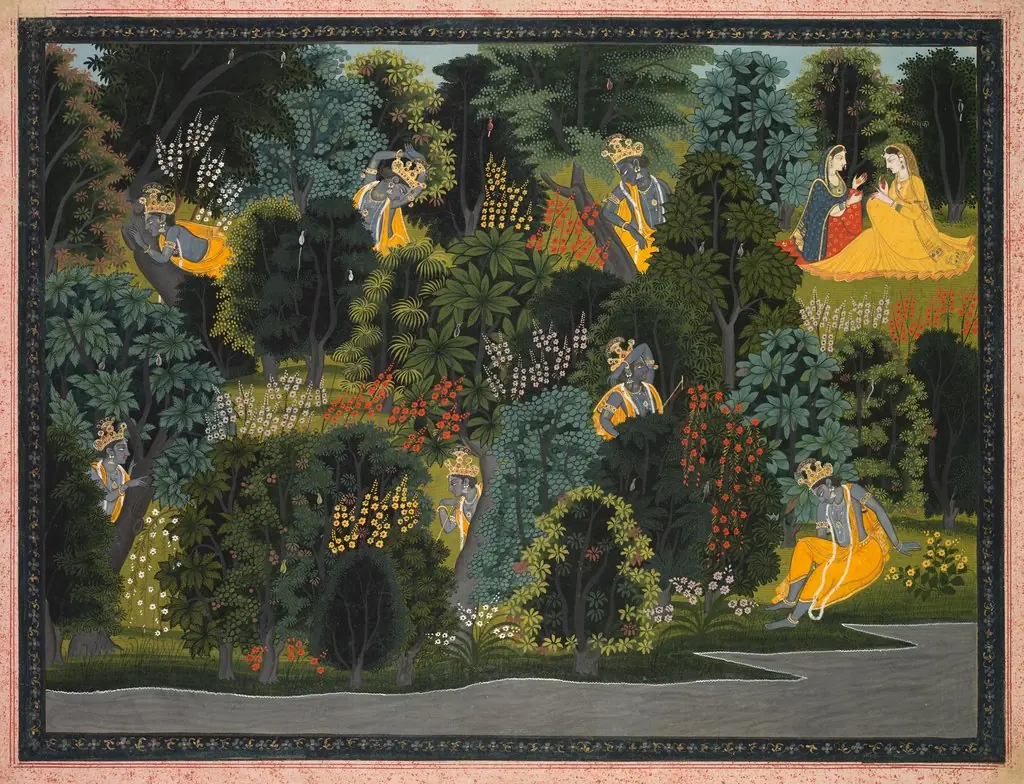 Krishna's Longing for Radha, from the Gita Govinda of Jayadeva
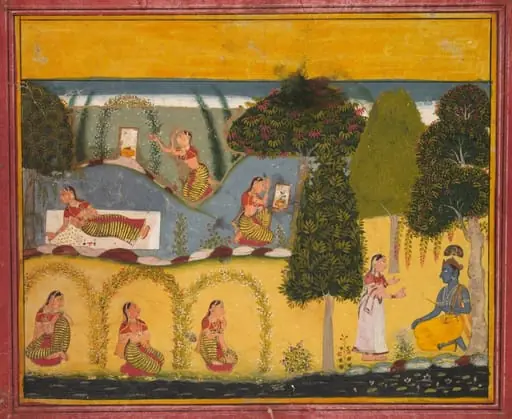 Radha Awaiting Reconciliation with Krishna, from a Gita Govinda of Jayadeva
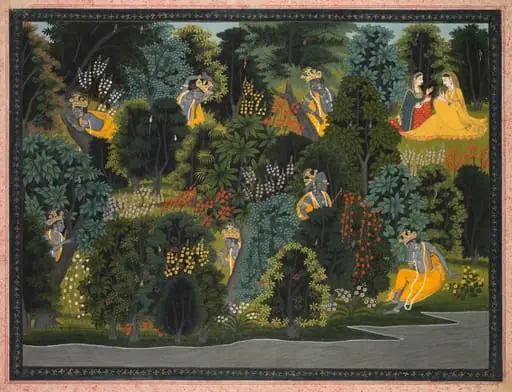 Krishna’s longing for Radha, from a Gita Govinda (Song of the Cowherd) of Jayadeva
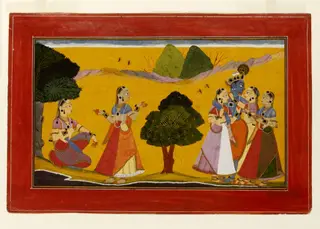 Radha and Krishna
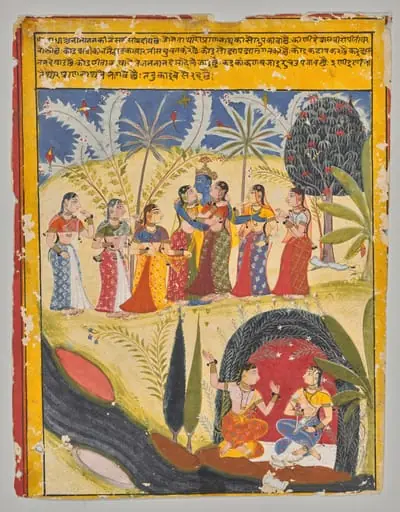 Krishna and Gopis
 Rati, the Goddess of Erotic Love, Takes Aim at Krishna, from a Rasikapriya