Artwork
The Itinerant Musician
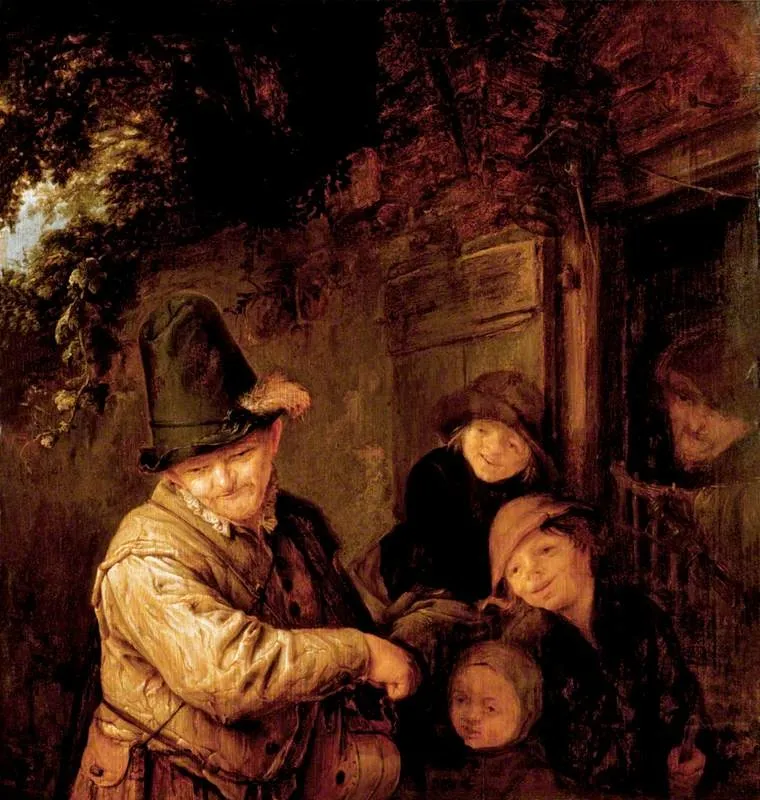
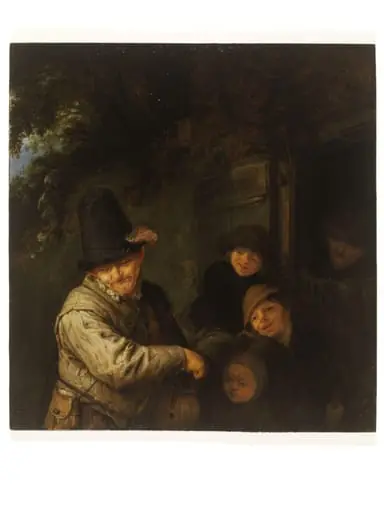
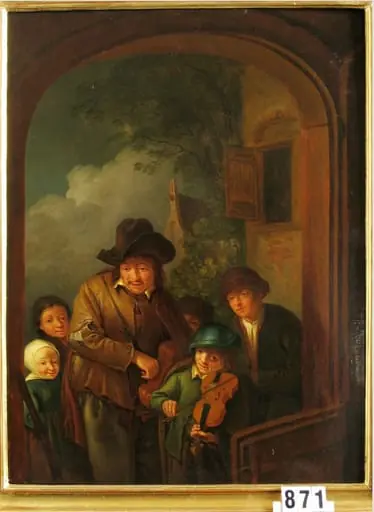
The Itinerant Musician is an oil painting by the Dutch Golden Age artist Adriaen van Ostade. It dates from 1647 and is held in the collection of the Victoria and Albert Museum.
About this work
Subject & Meaning
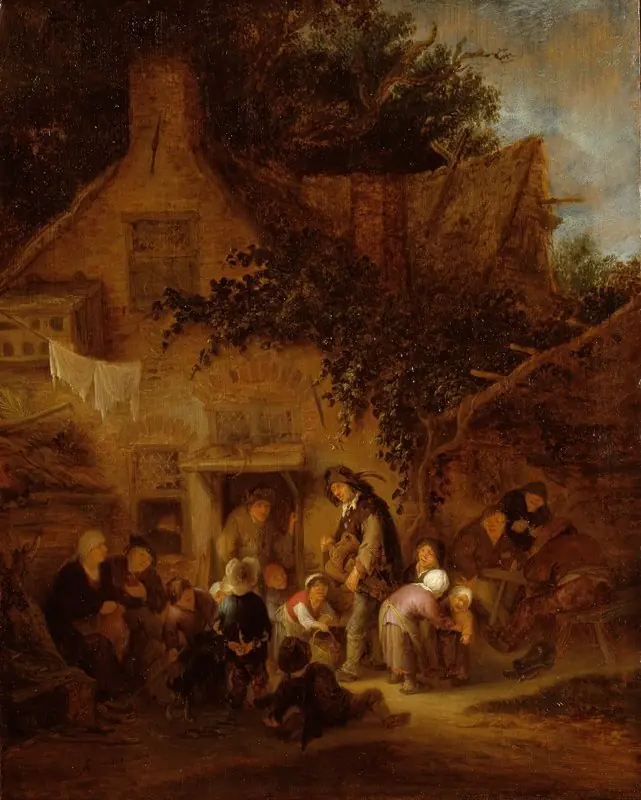
The Itinerant Musician shows a man playing a hurdy‑gurdy while a child stands beside him, a scene identified in the work’s description as depicting a man, hurdy‑gurdy and child. As a genre painting, Ostade presents a humble peasant subject, focusing on the itinerant musician’s portable instrument, which traditionally signified wandering minstrels and folk music of the lower classes. The hurdy‑gurdy’s association with mobility and modest livelihood, together with the child’s presence, invites readings of transience, poverty and the simple, everyday pleasures of rural life, themes recurrent in Ostade’s depictions of peasant culture.
Technique & Style
Stylistically, the piece functions as a genre scene depicting a man playing a hurdy-gurdy accompanied by a child.
Executed in 1647, this work is an oil painting applied to an oak panel support. The composition measures 36.2 cm in height and 33.7 cm in width. Stylistically, the piece functions as a genre scene depicting a man playing a hurdy-gurdy accompanied by a child.
The artwork was produced in Haarlem and exemplifies the material practices of Dutch Golden Age panel painting through its specific combination of oil pigments and wooden substrate.
History & Provenance
Adriaen van Ostade painted The Itinerant Musician in 1647 in Haarlem, creating an oil on oak panel depiction of a man playing a hurdy-gurdy with a child. The Victoria and Albert Museum acquired the work through the bequest of Constantine Alexander Ionides in 1901, accession number CAI.83.
The work is held in the Victoria and Albert Museum, where it is catalogued under accession number CAI.83. It entered the collection bequeathed by Constantine Alexander Ionides in 1901. The painting has not been recorded in any major exhibition history according to the available sources.
Legacy
Adriaen van Ostade’s The Itinerant Musician (1647) has endured as a touchstone in the study of Dutch Golden Age genre painting. Its intimate depiction of a traveling musician and child resonated with later artists and collectors, cementing van Ostade’s reputation as a master of peasant scenes. The work entered the Victoria and Albert Museum in 1901 as part of the Constantine Alexander Ionides bequest, where it has since been showcased as an exemplar of 17th-century Dutch realism.
The painting’s influence extends to its role in shaping perceptions of genre art’s social narrative. Its composition, balancing humor and pathos, has been cited in scholarship as a precursor to later explorations of marginalized figures in European art. The work remains a key reference for exhibitions and research focused on Dutch genre painting, particularly in discussions of music’s symbolic role in visual culture.
Overview
The Itinerant Musician is a 1647 oil painting by Adriaen van Ostade, a genre scene depicting a musician and children.
Artist & collection

Artist
Adriaen van Ostade (baptized as Adriaen Jansz Hendricx 10 December 1610 – buried 2 May 1685) was a Dutch Golden Age painter of genre works, showing the everyday life of ordinary men and women.