Artwork
Tavern Scene
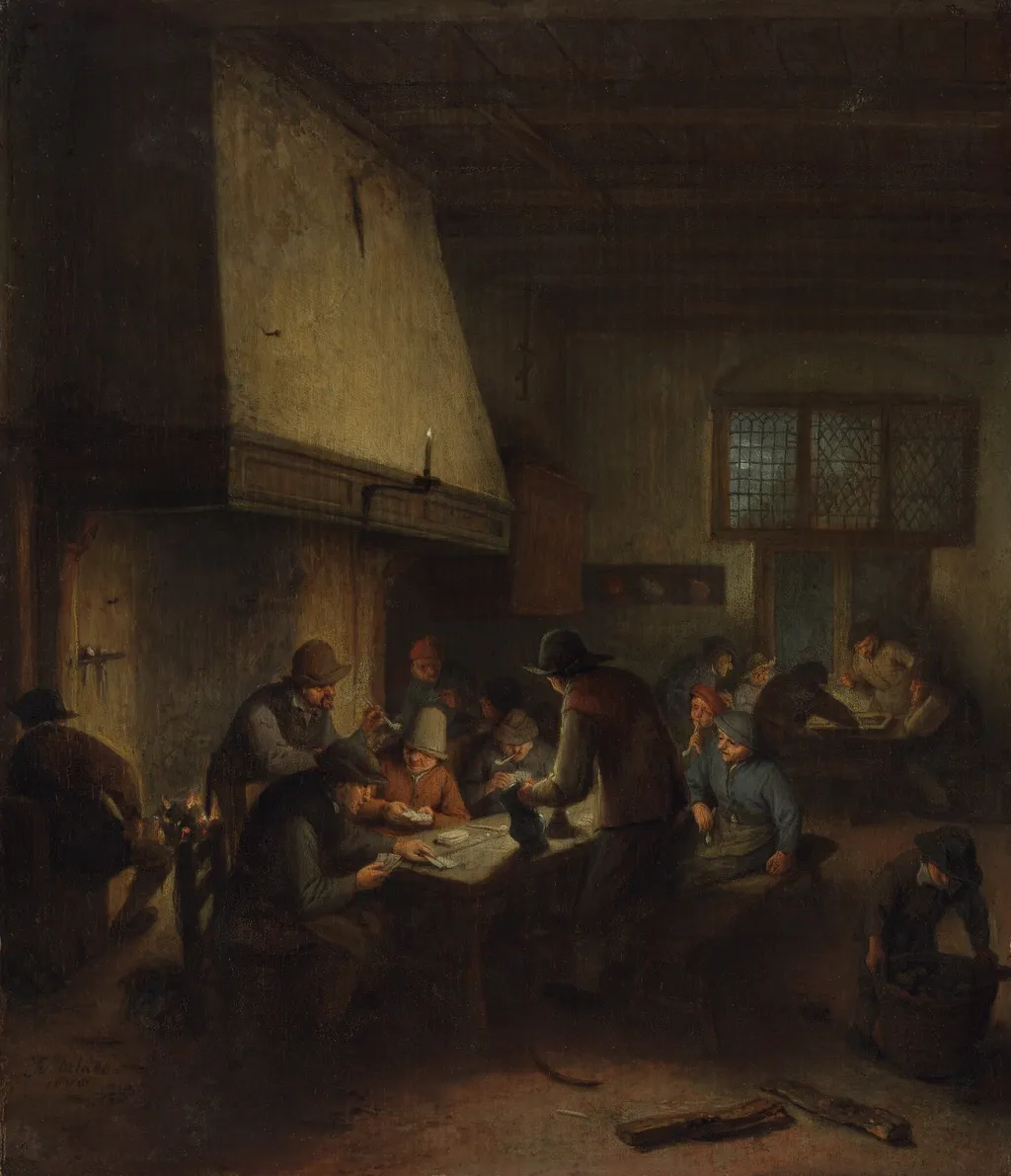
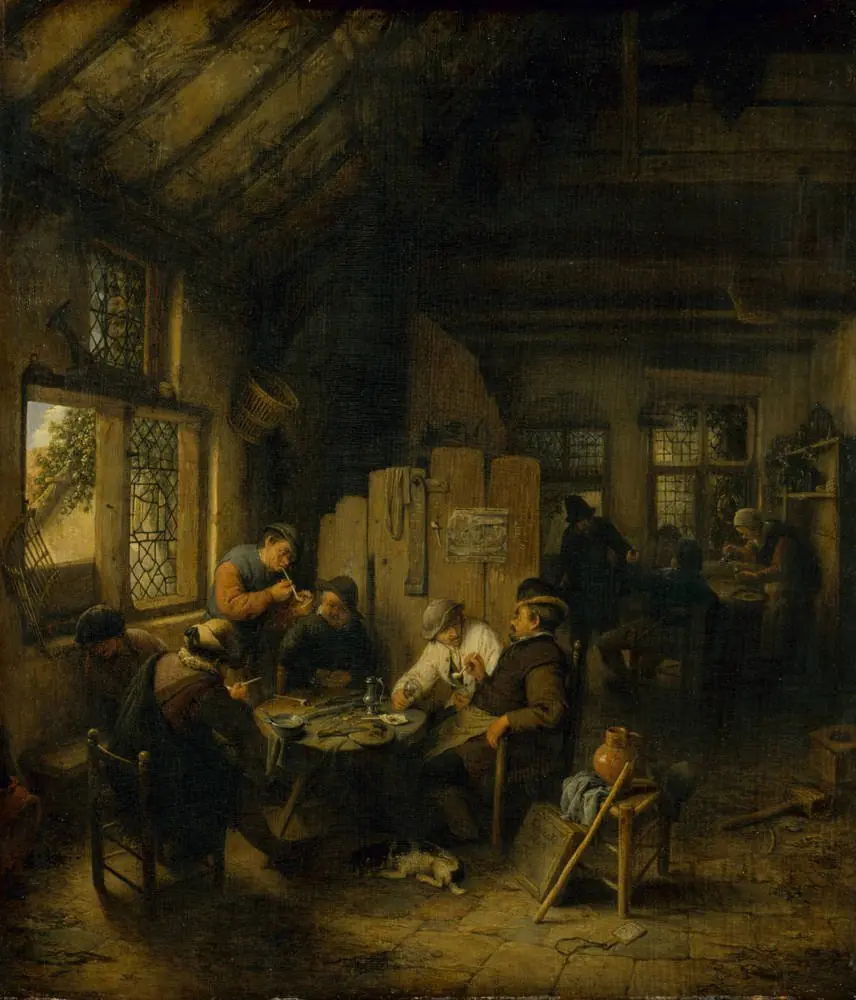
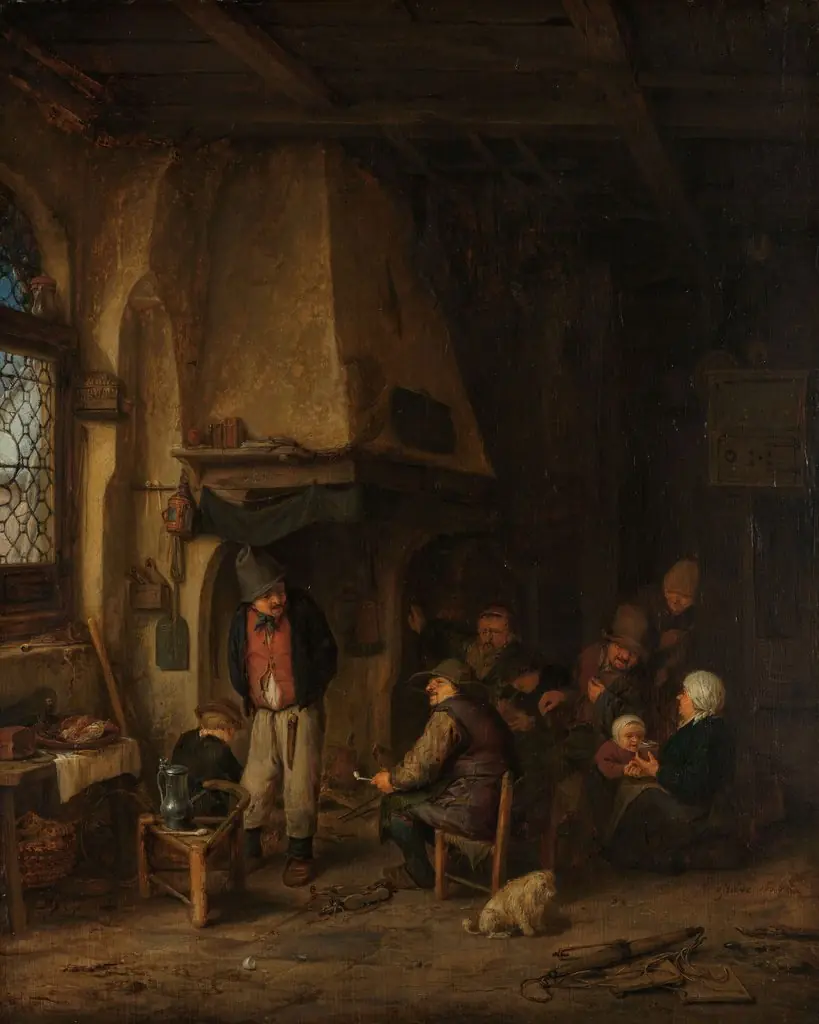
Tavern Scene is an oil painting by the Baroque artist Adriaen van Ostade. It dates from 1664 and is held in the collection of the National Gallery of Art.
- Inscription
- Inscribed:lower left: Av Ostade / 166[?]
About this work
Subject & Meaning
Symbolically, the tavern functions as more than a social space; it serves as a venue for both leisure and business in the 17th century.
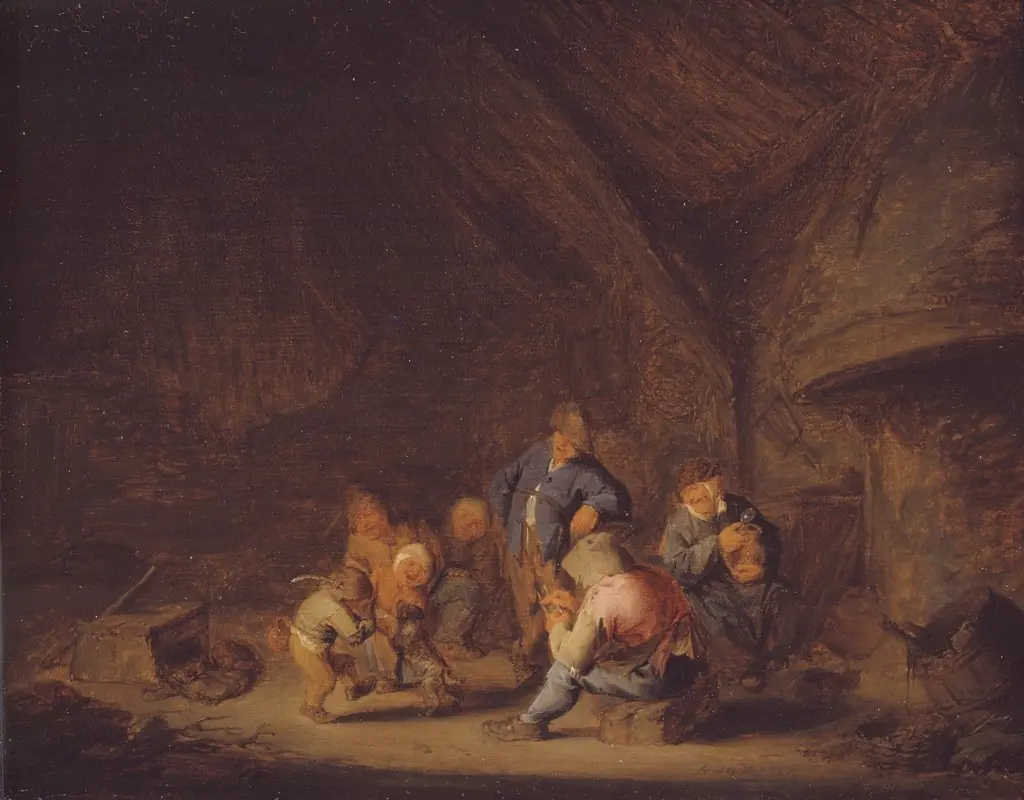
The painting depicts a bustling interior of a tavern where fourteen men gather around two tables in a dimly lit space. Five men sit at a central table playing cards or observing the scene, while others are positioned near a large chimney, a window, or a secondary table under a window. Activities include card playing, drinking beer from a pitcher, smoking pipes, and handling a basket.
Subtle details such as a broken pipe stem, bent wood, and scattered firewood ground the scene in everyday rural life. The work reflects van Ostade's focus on the quotidian activities of common people, rendered with a realistic and unidealized touch.
Symbolically, the tavern functions as more than a social space; it serves as a venue for both leisure and business in the 17th century. The presence of documents on a table and the engagement of figures in discussion suggest commercial transactions, while the modest interior and humble furnishings highlight the unpretentious nature of peasant existence. Van Ostade's nuanced use of light and shadow enhances the atmospheric depth, emphasizing the quiet intensity of the gathering.
Technique & Style
Executed in oil on panel, Tavern Scene measures 23.8 cm in height and 20.4 cm in width. The work is signed "Av Ostade" in the lower left corner with an incomplete date reading "166," consistent with the established creation year of 1660. Stylistically, the painting depicts a dimly lit interior where figures possess pale, ivory-like complexions and wear attire in brick-red, light blue, gray, and brown tones, accented by bright white collars.
The composition utilizes a vertical format to organize fourteen men around two tables and a large fireplace, employing chiaroscuro to highlight faces against deep shadows in the corners. Light sources include a candle partially obscured by a standing figure and moonlight streaming through a stained-glass window, while details such as broken clay pipes and scattered wood lie on the floor. The building itself is rendered as a substantial structure with a spacious chimney and intact windows, reflecting a shift toward a more realistic, less caricatured view of rural life.
History & Provenance
The painting is dated 1660 by the artist’s monogram and partial date on the panel. It entered the National Gallery of Art, Washington, DC, in 1977 via a gift from John Russell Mason, who had received it by inheritance through the Nash family after a European purchase around 1930 by Frances Nash Watson. Earlier, the work was likely in a private Belgian collection before its acquisition in Europe by Watson, who bequeathed it to her niece and nephew in Charlottesville, Virginia; upon their deaths it passed to Mason.
Tavern Scene has been in the collection of the National Gallery of Art in Washington, D.C. since 1977, when it was given to the institution by John Russell Mason, who had received it by gift from Ellen V. Nash and Edward Nash of Charlottesville, Virginia. The Nash siblings had inherited the panel from their aunt, Mrs. Edwin M. Watson (née Frances Nash), who had acquired it c. 1930 in Europe, probably from a private collection in Belgium. This provenance chain was documented by Mr. Mason in a letter of 29 March 1977 to J. Carter Brown, a copy of which is held in the NGA curatorial files.
The sources do not provide a specific accession number or a list of past exhibitions for the work.
Context
Tavern Scene is a late work by Adriaen van Ostade, dated 1660, and exemplifies the more refined phase of his genre production. Earlier in his career, Ostade's depictions of common people tended toward caricature, set in dilapidated barns; over time his scenes grew more realistic and sympathetic, a maturation also visible in his handling of light and shadow. The painting belongs to a body of work by an unusually prolific artist: more than eight hundred paintings, around fifty prints, and many drawings are attributed to him, a volume that secured him a substantial income and a respected standing among his contemporaries.
Ostade served actively in the administration of the Haarlem Guild of Saint Luke and influenced other Dutch genre painters. He was the elder brother of Isack van Ostade (1621–1649). The work entered the National Gallery of Art in Washington, D.C. in 1977 as part of this broader tradition of Dutch Golden Age tavern and peasant interiors.
The painting reflects seventeenth-century Dutch practice in which taverns functioned not only as inns and drinking houses but also as venues for business dealings, with figures gathered around documents as well as cards and beer.
Legacy
The painting has influenced later genre scenes that emphasize everyday social interaction. Art historians note its role in shaping the depiction of tavern interiors in Dutch painting and its contribution to the development of genre painting in the 17th century.
The work is part of the National Gallery of Art's collection in Washington, D.C., where it has been displayed as a key example of Adriaen van Ostade's mature style.
Scholars cite its realistic portrayal of communal activities, such as card playing and pipe smoking, as a model for later artists interested in depicting popular culture.
Its provenance, documented through private ownership in Belgium and the United States before its 1977 donation, reflects a documented transmission of ownership that contributed to its scholarly recognition.
The painting continues to be referenced in studies of Dutch Golden Age genre painting and is included in major exhibitions on 17th-century Dutch art.
Overview
Adriaen van Ostade’s Tavern Scene, executed in oil on wood panel around 1664, presents a bustling interior typical of Dutch genre painting. The composition centers on a modest tavern room illuminated by a fireplace and a window, where several men gather around a table, engaged in conversation and card play. The work captures a moment of everyday social interaction among ordinary citizens.
Own this work as a print
Artist & collection

Artist
Adriaen van Ostade (baptized as Adriaen Jansz Hendricx 10 December 1610 – buried 2 May 1685) was a Dutch Golden Age painter of genre works, showing the everyday life of ordinary men and women.