Artwork
Saint Cecilia
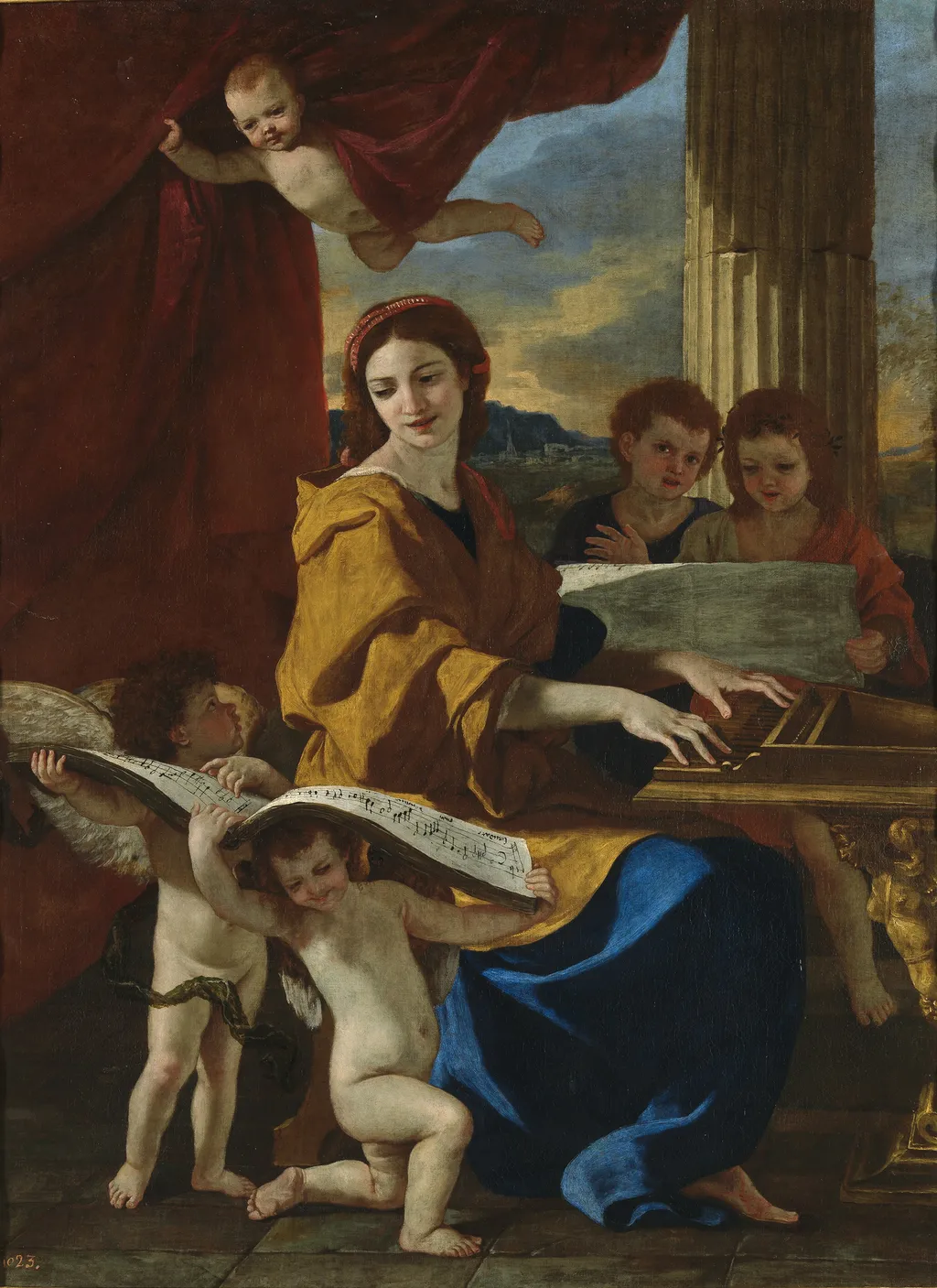
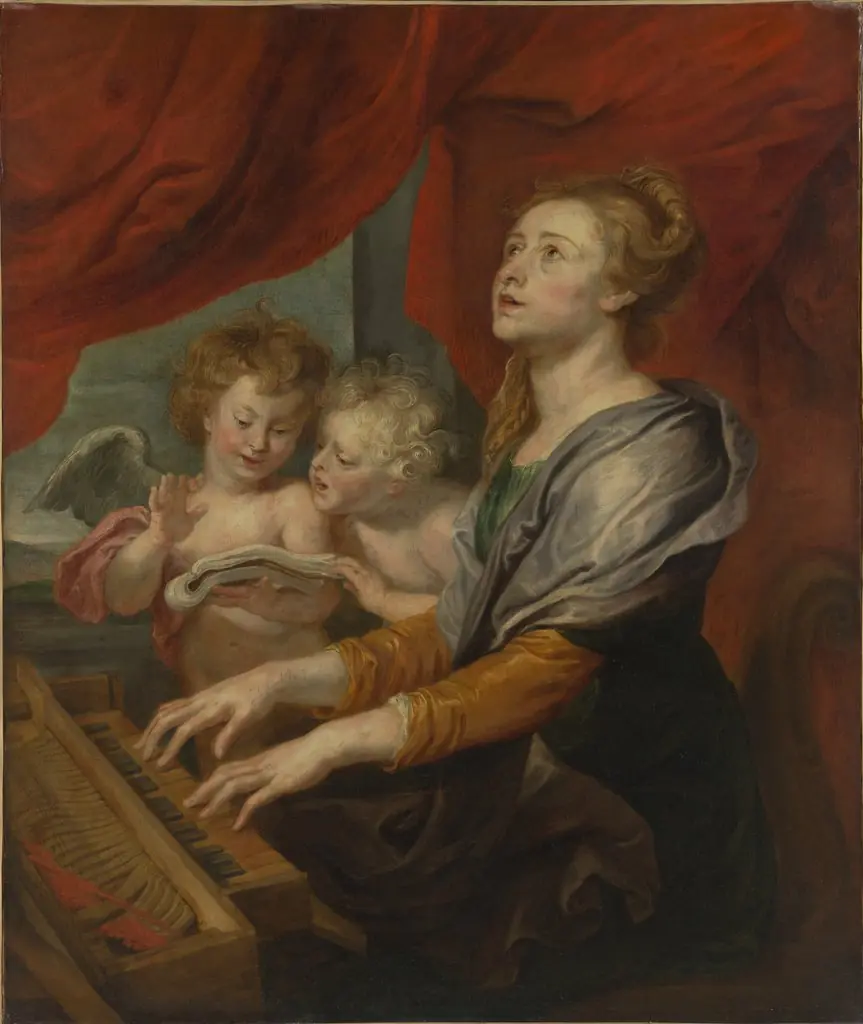
Saint Cecilia is an oil painting by the Classicist painting artist Nicolas Poussin. It dates from 1635 and is held in the collection of the Museo del Prado.
About this work
Subject & Meaning
Nicolas Poussin portrays her playing a keyboard instrument, likely a harpsichord or clavichord, emphasizing her musical expertise.
The painting depicts Saint Cecilia, a figure traditionally represented in Christian iconography as a master of music. Nicolas Poussin portrays her playing a keyboard instrument, likely a harpsichord or clavichord, emphasizing her musical expertise. The composition is populated by celestial figures that reinforce the sacred nature of the scene: two angels in the foreground hold up a musical score, while two others sing in the background near a classical column.
A third cherub is positioned above the saint, lifting a red curtain to reveal the scene. This arrangement highlights the connection between earthly music and divine harmony, presenting the saint as a conduit of spiritual song through her performance.
Technique & Style
Saint Cecilia is an oil painting on canvas created by Nicolas Poussin around 1635. The work measures 117.7 cm in height and 89 cm in width. Executed with a refined palette, the composition is dominated by red, yellow, and blue hues.
These colors are modulated through gradual transitions between illuminated and shadowed surfaces, demonstrating a secure drawing style and compositional elegance. The painting depicts Saint Cecilia playing a keyboard instrument, possibly a harpsichord or clavichord, surrounded by angels who hold a musical score and lift a red curtain. While the work was once attributed to Charles Mellin, it is now confirmed as a Poussin, likely created with assistance from his workshop.
History & Provenance
Saint Cecilia was painted by Nicolas Poussin around 1635, though its exact creation date is unknown; scholars have placed it before the Martirio de san Erasmo in the Vatican Museums, and the work was likely produced with assistance from his studio. Attribution was once questioned, with the French painter Charles Mellin proposed as the author, but Poussin's authorship has since been confirmed.
The painting is thought to have entered the Spanish royal collection through Philip V, who acquired various works by Poussin. It is documented in a 1734 inventory of the Alcázar de Madrid. In 1772 it was displayed in the dining room of the Infante at the Royal Palace of Madrid, and by the 1810s it was recorded in the prince's chamber. It was later held by Ferdinand VII of Spain and is now in the Museo del Prado.
The painting is held in the Museo del Prado in Madrid, Spain. It has been part of the Spanish crown's collection since at least the 18th century, appearing in the 1734 inventory of the Alcázar of Madrid. In 1772, it was exhibited in the Infanta's dining room at the Royal Palace of Madrid, and by the 1810s it was documented in the prince's chamber.
Overview
Nicolas Poussin's 'Saint Cecilia' (1627-1628) is an oil painting housed in the Prado Museum, Madrid. The work portrays the saint in a contemplative musical setting.
Context
In Christian art, Saint Cecilia is frequently depicted with musical instruments due to her legend, which associates her with hymns sung during her martyrdom. Poussin's interpretation reflects this tradition while incorporating his characteristic classical influences.
Own this work as a print
Artist & collection
Artist
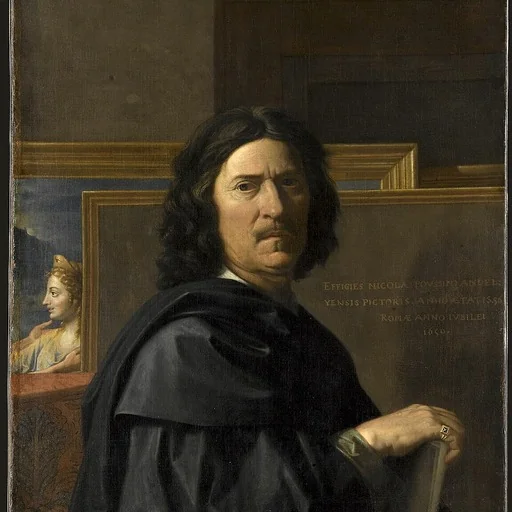
Nicolas Poussin (UK: US: French:; June 1594 – 19 November 1665) was a leading painter of the classical French Baroque style, although he spent most of his working life in Rome.