Artwork
Maison de la Poste, Cagnes
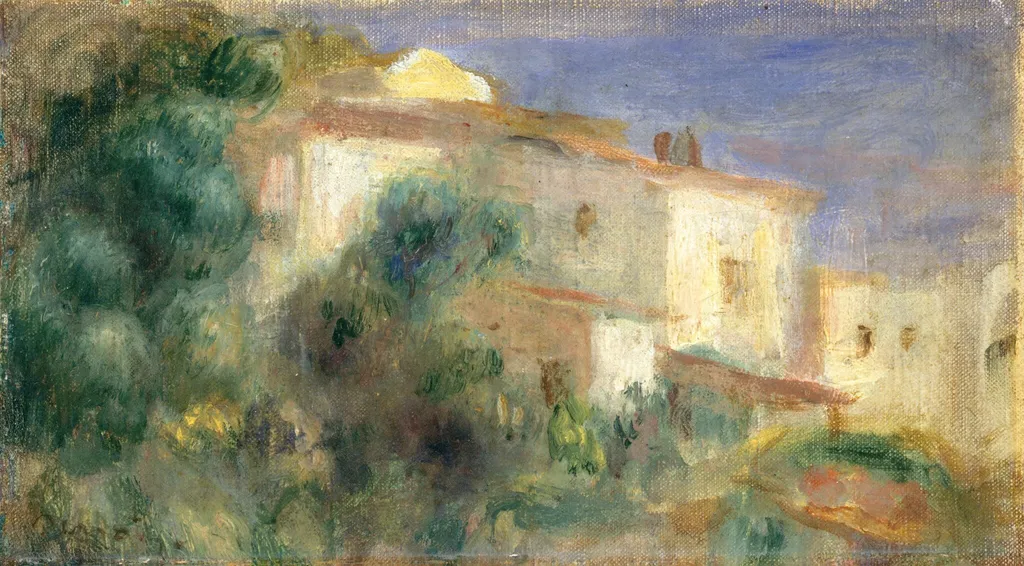
Maison de la Poste, Cagnes is an oil painting by the Impressionist artist Pierre-Auguste Renoir. It dates from 1906 and is held in the collection of the National Gallery of Art.
- Inscription
- Inscribed:lower left: Renoir.
About this work
Technique & Style
Its surface consists of oil paint applied to a stretched canvas support, typical of Renoir’s mature landscape practice.
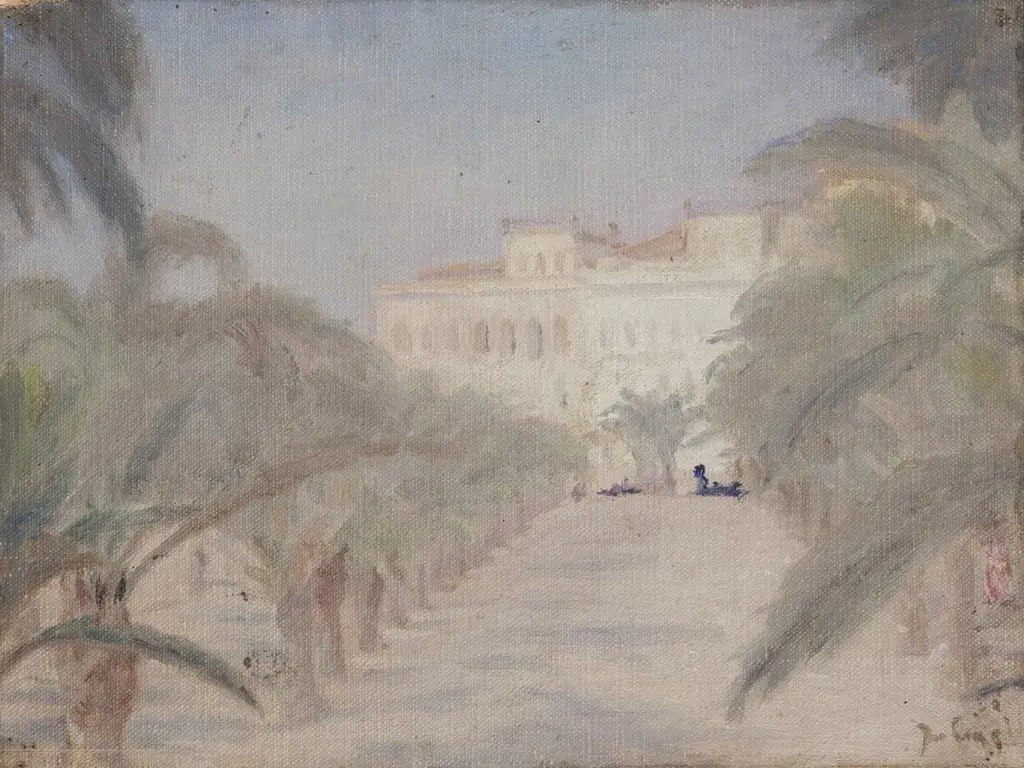
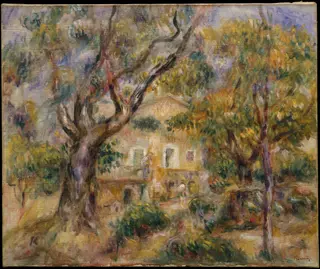
The work is an oil painting executed on canvas, measuring approximately 13 cm in height by 22.5 cm in width, and dated 1906. Its surface consists of oil paint applied to a stretched canvas support, typical of Renoir’s mature landscape practice. The composition depicts a modest house set among trees, a motif that recurs in his later rural scenes.
Formal analysis notes a restrained palette and soft brushwork that emphasize atmospheric light, characteristic of the artist’s impressionistic handling of landscape subjects. The painting’s provenance records multiple transactions from the artist to Durand‑Ruel, then to collectors Edward Molyneux and Ailsa Mellon Bruce, before its bequest to the National Gallery of Art, where it remains on public view.
History & Provenance
The work was commissioned by no later than 1906, when Renoir painted Maison de la Poste, Cagnes. It entered the first market phase in 1912, when Durand-Ruel, Paris acquired it directly from the artist on 22 October (stock no. 10150) and resold it to the New York branch on 3 January 1913 (stock no. 3626). The canvas remained in Durand-Ruel’s stock until 4 May 1936, when it was purchased by Howard Pretzel.
By 1952 it belonged to Capt. Edward H. Molyneux of Paris, who exhibited it that year at the National Gallery of Art. In 1955 Molyneux sold it to Ailsa Mellon Bruce, who bequeathed it to the National Gallery of Art, Washington, D.C., in 1970.
The painting is held by the National Gallery of Art, Washington, D.C., where it is recorded under accession number 1970.17.1. It was first acquired from the artist in 1912 by Durand-Ruel, Paris, then transferred to Durand-Ruel, New York, before passing through several private hands. It was exhibited as part of Capt. Edward H. Molyneux’s collection at the National Gallery of Art in 1952. In 1970 it entered the Gallery’s permanent holdings as a bequest from Ailsa Mellon Bruce.
Legacy
Since its acquisition by the National Gallery of Art in 1970, the painting has been displayed as part of the museum’s permanent collection, with a 1952 exhibition of the Edward Molyneux holdings drawing early public attention to its provenance. Documentation in both the internal catalogue and Wikidata records its journey from Durand‑Ruel in 1912 to the bequest by Ailsa Mellon Bruce, reflecting a continuous scholarly interest in Renoir’s late landscape work. The work’s documented history contributes to the broader appreciation of Renoir’s transition toward more intimate rural subjects in the early twentieth century.
Overview
Maison de la Poste, Cagnes, painted by Auguste Renoir in 1906, depicts a rural scene in the village of Cagnes-sur-Mer on the French Riviera. The composition centers on a pink-walled building, identified as the local post office, partially obscured by the dense foliage of a large tree in the foreground. Renoir employs his mature Impressionist technique, characterized by thick, textured brushstrokes that build up the surface of the canvas.
Sunlight filters through the leaves, casting dappled patches of light onto the roof and walls, creating a dynamic interplay between shadow and illumination. The palette is dominated by warm earth tones, with the green of the leaves contrasting against the red shutters and the soft pink of the architecture. Created late in the artist's career, this work reflects Renoir's enduring fascination with the light and landscape of the south of France, a period during which he frequently settled in Cagnes to escape the Parisian climate.
The painting exemplifies his late style, where forms are softened by color and light, moving away from the sharp contours of his earlier work toward a more fluid, atmospheric representation of the immediate environment.
Subject & Meaning
The composition centers on a pink house, its form softened by the expansive foliage of a large tree. Sunlight gently illuminates parts of the roof and a wall, creating subtle highlights. Renoir employs a palette where the tree's green leaves intermingle with the house's red shutters, contributing to the painting's overall sense of warmth and calm.
Context
Renoir created Maison de la Poste, Cagnes during his later years, specifically in 1906, while residing in Cagnes, France. This period saw the artist exploring landscapes and domestic scenes around his home, often characterized by a softer, more atmospheric quality as his health declined.
Artist & collection

Artist
Pierre-Auguste Renoir was a French artist who was a leading painter in the development of the Impressionist style.