Artwork
Tilla Durieux
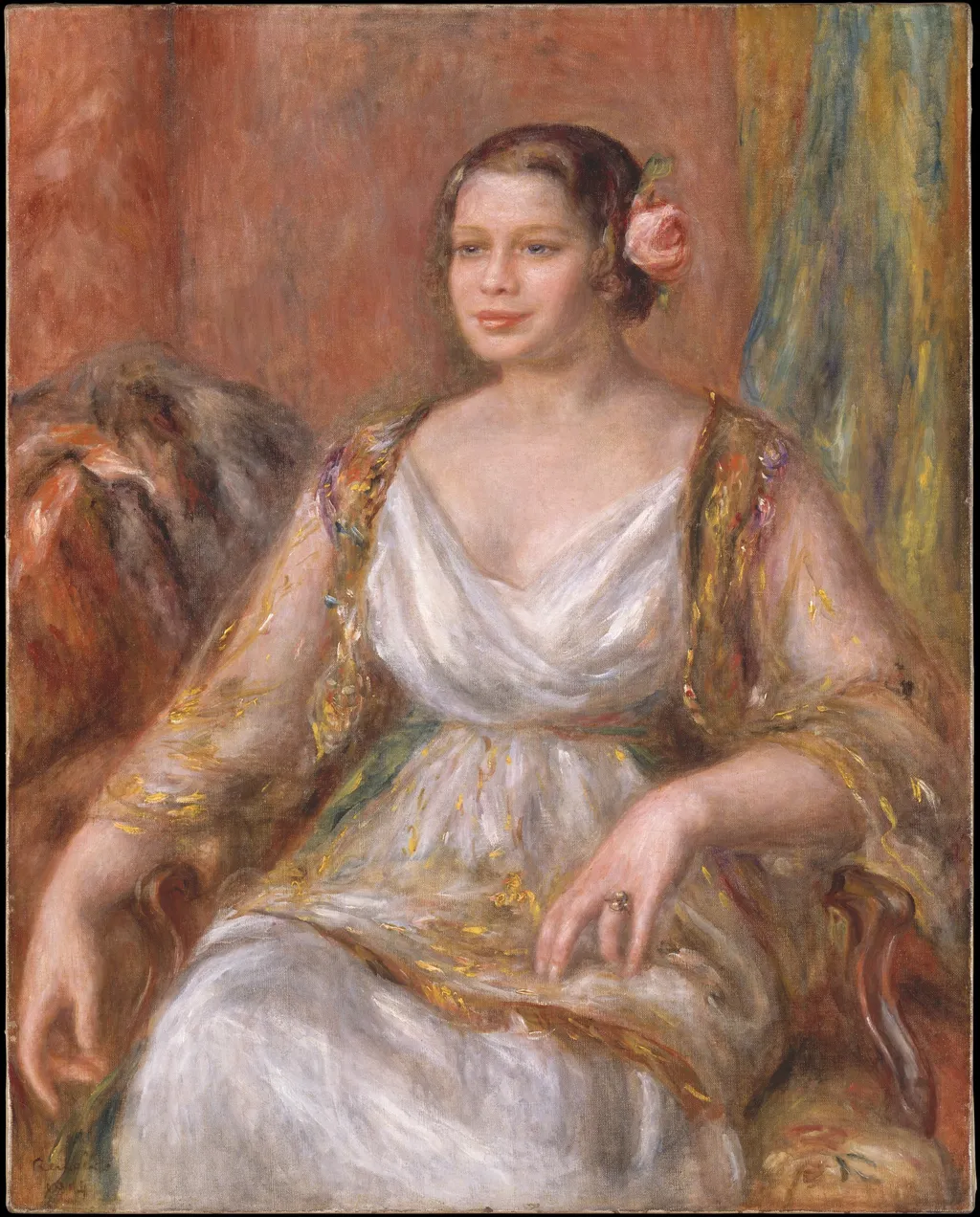
Tilla Durieux is an oil painting by the Impressionist artist Pierre-Auguste Renoir. It dates from 1914 and is held in the collection of the Metropolitan Museum of Art.
About this work
In July 1914, Austrian actress Tilla Durieux traveled from Berlin to Paris to sit for Pierre-Auguste Renoir, posing four hours a day for nineteen days while the arthritic painter worked from a wheelchair with his brush strapped to his hand. She wears Paul Poiret's costume for her role as Eliza Doolittle in Shaw's Pygmalion.
Subject & Meaning
Renoir's Impressionist portrait captures her expression and demeanor, reflecting the movement's interest in fleeting moments and light.
The painting depicts the actress Tilla Durieux, a notable figure in early-20th-century theater. She is shown seated, wearing a shawl and dress, with a gentle smile and a rose, a motif that may symbolize beauty or vitality. The ring on her finger adds an element of elegance.
Renoir's Impressionist portrait captures her expression and demeanor, reflecting the movement's interest in fleeting moments and light. Commissioned by the art dealer Paul Cassirer, Durieux's husband, the work underscores her cultural significance and personal presence.
History & Provenance
Painted in 1914 in Paris, this portrait of actress Tilla Durieux was commissioned by the art dealer Paul Cassirer. The painting initially remained in Renoir's possession before passing to Cassirer, then to the sitter herself, Tilla Durieux. Subsequent owners included the dealer Walter Feilchenfeldt, the Bignou Gallery, and the collector Stephen Carlton Clark.
The work ultimately entered the collection of the Metropolitan Museum of Art, where it is currently housed. No documentation of earlier stages or alternative attributions has been recorded.
The painting is held at the Metropolitan Museum of Art in New York. Its exhibition history includes showings at the Bignou Gallery, the 1939 New York World's Fair, Duveen Galleries, the Museum of Modern Art, the Century Association, Paul Rosenberg, Yale University Art Gallery, M. Knoedler & Co., the Musée de l'Orangerie, Wildenstein & Company, the Baltimore Museum of Art, the Hayward Gallery, the Galeries nationales du Grand Palais, the National Gallery of Canada, and the Art Institute of Chicago. No inventory or accession number is provided in the available sources.
Legacy
The portrait of Tilla Durieux has achieved enduring prominence through its inclusion in numerous prestigious exhibitions, such as the 1939 New York World's Fair and displays at the Museum of Modern Art, the Art Institute of Chicago, the Grand Palais, and the Hayward Gallery. This extensive showing across major international venues underscores its sustained reputation as a significant Impressionist work. Following its commission by Paul Cassirer and ownership by the sitter, the painting passed through notable dealers and collectors before entering the collection of the Metropolitan Museum of Art, where it remains a highlight of the museum's holdings.
Its institutional permanence and repeated exhibition history affirm the portrait's lasting legacy within Renoir's oeuvre and as a cultural artifact of early 20th-century portraiture.
Overview
Pierre-Auguste Renoir painted this portrait of the Austrian actress Tilla Durieux in July 1914, commissioned by her husband, Paul Cassirer. Durieux traveled to Paris, sitting daily for the elderly artist, who, despite severe arthritis, continued to paint from a wheelchair. The work captures her in a theatrical costume, reflecting her profession.
This significant late-period portrait is notable not only for its artistic qualities but also for its complex journey through the turmoil of two world wars, reflecting the sitter's own dramatic life.
Technique & Style
Despite the advanced arthritis that confined him to a wheelchair and necessitated strapping his brush to his hand, Renoir maintained a vigorous artistic spirit during the creation of this work. He employed a classicizing pyramidal composition, a nod to his enduring admiration for artists like Titian. The painting exemplifies Renoir's late style through its warm, luminous red and honeyed tones and monumental scale, which Metropolitan Museum of Art curators consider among his finest late portraits.

Own this work as a print
Artist & collection
Artist
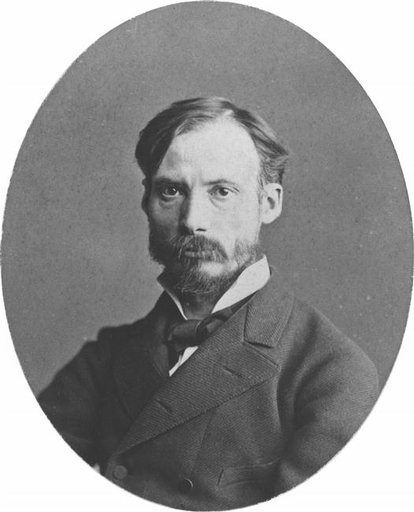
Pierre-Auguste Renoir was a French artist who was a leading painter in the development of the Impressionist style.

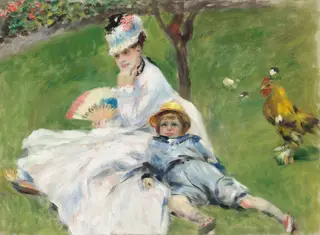

- Young woman seated, with neck and shoulders uncovered
 Nude
Nude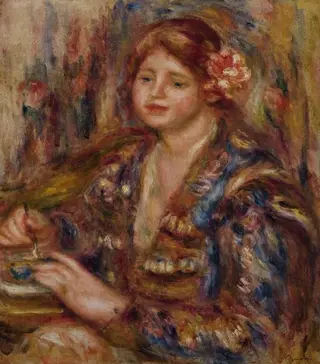 Woman with Rose
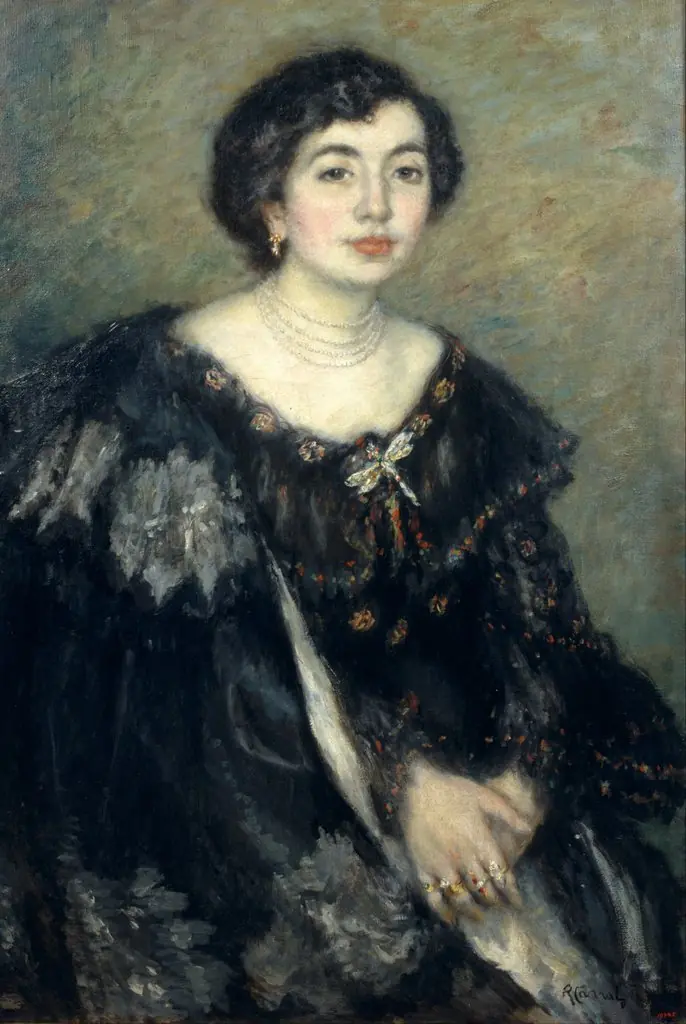 Portrait of Rosa Amouroux
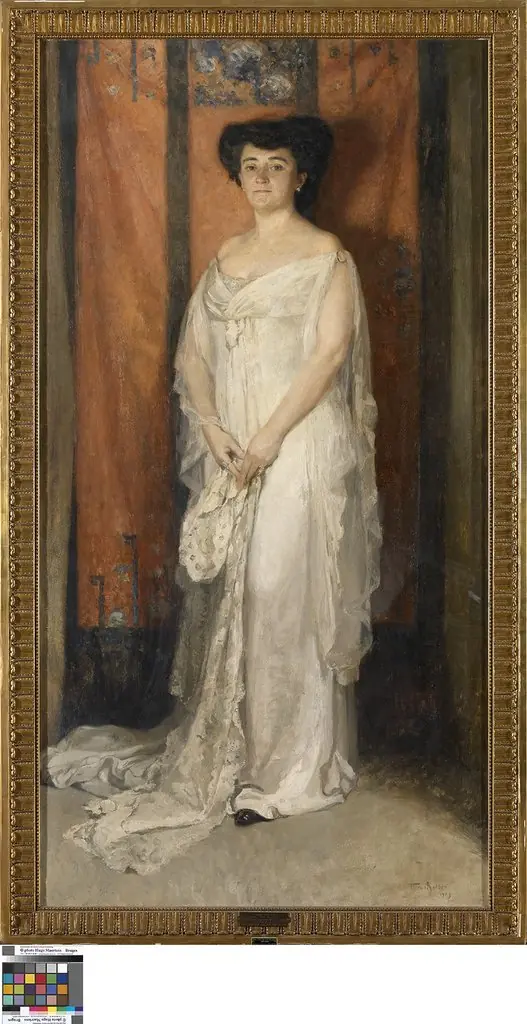 Portret van mevrouw A. Ganshof van der Meersch
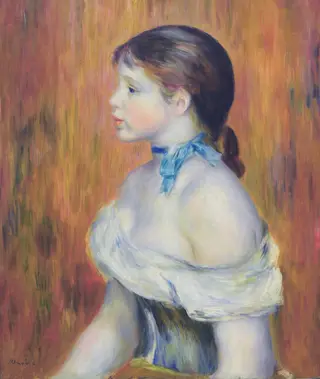 Young Woman with a Blue Choker
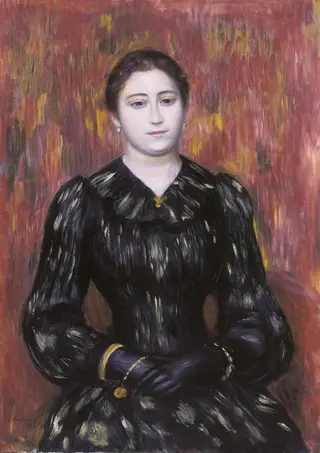 Portrait of Mme. Paulin
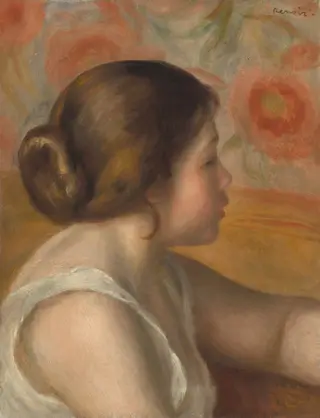 Head of a Young Girl
 Gabrielle with Open Blouse
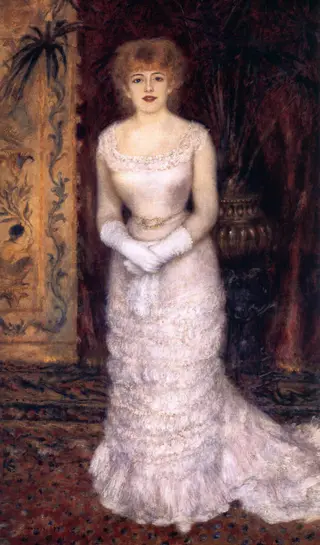 Portrait of Jeanna Samary
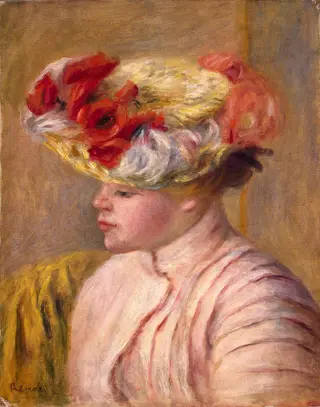 Young Woman in a Flowered Hat
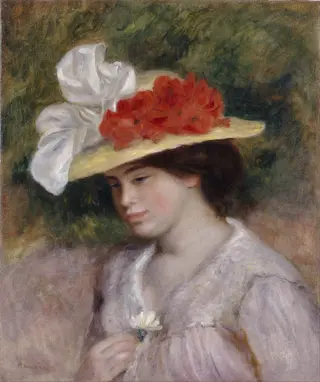 Woman in a Flowered Hat