Artwork
The Offering of Cain and Abel
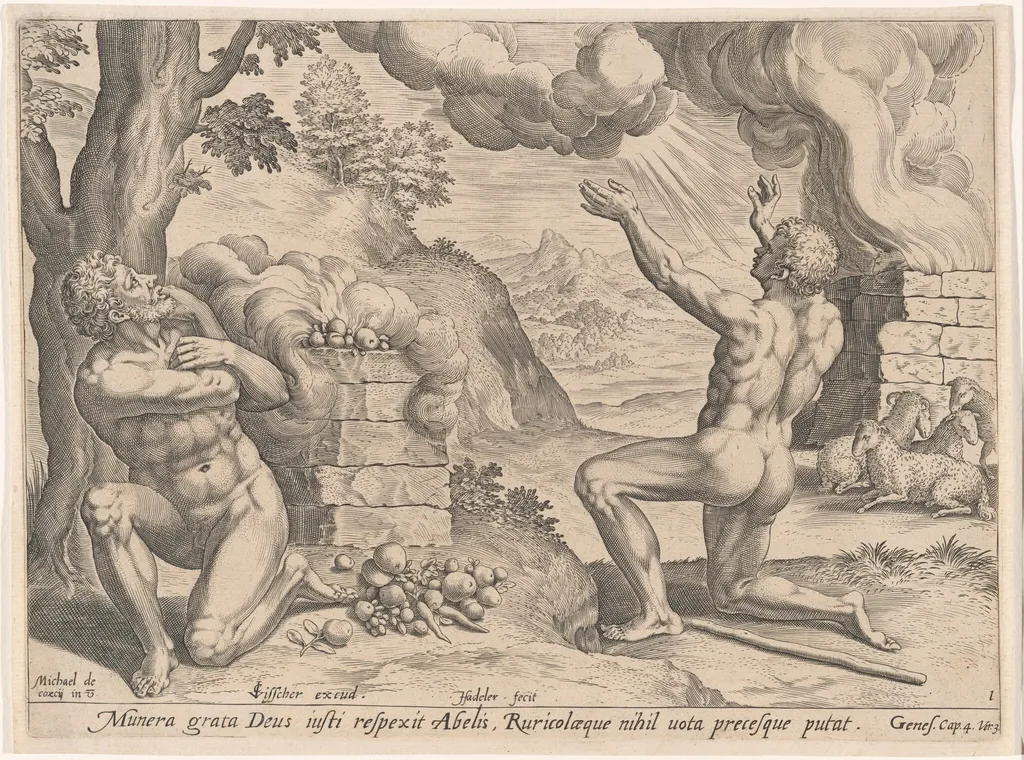
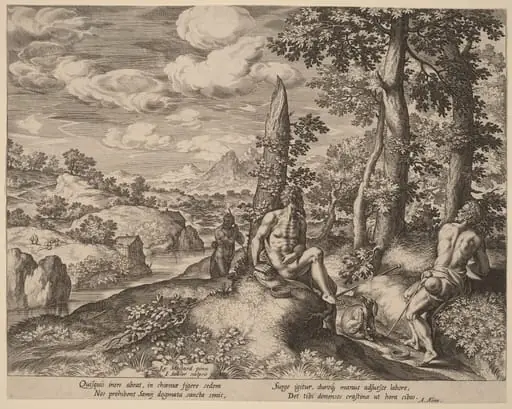
The Offering of Cain and Abel is an ink print by the Renaissance artist Jan Sadeler I. It dates from 1576 and is held in the collection of the National Gallery of Art.
- Inscription
- Inscribed:lower left in image: Michael de / coxcij inv; CIVisscher excud.; JSadeler fecit; lower right in image: 1; lower center in plate: Munera grata Deus iusti respexit Abelis, Ruricolaeque nihil uoata precesque putat. Genes. Cap. 4 Ver. 3.
About this work
Overview
Created in 1576 by Jan Sadeler I, this engraving on laid paper depicts the biblical story of Cain and Abel’s offerings to God.
Created in 1576 by Jan Sadeler I, this engraving on laid paper depicts the biblical story of Cain and Abel’s offerings to God. Executed with fine linear precision, the print captures a moment of ritual contrast between the two brothers. It resides in the collection of the National Gallery of Art in Washington, D.C., as part of a broader corpus of Northern Renaissance religious prints produced for devotional and educational use.
Subject & Meaning
The scene illustrates the moment when Cain and Abel present their gifts to God. One brother, standing, offers a basket of produce; the other, kneeling, holds an empty basket. The visual disparity suggests divine favor toward the agricultural offering over the pastoral one, as recounted in Genesis.
The Latin inscription below reinforces the narrative’s moral weight, framing the act as a test of piety and obedience.
Technique & Style
Sadeler employed engraving to render fine, controlled lines across the paper, achieving texture in foliage, fabric, and terrain with minimal tonal variation. The composition is tightly framed by trees and a low wall, directing focus to the figures’ gestures. The sky remains unshaded, emphasizing clarity over atmosphere. This method reflects the Northern European tradition of detailed, narrative-driven printmaking suited for wide dissemination.
History & Provenance
The print was produced during Sadeler’s active years in the Low Countries, a hub for religious print circulation. It entered the National Gallery of Art’s collection through established acquisition channels, likely as part of a larger group of engravings from the late 16th century. Its preservation reflects its role as a documented example of early printmaking used to convey biblical stories to literate and non-literate audiences alike.
Context
In the decades following the Reformation, religious imagery in print form became a key medium for teaching scripture, especially in regions where access to churches or manuscripts was limited. Sadeler’s work aligns with a wave of engravings that translated biblical episodes into accessible, morally legible scenes. The emphasis on gesture and symbolic contrast reflects broader trends in Protestant visual culture seeking clarity over ornamentation.
Legacy
This engraving contributes to the understanding of how religious narratives were visually standardized in early modern Europe. Sadeler’s precise technique influenced later printmakers who adapted similar compositional strategies for biblical subjects. Though not widely reproduced today, it remains a representative artifact of the print trade’s role in shaping religious perception during the late Renaissance.
Own this work as a print
Artist & collection