Artwork
Memorial painting
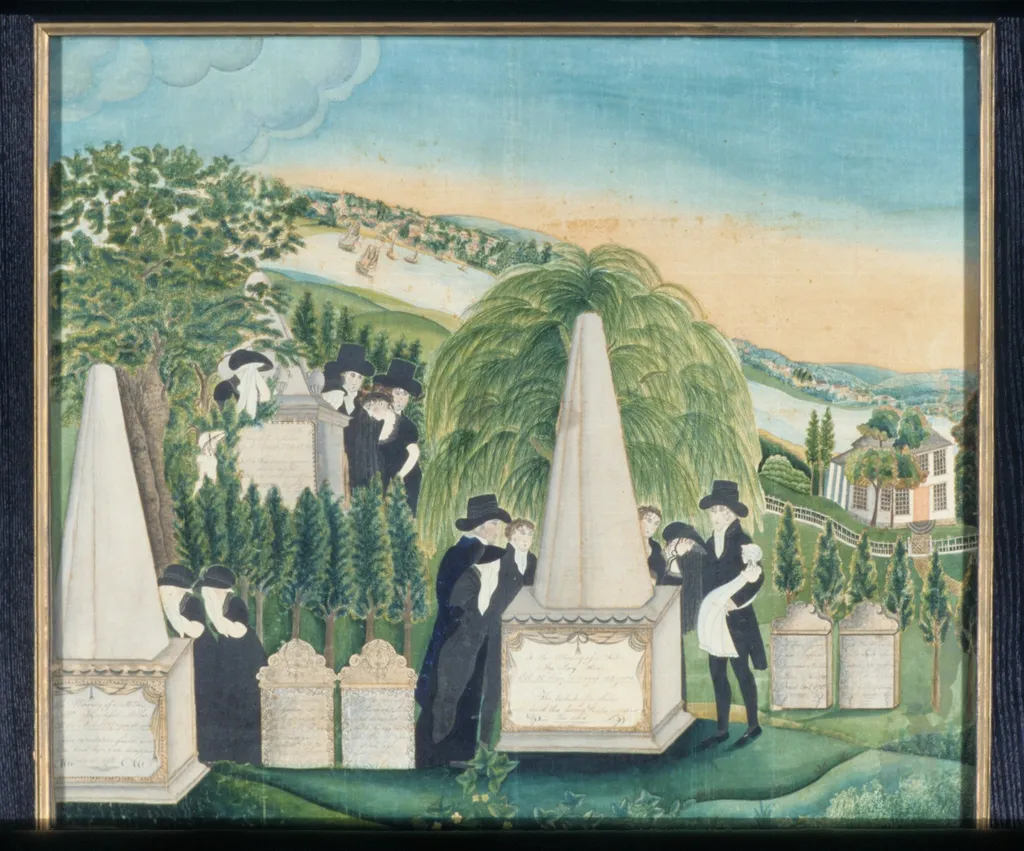
Memorial painting is an ink painting by the American Folk Art artist Sally Miller. It dates from 1811 and is held in the collection of the Metropolitan Museum of Art. This painting depicts a solemn gathering in a cemetery situated along a waterfront.
About this work
Subject & Meaning
The composition reflects the work's purpose as a memorial, commemorating a deceased individual within a coastal setting that suggests transition and burial.
The Memorial painting (1811) depicts a funeral scene that includes a man, an infant, a woman, and symbolic elements of mourning, a harbor, a grave and a cemetery. These figures and settings serve as iconography of loss and remembrance, with the infant and grave highlighting themes of mortality. The composition reflects the work's purpose as a memorial, commemorating a deceased individual within a coastal setting that suggests transition and burial.
By combining references to mourning attire and a cemetery landscape, the painting conveys a narrative of grief and the transitory nature of life, aligning with its classification as a memorial artwork.
Technique & Style
Created in 1811 at the Litchfield Female Academy, this memorial painting by Sally Miller is executed on a silk support. The artist employed watercolor paint and ink as the primary mediums to render the composition. The work measures approximately 71.1 by 82.2 centimeters.
Stylistically, the piece functions as a textile-based painting depicting a mourning scene within a cemetery setting near a harbor. The imagery features figures of men, women, and infants gathered around a grave, illustrating themes of funeral and bereavement characteristic of early nineteenth-century American memorial art. The combination of liquid pigments with a woven fabric ground distinguishes its material construction from traditional canvas or panel paintings.
History & Provenance
The work titled Memorial painting was executed in 1811 by Sally Miller, a student at the Litchfield Female Academy. The piece is a commemorative textile, employing silk as a support with watercolor and ink media. Its dimensions measure 71.1 cm by 82.2 cm, and the subject depicts a funeral scene with a man, an infant, and a mourning woman.
The painting entered the collection of the Metropolitan Museum of Art, where it remains, its provenance tracing from creation at the academy to acquisition by the museum.
Legacy
Created in 1811 as a silk memorial painting by Sally Miller, the work portrays a funeral scene with mourning figures set against a harbor and grave. The painting entered the Metropolitan Museum of Art's collection and is featured among the museum's textile highlights, reflecting curatorial interest in its historical significance as an early example of American commemorative needlework and memorial art.
Overview
This painting depicts a solemn gathering in a cemetery situated along a waterfront. Rendered on silk, the artwork presents a group of figures, dressed in formal attire, amidst tombstones and an open grave. A leaning palm tree and a distant, illuminated harbor frame the scene, contributing to its tranquil yet poignant atmosphere. The choice of silk as a support was distinctive for the period in which it was created.
Own this work as a print
Artist & collection
Artist
Sally Miller was born in 1782 in Middletown, Connecticut, and enrolled at the Litchfield Female Academy in 1811.

- In Memoriam - Column at Left
 Family Burying Ground
 Infant Funeral Procession
 Kochanowski tomb at the Powązki cemetery
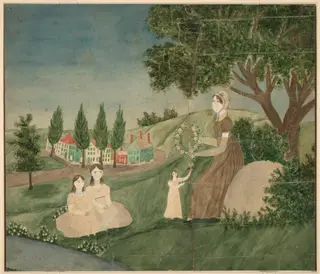 Mother and Three Children Making a Floral Wreath
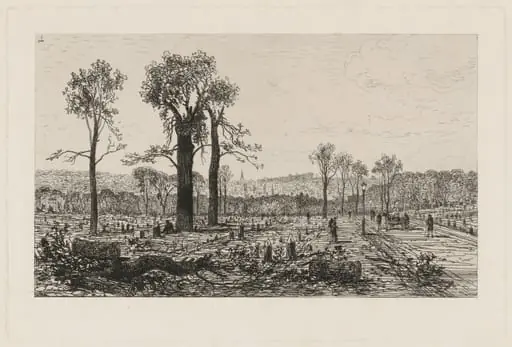 Avenue de Boulogne
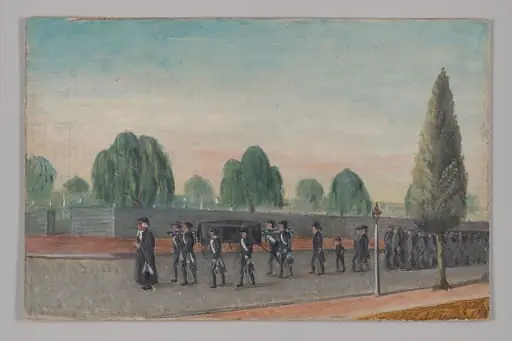 Adult Funeral Procession
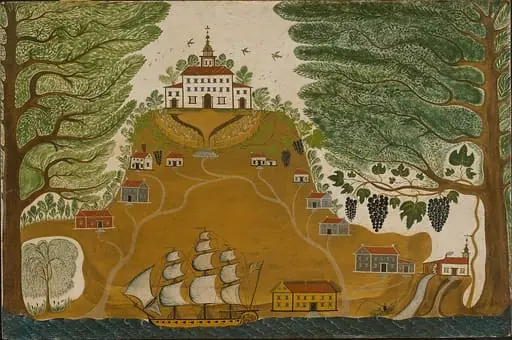 The Plantation
![View of a cromliach [cromlech] on the lands of Loughlins town, 7 miles from Dublin [...], by Gabriel, ca.1729-1817 Beranger](https://artifactworldgallery.com/img/gabriel-ca-1729-1817-beranger--view-of-a-cromliach-cromlech-on-the-lands-of-loughlins-town--2ec5dcc741513545-w320.webp) View of a cromliach [cromlech] on the lands of Loughlins town, 7 miles from Dublin [...]
View of a cromliach [cromlech] on the lands of Loughlins town, 7 miles from Dublin [...] The Picnic
 Refugees
![Yediküle with a Muslim Cemetery, Constantinople, by Michel-François Préaulx [Préaux]](https://artifactworldgallery.com/img/michel-francois-preaulx-preaux--yedikule-with-a-muslim-cemetery-constantinople--c422bdec8e9c6ba8-w320.webp) Yediküle with a Muslim Cemetery, Constantinople
Yediküle with a Muslim Cemetery, Constantinople