Artwork
柴田是真作 翁面図|Mask for the Noh Play Okina
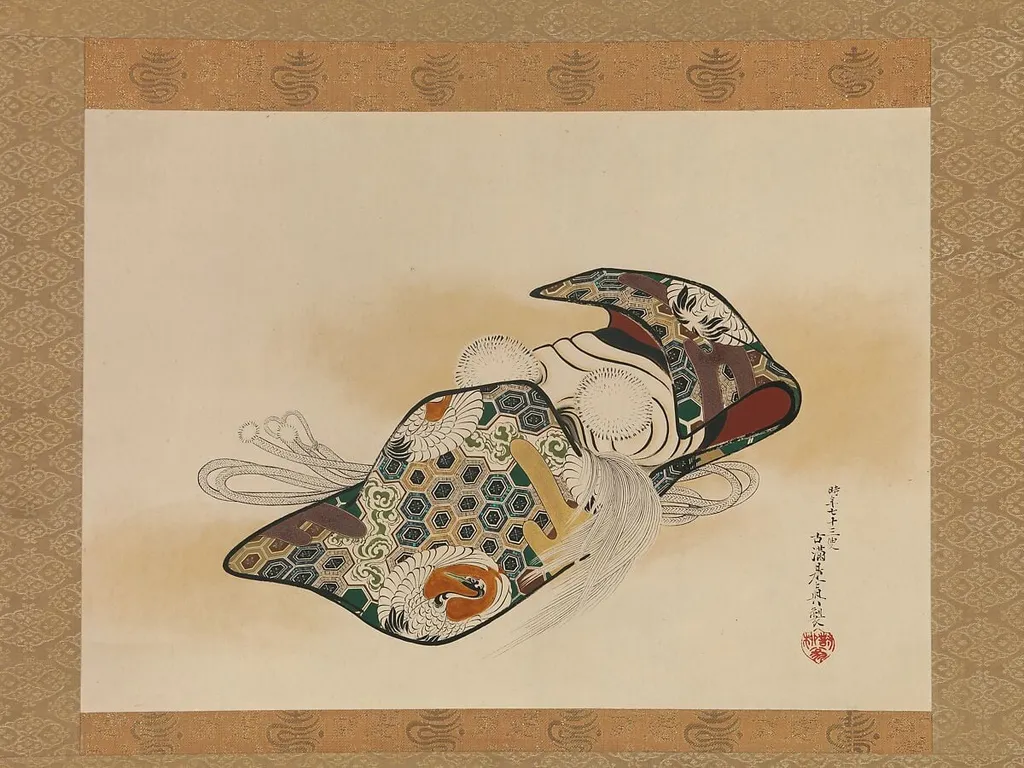
柴田是真作 翁面図|Mask for the Noh Play Okina is an oil painting by the Impressionist artist Shibata Zeshin. It dates from 1879 and is held in the collection of the Metropolitan Museum of Art.
About this work
Zeshin painted it in 1879, when Japan was rushing toward Western styles, yet he chose to honor this quiet tradition.
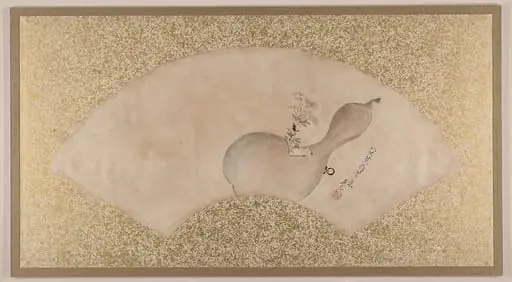
You see a white-bearded Noh mask floating against a gold-leaf sky. The eyes are half-closed, the mouth a gentle curve. Tiny mother-of-pearl dots trace the wrinkles like morning frost.
This mask wasn’t meant to be hung on a wall. It was carved to be worn in a 600-year-old play called Okina, where the actor becomes a god blessing the stage. Zeshin painted it in 1879, when Japan was rushing toward Western styles, yet he chose to honor this quiet tradition.
To see how masks like this move in performance, look up the subject masks.
Subject & Meaning
The work depicts a mask used in the Noh theater play known as Okina. As a portrait of this specific theatrical object, the subject is the mask itself rather than a living human figure or a broader landscape scene. The piece represents the visual artistry of the Noh tradition, capturing the form of the mask through the artist's unique combination of pigments, lacquer, and mother-of-pearl.
By rendering a ritual theater prop as a hanging scroll painting, the work elevates the object of performance into a subject of fine art contemplation.
History & Provenance
The hanging scroll titled Mask for the Noh Play Okina was created by Shibata Zeshin in 1879. Executed in Japan, the work combines pigments, lacquer, mother-of-pearl, gold foil, and ink on paper to depict a Noh mask. The piece measures 28.9 cm in height and 41 cm in width. It is currently held in the collection of the Metropolitan Museum of Art.
The work is held by the Metropolitan Museum of Art, New York, where it is recorded as an 1879 hanging scroll by Shibata Zeshin depicting a mask for the Noh play Okina.
It has been exhibited at the museum as part of its Japanese lacquer and painting holdings, although specific exhibition records are not detailed in the cited sources.
Overview
Created in 1879 by the Japanese artist Shibata Zeshin, this hanging scroll presents a painted representation of a Noh mask used in the ancient drama Okina. Executed on paper with pigments, lacquer, mother‑of‑pearl, gold foil and ink, the work measures as a portable visual record rather than a conventional wall‑mounted painting.
Technique & Style
Zeshin combined traditional materials, lacquer and mother‑of‑pearl inlay, with delicate pigment washes and gold‑leaf background to achieve a luminous surface. Fine ink lines delineate the mask’s features, while specks of mother‑of‑pearl mimic the frost‑like creases of the aged visage, reflecting the artist’s mastery of mixed‑media decoration.
Context
Okina is a ritual Noh play dating back six centuries, performed at the opening of a theatrical program to invoke divine protection. The mask depicted here is integral to that rite, serving as a wearable object rather than a decorative panel. Zeshin’s rendering thus functions as a study of stagecraft, offering insight into the material culture of traditional Japanese theater.
Artist & collection