Artwork
Untitled
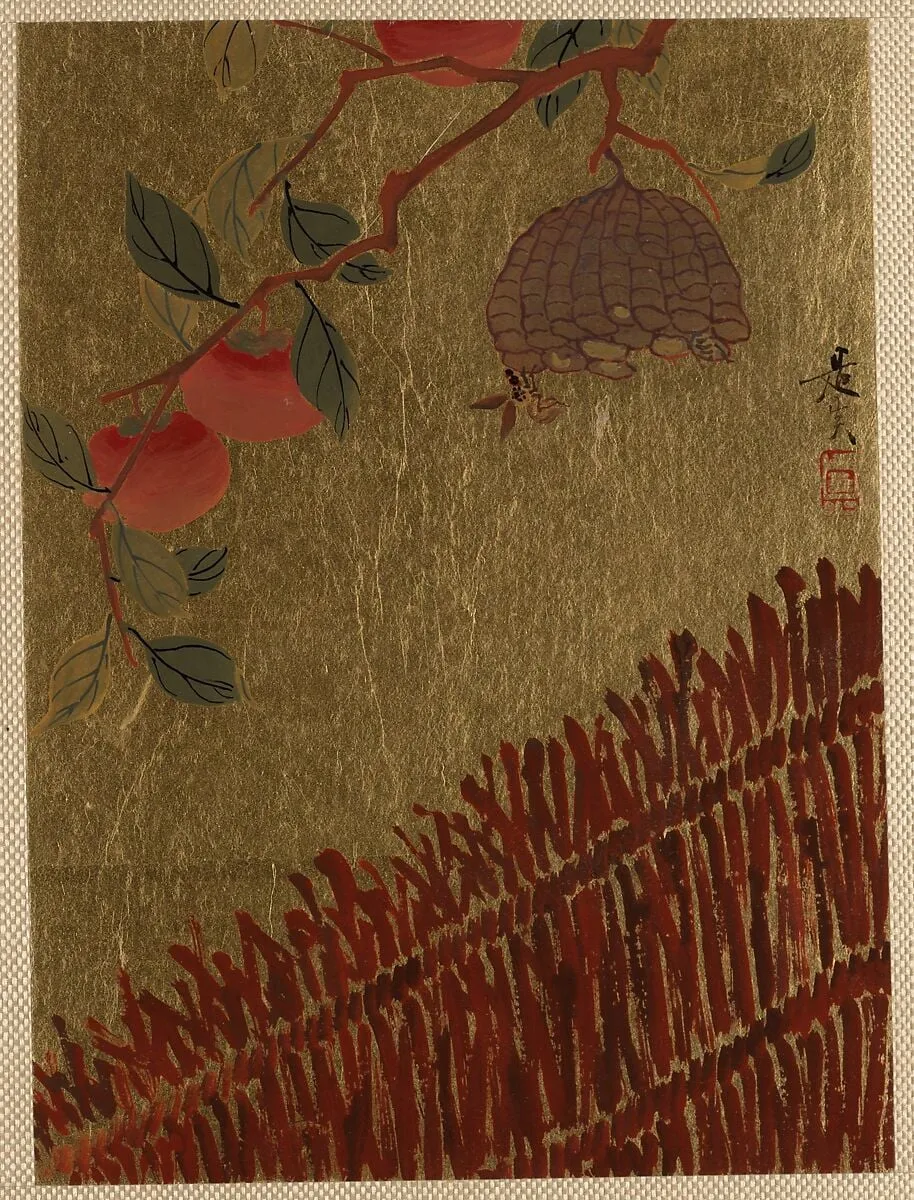
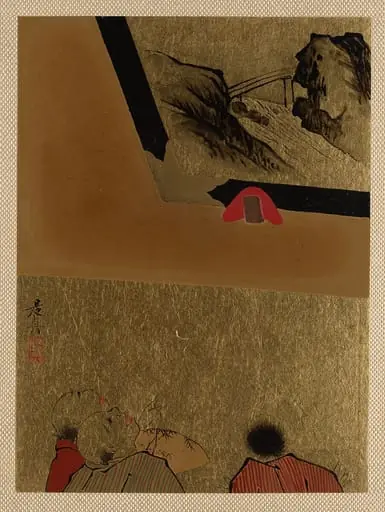
Untitled is a gold painting by the Nihonga artist Shibata Zeshin. It dates from 1837 and is held in the collection of the Metropolitan Museum of Art.
About this work
Subject & Meaning
The work shows a persimmon alongside Hymenoptera nests, rendered as a still‑life genre piece, suggesting an emphasis on everyday organic forms.
The work shows a persimmon alongside Hymenoptera nests, rendered as a still‑life genre piece, suggesting an emphasis on everyday organic forms. Created in 1837 in Japan, the piece was produced using lacquer on gold paper and measures roughly 12 × 9 cm. It is part of the Metropolitan Museum of Art’s collection, where it is catalogued as a work by Shibata Zeshin. The combination of fruit and insect habitats functions symbolically within the composition to highlight the interconnectedness of flora and fauna in a domestic setting.
Technique & Style
This small-scale work is executed in lacquer on gold paper, presented as an album leaf measuring 12.1 by 8.9 centimeters. The choice of lacquer as a pictorial medium on a gold ground reflects Shibata Zeshin's signature technique, in which the reflective metallic support is paired with built-up layers of urushi to render naturalistic subjects. The composition treats a still-life arrangement of a persimmon alongside Hymenoptera nests, with the lacquered forms set against the luminous gold paper to produce a richly textured surface.
Made in Japan in 1837, the piece is classified as a painting and is held in the collection of the Metropolitan Museum of Art.
History & Provenance
Created in 1837 by the Japanese artist Shibata Zeshin, this album leaf features lacquer applied to gold paper. The work, which depicts persimmons and Hymenoptera nests, was produced in Japan. It currently resides in the collection of the Metropolitan Museum of Art, where it is classified as a painting within the still-life genre. The available records confirm the inception date as 1837 and identify the piece by the title Untitled.
The album leaf is held in the collection of the Metropolitan Museum of Art. According to the Wikidata record for the work, its location is given as the Metropolitan Museum of Art, and the painting belongs to that institution's collection. No inventory or accession number is provided in the available sources.
The sources likewise do not document any exhibition history for this lacquer-on-gold-paper album leaf, leaving its display record unrecorded in the materials consulted.
Overview
Created in 1837, this album leaf by Shibata Zeshin depicts a still life of a persimmon and a wasp nest rendered in lacquer on gold paper. The composition centers on a single persimmon suspended from a branch, split open to reveal its seeds, accompanied by a textured wasp nest clinging to the adjacent twig. Several bees are depicted in flight around the fruit.
Zeshin executed the image using urushi lacquer, a medium traditionally reserved for functional objects such as bowls and boxes, rather than painting on paper. This technical choice imparts a distinct three-dimensional relief and lustrous depth to the organic forms, contrasting sharply with the flat, reflective gold background. The work exemplifies Zeshin's innovative approach to lacquerware, where he elevated the craft to the level of fine art by applying it to album leaves and screens.
Executed early in his career, this piece demonstrates his mastery of material manipulation and his ability to capture naturalistic detail with precision. The use of lacquer on paper was a signature experimentation of the artist, distinguishing his work within the 19th-century Japanese art scene and contributing to his reputation as a versatile master who bridged the gap between decorative arts and painting.
Context
This work belongs to a tradition of small-scale album leaves, which were often collected and viewed intimately. Zeshin's meticulous attention to detail in rendering natural forms, combined with his unique material choices, positioned him as a significant figure in 19th-century Japanese art. His ability to transform a utilitarian substance like lacquer into a fine art medium broadened the expressive possibilities for painters of his era.
Artist & collection