Artwork
Untitled
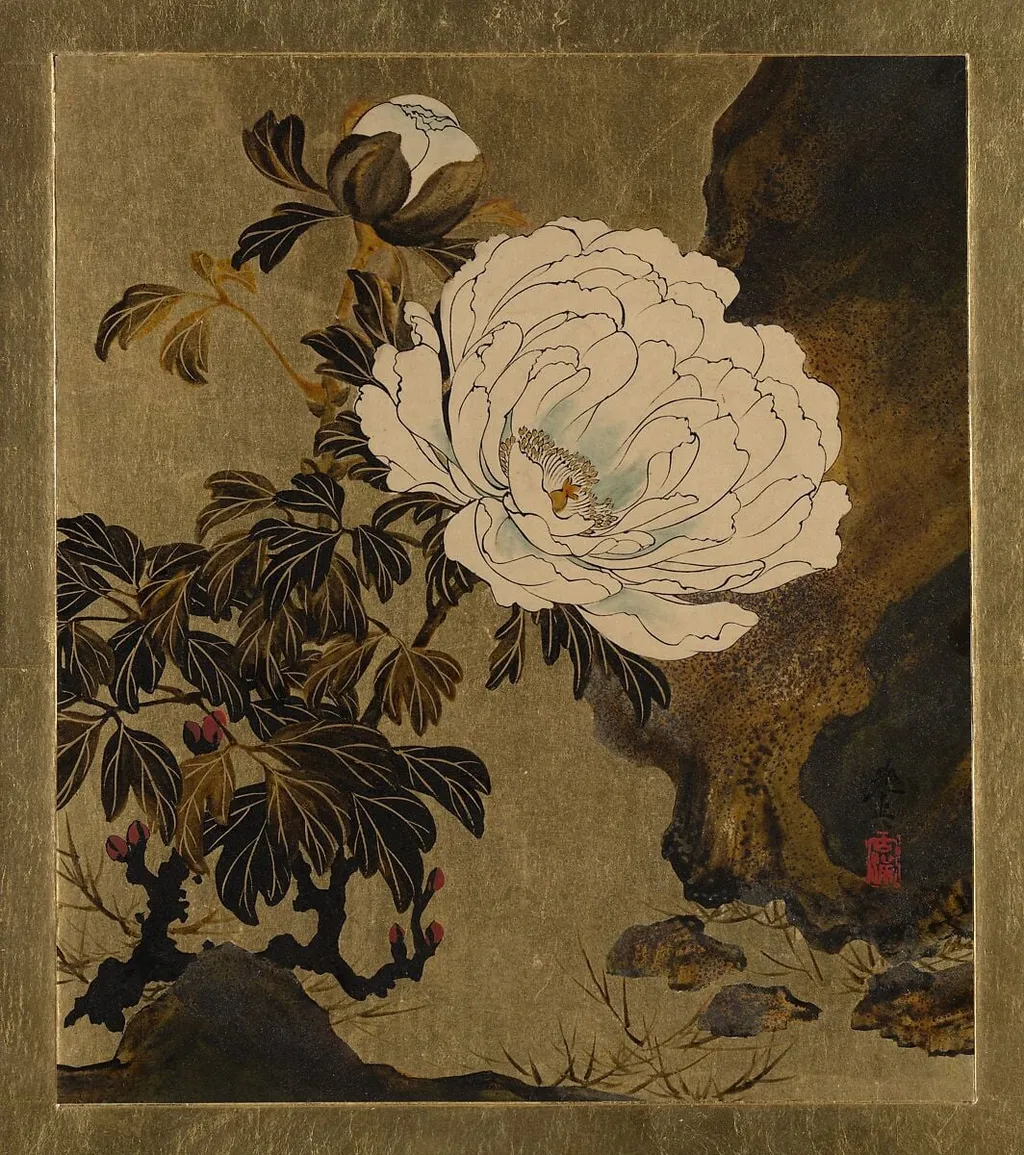
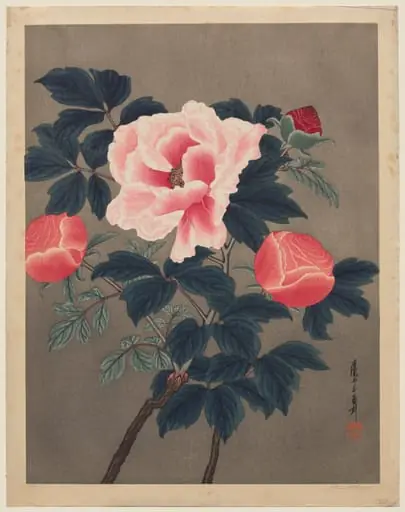
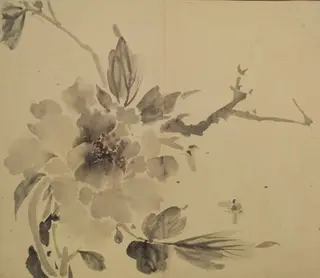
Untitled is a gold painting by the Impressionist artist Shibata Zeshin. It dates from 1882 and is held in the collection of the Metropolitan Museum of Art.
About this work
Subject & Meaning
The piece functions as a focused study of plant forms, emphasizing the aesthetic qualities of the bloom and its foliage within a confined pictorial space.
Created in 1882 by Shibata Zeshin, this lacquer-and-gold work on paper presents a still-life composition. The imagery is strictly botanical, featuring a peony flower accompanied by a leaf. As a genre piece focused on natural elements, the work relies on the visual representation of these flora rather than complex narrative iconography.
The peony, a significant motif in Japanese art, serves as the central subject, rendered here through Zeshin's characteristic use of lacquer. The piece functions as a focused study of plant forms, emphasizing the aesthetic qualities of the bloom and its foliage within a confined pictorial space.
Technique & Style
The work is executed in lacquer with gold leaf applied to paper, a technique characteristic of Shibata Zeshin's late nineteenth-century practice. The support is a sheet of paper, on which the artist built up a delicate still-life motif of a peony and leaf in layered lacquer and metallic highlights. Formal analysis notes the composition's flat, decorative surface and the interplay of translucent lacquer tones with reflective gold, producing a subtle three-dimensional effect despite the two-dimensional support. The painting's stylistic vocabulary aligns with the still-life genre, emphasizing naturalistic detail and ornamental patterning.
History & Provenance
Created in 1882, Untitled is a lacquer painting on paper executed by the Japanese artist Shibata Zeshin. The work, which depicts a peony and a leaf, originated in Japan and measures 19.1 by 16.5 centimeters. It is held in the collection of the Metropolitan Museum of Art, New York.
While the specific commission details and the precise chain of ownership prior to its arrival at the museum are not detailed in the available records, the work's creation date is established as 1882. The available records do not specify a distinct accession number, nor do they document the work's exhibition history.
Overview
Created in 1882, this untitled work by Shibata Zeshin depicts two peony blossoms and a single leaf set against a luminous gold background. Executed in lacquer and gold on paper, the piece exemplifies the artist's mastery of traditional lacquer techniques applied to a non-traditional support. The petals are rendered in soft pink tones, while the leaf appears in deep green, its veins delicately traced with fine gold lines.
Zeshin, renowned for elevating lacquerware to the status of fine art, frequently experimented with applying urushi lacquer to surfaces such as paper and silk to achieve painterly effects while retaining the material's characteristic depth and durability. This work reflects his late-career focus on botanical subjects, where he combined the decorative richness of the Edo period with a refined, naturalistic sensibility. The composition balances the organic forms of the flowers against the flat, radiant field of gold, creating a striking contrast that highlights the texture and color of the lacquer.
As a still life, it demonstrates Zeshin's ability to merge the functional heritage of lacquer with the aesthetic principles of Japanese painting, securing his reputation as a pivotal figure in 19th-century Japanese art.
Artist & collection


- Peonies, Magnolia, and Dandelions
 清 惲冰 花卉圖 册页|Flower Study
 Untitled
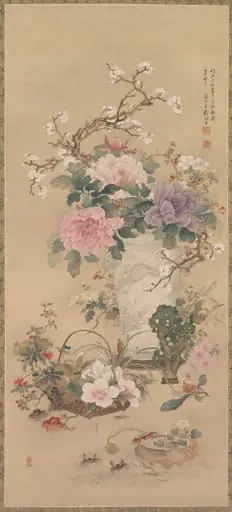 Vase of Flowers with Grasshopper, Marine Life, and Garden Rock
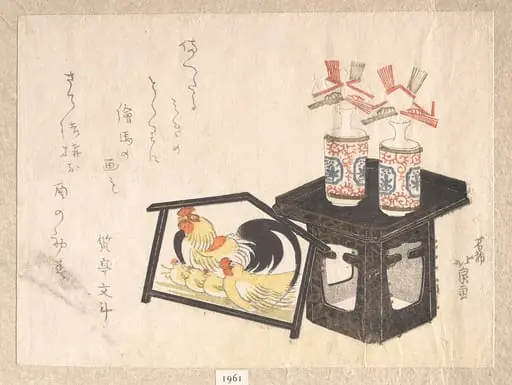 Untitled
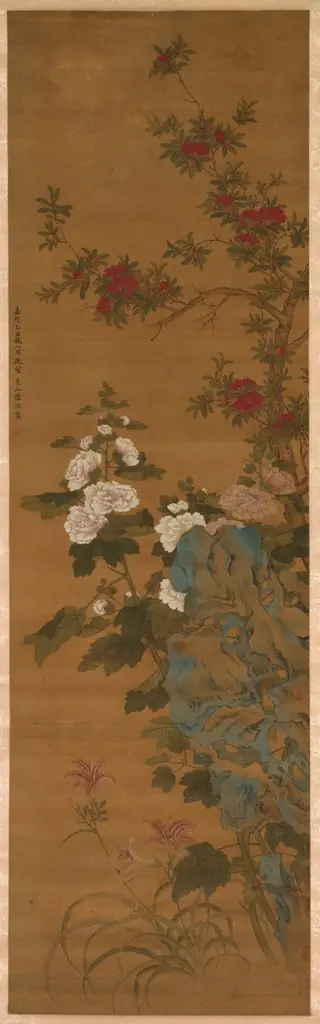 Flowers and Rocks
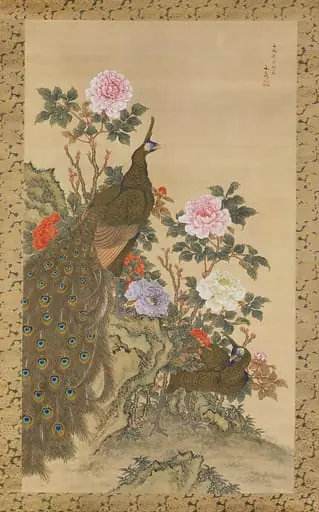 牡丹に孔雀図|Peacocks and Peonies
 Peonies
 Vase of Flowers with Grasshopper, Marine Life, and Garden Rock
 Myriad Longevities in an Everlasting Spring
 芥子図|Poppies
 Peony and Bumblebee