Artwork
Apollo and Marsyas
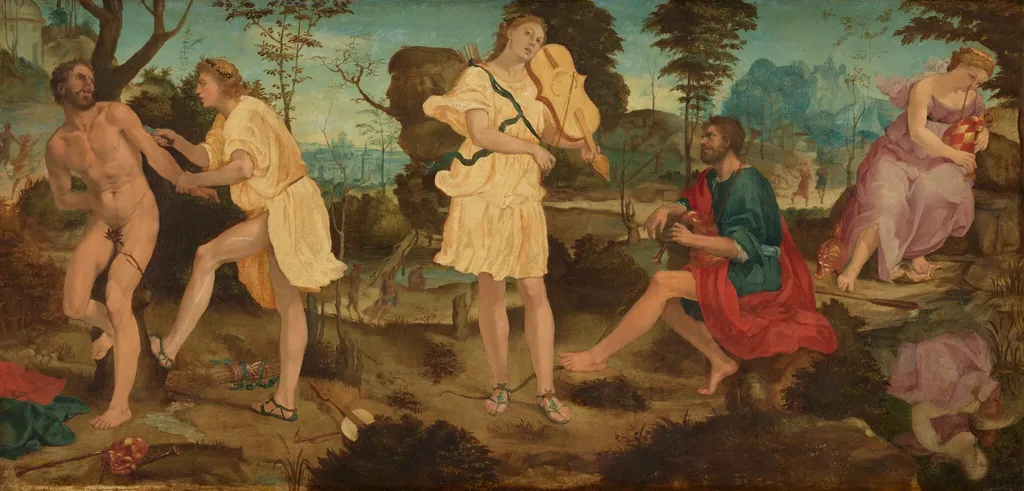
Apollo and Marsyas is an oil painting. It dates from 1540 and is held in the collection of the National Gallery of Art.
About this work
History & Provenance
Prior to entering the Kress collection, the work passed through the Galerie Sanct Lucas in Vienna and had been sold at Christie's in London in 1931.
Apollo and Marsyas, an oil on panel dated 1540 and attributed to a Sienese sixteenth-century artist (also identified as Michelangelo Anselmi), passed through a documented sequence of owners in the early twentieth century. The work was possibly held by John Francis Austen (d. 1893) in London and at Capel Manor, Horsmonden, Kent, and probably descended with the house and its contents to his widow, Georgiana F. Pearse. It appeared at the Austen sale conducted by Christie, Manson & Woods in London on 10 July 1931 (lot 47, there attributed to Cariani), where it was acquired by Galerie Sanct Lucas in Vienna.
The painting subsequently entered the collection of Count Alessandro Contini Bonacossi in Florence and Rome. In 1936 it was sold to the Samuel H. Kress Foundation in New York, and in 1939 the Foundation donated it to the National Gallery of Art in Washington, D.C.
The painting Apollo and Marsyas is held in the National Gallery of Art in Washington, D.C., as part of the Samuel H. Kress Collection. It was acquired by the museum in 1939 as a gift from the Samuel H. Kress Foundation, following its purchase by the foundation in 1936 from Count Alessandro Contini Bonacossi. Prior to entering the Kress collection, the work passed through the Galerie Sanct Lucas in Vienna and had been sold at Christie's in London in 1931.
The inventory history traces back to John Francis Austen of Capel Manor, Kent, whose widow inherited the piece before its sale. The work is cataloged within the gallery's Italian paintings collection, with specific documentation in Fern Rusk Shapley's 1979 catalogue.
Context
Scholarship identifies the work as a 1540 mythological oil on panel by Michelangelo Anselmi, a painter associated with the 16th‑century Sienese school. The composition, depicting Apollo confronting the satyr Marsyas, reflects Counter‑Reformation fascination with classical narratives and the moral themes of punishment and artistic hubris. Its provenance, from a private English collection through Galerie Sanct Lucas and the Contini Bonacossi family to the Samuel H. Kress Foundation, illustrates the 20th‑century market for Italian Renaissance works in American museums.
The painting’s inclusion in the National Gallery of Art’s catalogue (Fern Rusk Shapley, 1979) cemented its status as a representative example of Anselmi’s oeuvre and of the period’s synthesis of High Renaissance ideals with emerging Mannerist dynamism.
Overview
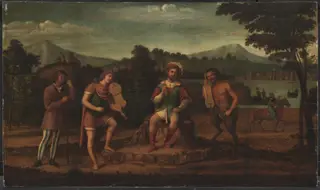
The oil on panel painting titled "Apollo and Marsyas" captures a pivotal and brutal scene from Greek mythology. It depicts a satyr, characterized by his goat legs and horns, lying in agony on the ground. Above him stand two figures: one with pale skin and long hair, representing the god Apollo, and another, a flayed man, suspended from a tree, illustrating the myth's severe conclusion.
Subject & Meaning
This artwork illustrates the ancient Greek myth where Marsyas, a satyr, challenged the god Apollo to a musical competition. Upon Apollo's victory, Marsyas was subjected to the horrific punishment of being flayed alive. The narrative traditionally functions as a moral warning against excessive pride and the perils of challenging divine power or artistic supremacy, emphasizing humility and respect for the gods.
Technique & Style
The artist employed specific painting techniques to enhance the visceral impact of the subject matter. For instance, the depiction of the flayed man on the right side of the composition utilizes impasto. This technique involves applying paint thickly to the panel, allowing it to stand out from the surface.
This textured application effectively conveys the rough and moist quality of exposed flesh, intensifying the scene's raw emotion.
Artist & collection