Artwork
The Voyage of Life: Manhood
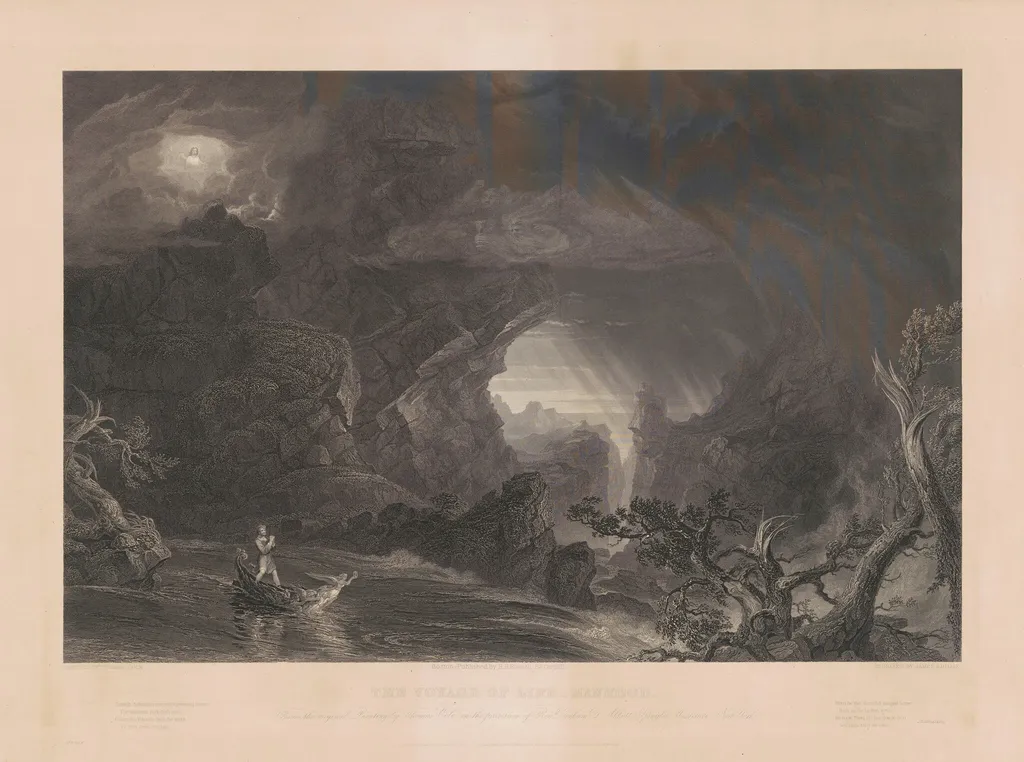
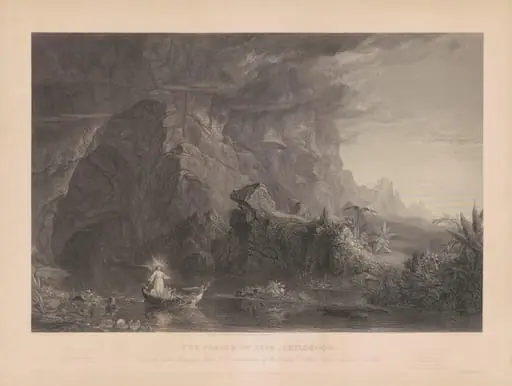
The Voyage of Life: Manhood is an ink print by the Impressionist artist James Smillie. It dates from 1855 and is held in the collection of the National Gallery of Art.
- Inscription
- Inscribed:text at bottom in plate: Painted by Thomas Cole / Boston - Published by B. B. Russell 55 Cornhill / Engraved by James Smillie / The Voyage of Life _ Manhood. / From the original Painting by Thomas Cole, in the possession of Revd. Gorham D. Abbott, Spingler Institute, New York. / Through darkening rains, and threatening storms, / The shattered bark doth ride; / O save the Voyager from the wreck, / Of sin's devouring ride. / When by the dreadful tempest borne, / High on the broken wave, / We know, Thou art not slow to hear, / Nor, impotent, to save. / Proof / "Entered according to Act of Congress U.S.A. _ by James Smillie in the Clerks Office of the U.S. District Court of the Southern District of New York." / J.H.Daniels, Pr.
About this work
Overview
James Smill’s mid‑nineteenth‑century engraving, titled The Voyage of Life: Manhood, presents a solitary figure steering a small boat through a stark, crag‑filled terrain. Rendered in black on wove paper, the image balances a sense of solitary endeavor with a luminous focal point beyond the foreground.
Subject & Meaning
The central figure, clad only in a simple loincloth, rows a narrow vessel with a long oar, suggesting a rite of passage or personal journey. The surrounding cliffs and rock formations frame the scene as an arduous passage, while a bright archway ahead hints at a hopeful destination or transformative moment.
Technique & Style
Smill employs fine cross‑hatching and varied line work to model depth, texture, and the play of light across stone and water. The engraving’s meticulous line density creates a realistic impression of rugged surfaces, while the contrast between dark foreground and the illuminated archway heightens visual drama.
History & Provenance
Created around 1855, the print belongs to a series exploring stages of life, a popular Victorian theme. Though specific ownership records are limited, the work appears in several 19th‑century print collections, indicating it was circulated among audiences interested in allegorical narratives.
Context
The image reflects the era’s fascination with moral allegory and the concept of life as a voyage, a motif echoed in literature and visual arts of the period. Its rugged natural setting aligns with Romantic ideals of nature as both obstacle and guide for human development.
Legacy
While not widely reproduced today, the engraving remains a reference point for studies of Victorian printmaking and the visual articulation of life stages, illustrating how technical skill served narrative purpose in mid‑century art.
Own this work as a print
Artist & collection