Artwork
High Street, Lavenham
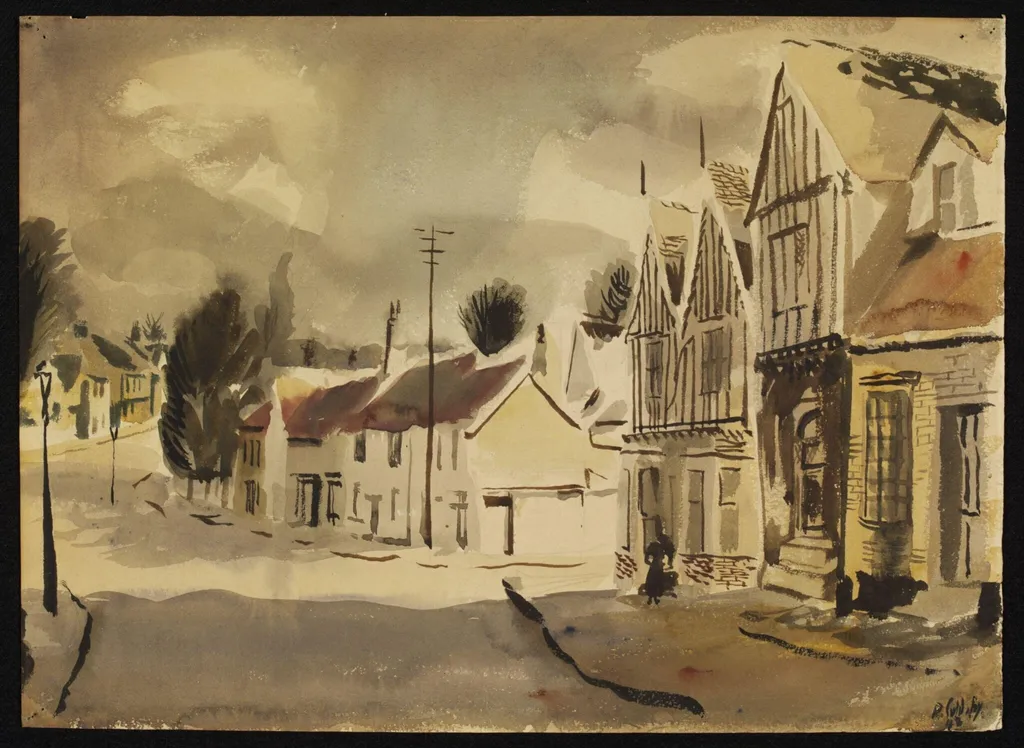
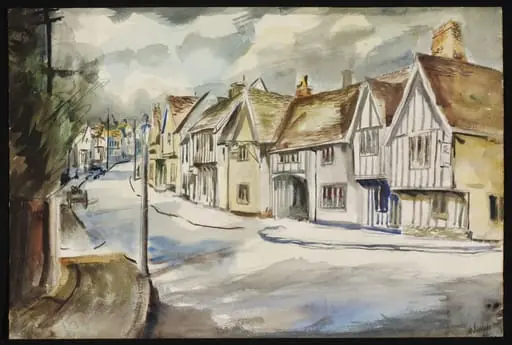
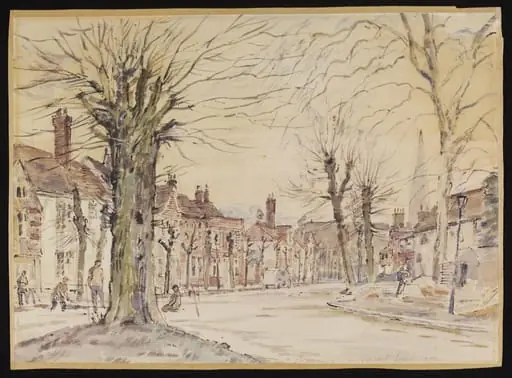
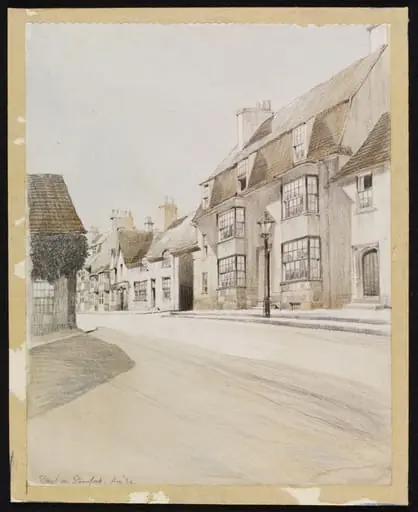
High Street, Lavenham is a watercolor work on paper by the Social Realist artist Suddaby. It dates from 1941 and is held in the collection of the Victoria and Albert Museum.
About this work
Overview
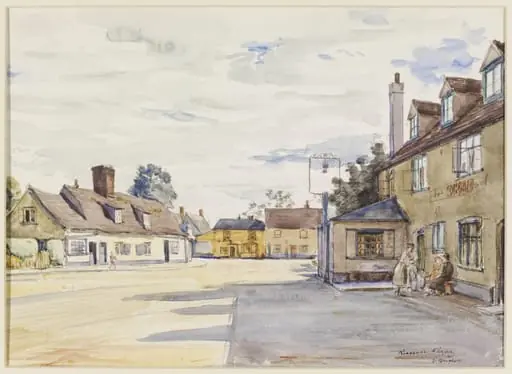
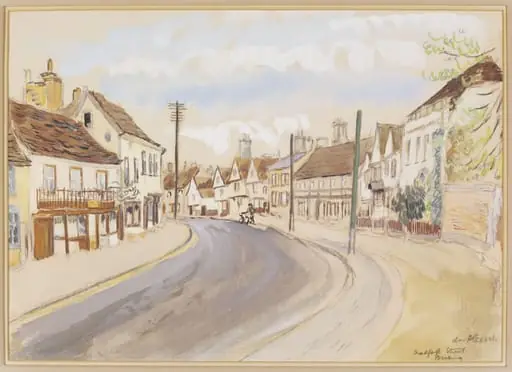
Created in 1941, this watercolour by Suddaby captures a quiet stretch of High Street in Lavenham, Suffolk.
Created in 1941, this watercolour by Suddaby captures a quiet stretch of High Street in Lavenham, Suffolk. Executed during the Second World War, it was produced under the 'Recording Britain' initiative, which commissioned artists to document vernacular architecture and rural scenes at risk from wartime destruction and modernization. The work is one of over 1,500 pieces gathered by the Pilgrim Trust under Sir Kenneth Clark’s direction, preserving a visual record of England’s changing landscape.
Subject & Meaning
The painting portrays a solitary pedestrian walking along an empty street lined with timber-framed buildings, their steep roofs and small windows suggesting centuries of local craftsmanship. The absence of crowds or activity conveys stillness, evoking a sense of quiet endurance amid wartime uncertainty. The lone figure underscores isolation, while the buildings themselves become silent witnesses to continuity, offering a subtle meditation on resilience and memory.
Technique & Style
Suddaby employed loose, economical brushwork and muted tones to suggest form without detailed rendering. The buildings are rendered in simplified shapes, with subtle hints of red and brown emerging from a pale, washed background. Watercolour’s transparency allows underlying pencil lines to remain visible, reinforcing the sketch-like immediacy.
Telephone poles and sparse trees are indicated with minimal strokes, enhancing the sense of a fleeting, observed moment rather than a polished composition.
History & Provenance
The work was produced as part of the 'Recording Britain' project, a government-backed effort initiated in 1939 to preserve visual records of at-risk architecture. Funded by the Pilgrim Trust and overseen by Sir Kenneth Clark, the project employed artists across England to document scenes deemed vulnerable to war or development. Suddaby’s watercolour entered the Victoria and Albert Museum’s collection as part of this archive, where it remains accessible as a historical document of mid-20th-century British life.
Context
During the early 1940s, Britain faced widespread anxiety over cultural loss due to bombing and rapid change. 'Recording Britain' responded by turning artists into archivists, prioritizing vernacular structures over grand monuments. Lavenham, a well-preserved medieval town, exemplified the kind of heritage the project sought to safeguard. Suddaby’s depiction aligns with this mission, focusing on everyday architecture rather than picturesque spectacle, reflecting a broader cultural effort to define national identity through ordinary places.
Legacy
The 'Recording Britain' collection endures as a vital resource for historians and conservators, offering insight into pre-war rural and small-town life. Suddaby’s watercolour, like others in the series, contributes to an archive that values quiet observation over dramatic representation. Today, these works serve not as artistic triumphs but as quiet testaments to a nation’s effort to preserve its physical memory during a time of upheaval.
Artist & collection
Artist
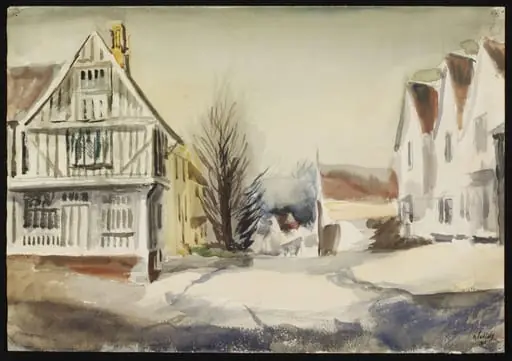
A British watercolor artist from the mid-20th century, Suddaby painted quiet, detailed scenes of East Anglia’s streets and churches in the 1940s.