Artwork
View of the Church "Quattro Santi Coronati"
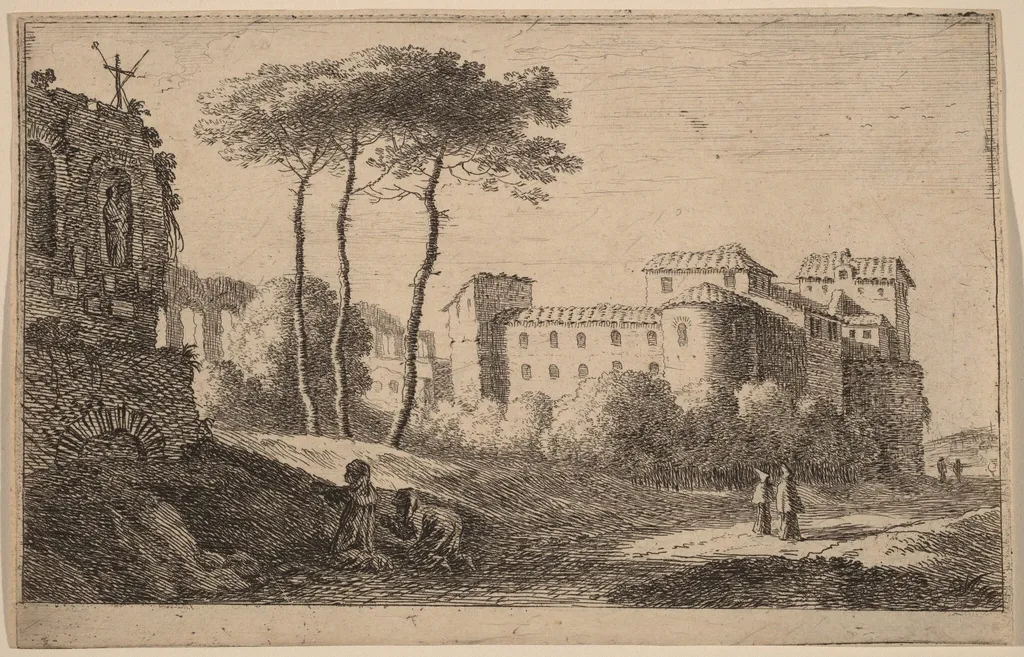
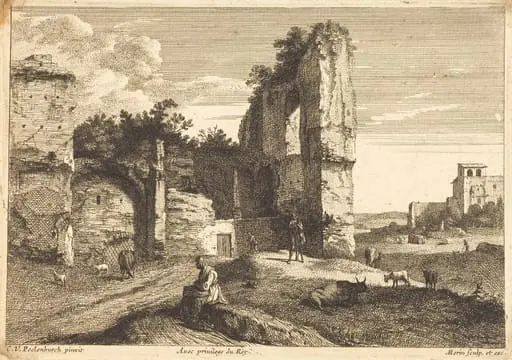
View of the Church "Quattro Santi Coronati" is an ink print by the Baroque artist Herman van Swanevelt. It dates from 1628 and is held in the collection of the National Gallery of Art.
About this work
Overview
The composition balances the verticality of the church and surrounding trees against a horizontal landscape that descends toward a body of water.
View of the Church 'Quattro Santi Coronati' is an etching by the Dutch Golden Age artist Herman van Swanevelt, created in 1628. The work depicts the Roman church of Santi Quattro Coronati situated atop a rocky hill, rendered with the atmospheric perspective characteristic of the artist's Italian period. The composition balances the verticality of the church and surrounding trees against a horizontal landscape that descends toward a body of water.
A winding path guides the viewer's eye from the foreground down to the shore, where a solitary figure walks near the water's edge, providing a sense of scale and human presence within the expansive setting. Swanevelt employs fine line work and delicate cross-hatching to model the terrain and foliage, creating a serene, twilight-like mood. This piece exemplifies the artist's contribution to the development of the Italianate landscape in Dutch art, bridging the gap between topographical accuracy and poetic idealization.
Produced during a time when Dutch artists frequently traveled to Italy to study classical ruins and light, the etching reflects the influence of Claude Lorrain and the broader tradition of the Bamboccianti, focusing on the quiet beauty of the Roman countryside rather than grand historical narratives.
Subject & Meaning
The print depicts the church of Quattro Santi Coronata, perched on a promontory above a modest settlement. The surrounding trees, a tiled-roofed structure, and the winding path suggest a quiet, perhaps contemplative, rural setting, while the solitary traveler near the water adds a narrative of movement within an otherwise still scene.
Technique & Style
Executed with fine, cross‑hatching lines, the etching conveys texture through varied strokes: rough brickwork on the church, smooth washes for the water, and delicate filigree for foliage. Van Swanevelt’s handling of light and shadow creates depth, allowing the bell tower to serve as the visual anchor of the composition.
History & Provenance
Created in 1628, this work belongs to the early phase of van Swanevelt’s career, when he was exploring Italianate landscapes despite being a Dutch artist. The print has circulated among collectors of 17th‑century European prints and is documented in several museum catalogues of baroque etchings.
Own this work as a print
Artist & collection


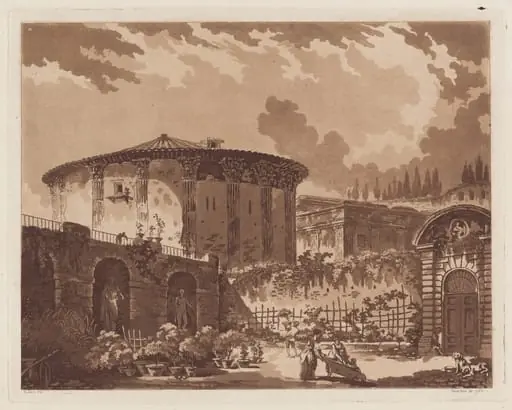 View in the Garden of a Roman Villa, with the Temple of Hercules Victor and the Temple of Portunus
 Square in Front of an Inn
 Antique Ruins of an Amphitheatre
 Italian Buildings on a Hillside
 The Bent Tree
 Houses at the Side of a River
 View of an Italian Villa
 View of a Town on a River Bank
 View of a Convent
 Round Tower near the Tiber
 Old Woman Seated
- The Old Palace at Tivoli